Notice

I am working on the template of this blog today in order to chase down some problems that have developed with my template and widgets.

Macon County Commissioners

Coverage of the meetings of the Macon County Board of County Commissioners.

Franklin Town Board of Aldermen

Coverage of the meetings of the Franklin Town Board of Aldermen.

Macon County School Board

Coverage of the meetings of the Macon County School Board.

Photoblog

Photos from my photoblog.

nullspace for future use

nullspace for future use

About

Showing posts with label Independence Day. Show all posts

Thursday, July 4, 2024

Pet Safety in the Summer and During Fireworks Displays


Here are some tips on keeping your pets safe during the summer heat and fireworks season from the American Veterinary Medical Association: 

Fireworks, picnics and other Fourth of July traditions can be great fun for people. But all of the festivities can be frightening and even dangerous for animals. Noisy fireworks and other celebrations can startle animals and cause them to run away; holiday foods can be unhealthy; summer heat and travel can be dangerous; and potentially dangerous debris can end up lying on the ground where pets can eat or play with it.

Whether or not you're planning your own Independence Day celebration, it's important to take precautions to keep your pets safe both during and after Fourth of July festivities.

Preparing in advance:

  • Make sure your pets—cats and dogs alike—have identification tags with up-to-date information. If you have horses, you might consider marking a safety (breakaway) halter with your contact information and leaving it on your horse during this stressful time.
  • If your pets aren’t already microchipped, talk with your veterinarian about microchipping. This simple procedure can greatly improve your chances of getting your pets back if they become lost.
  • If your pets are microchipped, make sure your contact information in the microchip registry is up to date.
  • Take a current photo of all of your cats, dogs and horses—just in case.
  • If your pet has historically been anxious on this holiday, or if you have reason to expect potentially harmful reactions, consider behavioral therapy to desensitize your pet and reduce the risk of problems. Some pets may need medication. Consult your veterinarian or a veterinary behaviorist.
  • Make sure the environment is safe and secure. If your neighbors set off fireworks at an unexpected time, is your yard secure enough to keep your pet contained? Are pasture fences secure enough to keep horses or other livestock confined? Evaluate your options, and choose the safest area for your animals. Make improvements if needed to make the area more secure.

Safety during July 4 celebrations:

  • Leave your pets at home when you go to parties, fireworks displays, parades and other gatherings. Loud fireworks, unfamiliar places and crowds can all be very frightening to pets, and there's great risk of pets becoming spooked and running away.
  • Consider putting your pets in a safe, escape-proof room or crate during parties and fireworks.
  • Keep horses and livestock in safely fenced areas and as far from the excitement and noise as possible.
  • If you're hosting guests, ask them to help keep an eye on your pets to make sure they don’t escape. Placing notes on exit doors and gates can help both you and your guests remain vigilant.
  • Keep your pets inside if you or your neighbors are setting off fireworks.
  • Keep sparklers, glow sticks, fireworks, charcoal and kabob skewers away from curious pets.
  • Don't let pets get near your barbecue grill while it is in use or still hot.
  • Avoid the urge to feed your pets table scraps or other foods intended for people. Be especially careful to keep them away from these common foods that are actually toxic.
  • Remember that too much sun and heat (and humidity!) can be dangerous to pets. Keep them inside when it's extremely hot/humid, and make sure they have access to shady spots and plenty of water when outdoors. Don't leave pets outside for extended periods in hot weather. And know the signs that a pet may be overheating.
  • Never leave your pet in your car when it's warm outside. Vehicle interiors heat up much faster than the air around them, and even a short time in a locked car can be dangerous to pets.
  • If you're travelling out of town for the holiday, consider leaving your pets at home with a pet sitter or boarding them in a kennel. If you need to bring them with you, be sure you know how to keep them safe.
  • Follow safe food handling and hygiene practices to protect your family and guests.

After the celebrations:

  • Check your yard for fireworks debris before allowing pets outside to play or relax. Even if you didn't set off fireworks yourself, debris can make its way into your yard, where curious animals may pick it up to play with or eat.
  • Check your pastures and remove debris to protect horses and livestock.
  • If you hosted guests, check both your yard and home for food scraps or other debris that might be dangerous to pets, such as food skewers.

Happy 248th Birthday, America!


Today, in 1776, the Declaration of Independence was publicly proclaimed after having been passed in secret on July 2nd by the Continental Congress. The Continental Congress voted to pass the Lee Resolution that formally declared the colonies free and independent states and absolved all allegiance to the British Crown. A more detailed play-by-play of the events and a copy of both the Lee Resolution and the Declaration of Independence is posted below. Also included is a video from the National Archives that discusses the Lee Resolution.


The Lee Resolution and the Declaration of Independence

On May 15, 1776, the revolutionary Virginia Convention, then meeting in Williamsburg, passed a resolution instructing Virginia's delegates in the Continental Congress "to propose to that respectable body to declare the United Colonies free and independent States, absolved from all allegiance to, or dependence upon, the Crown or Parliament of Great Britain". In accordance with those instructions, on June 7, Richard Henry Lee proposed the resolution to Congress and it was seconded by John Adams.

Resolved, That these United Colonies are, and of right ought to be, free and independent States, that they are absolved from all allegiance to the British Crown, and that all political connection between them and the State of Great Britain is, and ought to be, totally dissolved.
That it is expedient forthwith to take the most effectual measures for forming foreign Alliances.


That a plan of confederation be prepared and transmitted to the respective Colonies for their consideration and approbation.
Congress as a whole was not yet ready to declare independence at that moment, because the delegates from some of the colonies, including Maryland, Pennsylvania, Delaware, New Jersey, and New York, had not yet been authorized to vote for independence. Voting on the first clause of Lee's resolution was therefore postponed for three weeks while advocates of independence worked to build support in the colonial governments for the resolution. Meanwhile, a Committee of Five was appointed to prepare a formal declaration so that it would be ready when independence, which almost everyone recognized was now inevitable, was approved. The committee prepared a declaration of independence, written primarily by Thomas Jefferson, and presented it to Congress on June 28, 1776.

The declaration was set aside while the resolution of independence was debated for several days. The vote on the independence section of the Lee resolution had been postponed until Monday, July 1, when it was taken up by the Committee of the Whole. At the request of South Carolina, the resolution was not acted upon until the following day in the hope of securing unanimity. A trial vote had been tested on the 1st where it was found that South Carolina and Pennsylvania were in the negative, with Delaware split in a tie between its two delegates. The vote was held on July 2, with critical changes happening between Monday and Tuesday. Edward Rutledge was able to persuade South Carolina delegates to vote yea, two Pennsylvania delegates were persuaded to be absent, and Caesar Rodney had been sent for through the night to break Delaware's tie. So Lee's resolution of independence was approved by twelve of the thirteen colonies. Delegates from New York still lacked instructions to vote for independence, and so they abstained on this vote, although on July 9 the New York Provincial Congress would vote to "join with the other colonies in supporting" independence.

Video from the National Archives

Take a virtual journey with the National Archives to find out how the Declaration of Independence came to be and learn about Richard Henry Lee's writing of the Lee Resolution. The National Archives is the permanent home of the original Declaration of Independence. The Lee Resolution for Independence can be viewed here: https://catalog.archives.gov/ID/301684


Declaration of Independence, July 4, 1776

When in the course of human events, it becomes necessary for one people to dissolve the political bands which have connected them with another,
and to assume among the powers of the earth, the separate and equal station to which the laws of nature and of nature's God entitle them, a decent respect to the opinions of mankind requires that they should declare the causes which impel them to the separation.

We hold these truths to be self-evident:

That all men are created equal; that they are endowed by their Creator with certain unalienable rights; that among these are life, liberty, and the pursuit of happiness; that, to secure these rights, governments are instituted among men, deriving their just powers from the consent of the governed; that whenever any form of government becomes destructive of these ends, it is the right of the people to alter or to abolish it, and to institute new government, laying its foundation on such principles, and organizing its powers in such form, as to them shall seem most likely to effect their safety and happiness. Prudence, indeed, will dictate that governments long established should not be changed for light and transient causes; and accordingly all experience hath shown that mankind are more disposed to suffer, while evils are sufferable than to right themselves by abolishing the forms to which they are accustomed. But when a long train of abuses and usurpations, pursuing invariably the same object, evinces a design to reduce them under absolute despotism, it is their right, it is their duty, to throw off such government, and to provide new guards for their future security. Such has been the patient sufferance of these colonies; and such is now the necessity which constrains them to alter their former systems of government. The history of the present King of Great Britain is a history of repeated injuries and usurpations, all having in direct object the establishment of an absolute tyranny over these states. To prove this, let facts be submitted to a candid world.

He has refused his assent to laws, the most wholesome and necessary for the public good.

He has forbidden his governors to pass laws of immediate and pressing importance, unless suspended in their operation till his assent should be obtained; and, when so suspended, he has utterly neglected to attend to them.

He has refused to pass other laws for the accommodation of large districts of people, unless those people would relinquish the right of representation in the legislature, a right inestimable to them, and formidable to tyrants only.

He has called together legislative bodies at places unusual uncomfortable, and distant from the depository of their public records, for the sole purpose of fatiguing them into compliance with his measures.

He has dissolved representative houses repeatedly, for opposing, with manly firmness, his invasions on the rights of the people.

He has refused for a long time, after such dissolutions, to cause others to be elected; whereby the legislative powers, incapable of annihilation, have returned to the people at large for their exercise; the state remaining, in the mean time, exposed to all the dangers of invasions from without and convulsions within.

He has endeavored to prevent the population of these states; for that purpose obstructing the laws for naturalization of foreigners; refusing to pass others to encourage their migration hither, and raising the conditions of new appropriations of lands.

He has obstructed the administration of justice, by refusing his assent to laws for establishing judiciary powers.

He has made judges dependent on his will alone, for the tenure of their offices, and the amount and payment of their salaries.

He has erected a multitude of new offices, and sent hither swarms of officers to harass our people and eat out their substance.

He has kept among us, in times of peace, standing armies, without the consent of our legislatures.

He has affected to render the military independent of, and superior to, the civil power.

He has combined with others to subject us to a jurisdiction foreign to our constitution and unacknowledged by our laws, giving his assent to their acts of pretended legislation:

For quartering large bodies of armed troops among us;

For protecting them, by a mock trial, from punishment for any murders which they should commit on the inhabitants of these states;

For cutting off our trade with all parts of the world;

For imposing taxes on us without our consent;

For depriving us, in many cases, of the benefits of trial by jury;

For transporting us beyond seas, to be tried for pretended offenses;

For abolishing the free system of English laws in a neighboring province, establishing therein an arbitrary government, and enlarging its boundaries, so as to render it at once an example and fit instrument for introducing the same absolute rule into these colonies;

For taking away our charters, abolishing our most valuable laws, and altering fundamentally the forms of our governments;

For suspending our own legislatures, and declaring themselves invested with power to legislate for us in all cases whatsoever.

He has abdicated government here, by declaring us out of his protection and waging war against us.

He has plundered our seas, ravaged our coasts, burned our towns, and destroyed the lives of our people.

He is at this time transporting large armies of foreign mercenaries to complete the works of death, desolation, and tyranny already begun with circumstances of cruelty and perfidy scarcely paralleled in the most barbarous ages, and totally unworthy the head of a civilized nation.

He has constrained our fellow-citizens, taken captive on the high seas, to bear arms against their country, to become the executioners of their friends and brethren, or to fall themselves by their hands.

He has excited domestic insurrection among us, and has endeavored to bring on the inhabitants of our frontiers the merciless Indian savages, whose known rule of warfare is an undistinguished destruction of all ages, sexes, and conditions.

In every stage of these oppressions we have petitioned for redress in the most humble terms; our repeated petitions have been answered only by repeated injury. A prince, whose character is thus marked by every act which may define a tyrant, is unfit to be the ruler of a free people.

Nor have we been wanting in our attentions to our British brethren. We have warned them, from time to time, of attempts by their legislature to extend an unwarrantable jurisdiction over us. We have reminded them of the circumstances of our emigration and settlement here. We have appealed to their native justice and magnanimity; and we have conjured them, by the ties of our common kindred, to disavow these usurpations which would inevitably interrupt our connections and correspondence. They too, have been deaf to the voice of justice and of consanguinity. 

We must, therefore, acquiesce in the necessity which denounces our separation, and hold them as we hold the rest of mankind, enemies in war, in peace friends.

We, therefore, the representatives of the United States of America, in General Congress assembled, appealing to the Supreme Judge of the world for the rectitude of our intentions, do, in the name and by the authority of the good people of these colonies solemnly publish and declare, That these United Colonies are, and of right ought to be, FREE AND INDEPENDENT STATES; that they are absolved from all allegiance to the British crown and that all political connection between them and the state of Great Britain is, and ought to be, totally dissolved; and that, as free and independent states, they have full power to levy war, conclude peace, contract alliances, establish commerce, and do all other acts and things which independent states may of right do. And for the support of this declaration, with a firm reliance on the protection of Divine Providence, we mutually pledge to each other our lives, our fortunes, and our sacred honor.

[Signed by] JOHN HANCOCK [President]


New Hampshire
JOSIAH BARTLETT,
WM. WHIPPLE,
MATTHEW THORNTON.

Massachusetts Bay
SAML. ADAMS,
JOHN ADAMS,
ROBT. TREAT PAINE,
ELBRIDGE GERRY

Rhode Island
STEP. HOPKINS,
WILLIAM ELLERY.

Connecticut
ROGER SHERMAN,
SAM'EL HUNTINGTON,
WM. WILLIAMS,
OLIVER WOLCOTT.

New York
WM. FLOYD,
PHIL. LIVINGSTON,
FRANS. LEWIS,
LEWIS MORRIS.

New Jersey
RICHD. STOCKTON,
JNO. WITHERSPOON,
FRAS. HOPKINSON,
JOHN HART,
ABRA. CLARK.

Pennsylvania
ROBT. MORRIS
BENJAMIN RUSH,
BENJA. FRANKLIN,
JOHN MORTON,
GEO. CLYMER,
JAS. SMITH,
GEO. TAYLOR,
JAMES WILSON,
GEO. ROSS.

Delaware
CAESAR RODNEY,
GEO. READ,
THO. M'KEAN.

Maryland
SAMUEL CHASE,
WM. PACA,
THOS. STONE,
CHARLES CARROLL of Carrollton.

Virginia
GEORGE WYTHE,
RICHARD HENRY LEE,
TH. JEFFERSON,
BENJA. HARRISON,
THS. NELSON, JR.,
FRANCIS LIGHTFOOT LEE,
CARTER BRAXTON.

North Carolina
WM. HOOPER,
JOSEPH HEWES,
JOHN PENN.

South Carolina
EDWARD RUTLEDGE,
THOS. HAYWARD, JUNR.,
THOMAS LYNCH, JUNR.,
ARTHUR MIDDLETON.

Georgia
BUTTON GWINNETT,
LYMAN HALL,
GEO. WALTON.

NOTE.-Mr. Ferdinand Jefferson, Keeper of the Rolls in the Department of State, at Washington, says: " The names of the signers are spelt above as in the facsimile of the original, but the punctuation of them is not always the same; neither do the names of the States appear in the facsimile of the original. The names of the signers of each State are grouped together in the facsimile of the original, except the name of Matthew Thornton, which follows that of Oliver Wolcott."-Revised Statutes of the United States, 2d edition, 1878, p. 6.

Source:
Documents Illustrative of the Formation of the Union of the American States.
Government Printing Office, 1927. House Document No. 398. 


Published at 9.35am on Tuesday, July 4, 2024, 248 years later.

Tuesday, July 4, 2023

Happy 247th Birthday, America!


Today, in 1776, the Declaration of Independence was publicly proclaimed after having been passed in secret on July 2nd by the Continental Congress. The Continental Congress voted to pass the Lee Resolution that formally declared the colonies free and independent states and absolved all allegiance to the British Crown. A more detailed play-by-play of the events and a copy of both the Lee Resolution and the Declaration of Independence is posted below. Also included is a video from the National Archives that discusses the Lee Resolution.


The Lee Resolution and the Declaration of Independence

On May 15, 1776, the revolutionary Virginia Convention, then meeting in Williamsburg, passed a resolution instructing Virginia's delegates in the Continental Congress "to propose to that respectable body to declare the United Colonies free and independent States, absolved from all allegiance to, or dependence upon, the Crown or Parliament of Great Britain". In accordance with those instructions, on June 7, Richard Henry Lee proposed the resolution to Congress and it was seconded by John Adams.

Resolved, That these United Colonies are, and of right ought to be, free and independent States, that they are absolved from all allegiance to the British Crown, and that all political connection between them and the State of Great Britain is, and ought to be, totally dissolved.
That it is expedient forthwith to take the most effectual measures for forming foreign Alliances.


That a plan of confederation be prepared and transmitted to the respective Colonies for their consideration and approbation.
Congress as a whole was not yet ready to declare independence at that moment, because the delegates from some of the colonies, including Maryland, Pennsylvania, Delaware, New Jersey, and New York, had not yet been authorized to vote for independence. Voting on the first clause of Lee's resolution was therefore postponed for three weeks while advocates of independence worked to build support in the colonial governments for the resolution. Meanwhile, a Committee of Five was appointed to prepare a formal declaration so that it would be ready when independence, which almost everyone recognized was now inevitable, was approved. The committee prepared a declaration of independence, written primarily by Thomas Jefferson, and presented it to Congress on June 28, 1776.

The declaration was set aside while the resolution of independence was debated for several days. The vote on the independence section of the Lee resolution had been postponed until Monday, July 1, when it was taken up by the Committee of the Whole. At the request of South Carolina, the resolution was not acted upon until the following day in the hope of securing unanimity. A trial vote had been tested on the 1st where it was found that South Carolina and Pennsylvania were in the negative, with Delaware split in a tie between its two delegates. The vote was held on July 2, with critical changes happening between Monday and Tuesday. Edward Rutledge was able to persuade South Carolina delegates to vote yea, two Pennsylvania delegates were persuaded to be absent, and Caesar Rodney had been sent for through the night to break Delaware's tie. So Lee's resolution of independence was approved by twelve of the thirteen colonies. Delegates from New York still lacked instructions to vote for independence, and so they abstained on this vote, although on July 9 the New York Provincial Congress would vote to "join with the other colonies in supporting" independence.

Video from the National Archives

Take a virtual journey with the National Archives to find out how the Declaration of Independence came to be and learn about Richard Henry Lee's writing of the Lee Resolution. The National Archives is the permanent home of the original Declaration of Independence. The Lee Resolution for Independence can be viewed here: https://catalog.archives.gov/ID/301684


Declaration of Independence, July 4, 1776

When in the course of human events, it becomes necessary for one people to dissolve the political bands which have connected them with another,
and to assume among the powers of the earth, the separate and equal station to which the laws of nature and of nature's God entitle them, a decent respect to the opinions of mankind requires that they should declare the causes which impel them to the separation.

We hold these truths to be self-evident:

That all men are created equal; that they are endowed by their Creator with certain unalienable rights; that among these are life, liberty, and the pursuit of happiness; that, to secure these rights, governments are instituted among men, deriving their just powers from the consent of the governed; that whenever any form of government becomes destructive of these ends, it is the right of the people to alter or to abolish it, and to institute new government, laying its foundation on such principles, and organizing its powers in such form, as to them shall seem most likely to effect their safety and happiness. Prudence, indeed, will dictate that governments long established should not be changed for light and transient causes; and accordingly all experience hath shown that mankind are more disposed to suffer, while evils are sufferable than to right themselves by abolishing the forms to which they are accustomed. But when a long train of abuses and usurpations, pursuing invariably the same object, evinces a design to reduce them under absolute despotism, it is their right, it is their duty, to throw off such government, and to provide new guards for their future security. Such has been the patient sufferance of these colonies; and such is now the necessity which constrains them to alter their former systems of government. The history of the present King of Great Britain is a history of repeated injuries and usurpations, all having in direct object the establishment of an absolute tyranny over these states. To prove this, let facts be submitted to a candid world.

He has refused his assent to laws, the most wholesome and necessary for the public good.

He has forbidden his governors to pass laws of immediate and pressing importance, unless suspended in their operation till his assent should be obtained; and, when so suspended, he has utterly neglected to attend to them.

He has refused to pass other laws for the accommodation of large districts of people, unless those people would relinquish the right of representation in the legislature, a right inestimable to them, and formidable to tyrants only.

He has called together legislative bodies at places unusual uncomfortable, and distant from the depository of their public records, for the sole purpose of fatiguing them into compliance with his measures.

He has dissolved representative houses repeatedly, for opposing, with manly firmness, his invasions on the rights of the people.

He has refused for a long time, after such dissolutions, to cause others to be elected; whereby the legislative powers, incapable of annihilation, have returned to the people at large for their exercise; the state remaining, in the mean time, exposed to all the dangers of invasions from without and convulsions within.

He has endeavored to prevent the population of these states; for that purpose obstructing the laws for naturalization of foreigners; refusing to pass others to encourage their migration hither, and raising the conditions of new appropriations of lands.

He has obstructed the administration of justice, by refusing his assent to laws for establishing judiciary powers.

He has made judges dependent on his will alone, for the tenure of their offices, and the amount and payment of their salaries.

He has erected a multitude of new offices, and sent hither swarms of officers to harass our people and eat out their substance.

He has kept among us, in times of peace, standing armies, without the consent of our legislatures.

He has affected to render the military independent of, and superior to, the civil power.

He has combined with others to subject us to a jurisdiction foreign to our constitution and unacknowledged by our laws, giving his assent to their acts of pretended legislation:

For quartering large bodies of armed troops among us;

For protecting them, by a mock trial, from punishment for any murders which they should commit on the inhabitants of these states;

For cutting off our trade with all parts of the world;

For imposing taxes on us without our consent;

For depriving us, in many cases, of the benefits of trial by jury;

For transporting us beyond seas, to be tried for pretended offenses;

For abolishing the free system of English laws in a neighboring province, establishing therein an arbitrary government, and enlarging its boundaries, so as to render it at once an example and fit instrument for introducing the same absolute rule into these colonies;

For taking away our charters, abolishing our most valuable laws, and altering fundamentally the forms of our governments;

For suspending our own legislatures, and declaring themselves invested with power to legislate for us in all cases whatsoever.

He has abdicated government here, by declaring us out of his protection and waging war against us.

He has plundered our seas, ravaged our coasts, burned our towns, and destroyed the lives of our people.

He is at this time transporting large armies of foreign mercenaries to complete the works of death, desolation, and tyranny already begun with circumstances of cruelty and perfidy scarcely paralleled in the most barbarous ages, and totally unworthy the head of a civilized nation.

He has constrained our fellow-citizens, taken captive on the high seas, to bear arms against their country, to become the executioners of their friends and brethren, or to fall themselves by their hands.

He has excited domestic insurrection among us, and has endeavored to bring on the inhabitants of our frontiers the merciless Indian savages, whose known rule of warfare is an undistinguished destruction of all ages, sexes, and conditions.

In every stage of these oppressions we have petitioned for redress in the most humble terms; our repeated petitions have been answered only by repeated injury. A prince, whose character is thus marked by every act which may define a tyrant, is unfit to be the ruler of a free people.

Nor have we been wanting in our attentions to our British brethren. We have warned them, from time to time, of attempts by their legislature to extend an unwarrantable jurisdiction over us. We have reminded them of the circumstances of our emigration and settlement here. We have appealed to their native justice and magnanimity; and we have conjured them, by the ties of our common kindred, to disavow these usurpations which would inevitably interrupt our connections and correspondence. They too, have been deaf to the voice of justice and of consanguinity. 

We must, therefore, acquiesce in the necessity which denounces our separation, and hold them as we hold the rest of mankind, enemies in war, in peace friends.

We, therefore, the representatives of the United States of America, in General Congress assembled, appealing to the Supreme Judge of the world for the rectitude of our intentions, do, in the name and by the authority of the good people of these colonies solemnly publish and declare, That these United Colonies are, and of right ought to be, FREE AND INDEPENDENT STATES; that they are absolved from all allegiance to the British crown and that all political connection between them and the state of Great Britain is, and ought to be, totally dissolved; and that, as free and independent states, they have full power to levy war, conclude peace, contract alliances, establish commerce, and do all other acts and things which independent states may of right do. And for the support of this declaration, with a firm reliance on the protection of Divine Providence, we mutually pledge to each other our lives, our fortunes, and our sacred honor.

[Signed by] JOHN HANCOCK [President]


New Hampshire
JOSIAH BARTLETT,
WM. WHIPPLE,
MATTHEW THORNTON.

Massachusetts Bay
SAML. ADAMS,
JOHN ADAMS,
ROBT. TREAT PAINE,
ELBRIDGE GERRY

Rhode Island
STEP. HOPKINS,
WILLIAM ELLERY.

Connecticut
ROGER SHERMAN,
SAM'EL HUNTINGTON,
WM. WILLIAMS,
OLIVER WOLCOTT.

New York
WM. FLOYD,
PHIL. LIVINGSTON,
FRANS. LEWIS,
LEWIS MORRIS.

New Jersey
RICHD. STOCKTON,
JNO. WITHERSPOON,
FRAS. HOPKINSON,
JOHN HART,
ABRA. CLARK.

Pennsylvania
ROBT. MORRIS
BENJAMIN RUSH,
BENJA. FRANKLIN,
JOHN MORTON,
GEO. CLYMER,
JAS. SMITH,
GEO. TAYLOR,
JAMES WILSON,
GEO. ROSS.

Delaware
CAESAR RODNEY,
GEO. READ,
THO. M'KEAN.

Maryland
SAMUEL CHASE,
WM. PACA,
THOS. STONE,
CHARLES CARROLL of Carrollton.

Virginia
GEORGE WYTHE,
RICHARD HENRY LEE,
TH. JEFFERSON,
BENJA. HARRISON,
THS. NELSON, JR.,
FRANCIS LIGHTFOOT LEE,
CARTER BRAXTON.

North Carolina
WM. HOOPER,
JOSEPH HEWES,
JOHN PENN.

South Carolina
EDWARD RUTLEDGE,
THOS. HAYWARD, JUNR.,
THOMAS LYNCH, JUNR.,
ARTHUR MIDDLETON.

Georgia
BUTTON GWINNETT,
LYMAN HALL,
GEO. WALTON.

NOTE.-Mr. Ferdinand Jefferson, Keeper of the Rolls in the Department of State, at Washington, says: " The names of the signers are spelt above as in the facsimile of the original, but the punctuation of them is not always the same; neither do the names of the States appear in the facsimile of the original. The names of the signers of each State are grouped together in the facsimile of the original, except the name of Matthew Thornton, which follows that of Oliver Wolcott."-Revised Statutes of the United States, 2d edition, 1878, p. 6.

Source:
Documents Illustrative of the Formation of the Union of the American States.
Government Printing Office, 1927. House Document No. 398. 


Published at 9.35am on Tuesday, July 4, 2020, 247 years later.

Monday, June 19, 2023

Town of Franklin Fourth of July Celebration Returns Tuesday, July 4th


PRESS RELEASE (06-19-2023)
TOWN OF FRANKLIN INDEPENDENCE DAY ACTIVITIES


Town of Franklin Fourth of July Celebration Returns Tuesday, July 4th

(Franklin, NC) The Town of Franklin is pleased to announce plans for the annual Fourth of July Festivities and Fireworks Over Franklin.

The celebration kicks off at 11:00 a.m. on Tuesday, July 4 th with our traditional patriotic parade. “Franklin’s July 4 th celebration is a true, small-town experience for all ages,” said Mayor Jack Horton. “The Town Council and Employees are planning a Fourth that is open to everyone —veterans, children, residents, visitors, and even pets have the opportunity to take part in the parade and all activities as we celebrate our Nation’s 247th birthday,” said Horton.

Please note that this year Main Street will be closed to traffic for the daytime festivities beginning at 10:00 a.m. There will be signage to direct you to parking in the downtown area. “Franklin hosts one of the few parades in the country that everyone can actually participate in,” said Amie Owens, Town Manager. “If you would like to be part of the parade, be in the lower parking lot of Town Hall at 10:30am for lineup.” Entrants can walk, drive or ride and are encouraged to show their patriotic pride in red, white and blue.

This year, the Parade will leave Town Hall, travel down Main Street and disband at First Citizens Bank.

“Following the parade everyone can enjoy one of our July 4 th traditions in Franklin. The Town will be serving free watermelon and bottled water as long as it lasts,” said Owens. The Town of Franklin has worked to expand the July 4 th festivities and a food court will be featured this year on Iotla Street. Participating vendors will be Ben’s Backdraft Barbecue, Franklin’s Chick-fil-A, Kona Ice, and Sweet Caroline’s Ice Cream. Franklin Fire & Rescue will also be grilling hotdogs as a fundraiser for the department.

Other fun activities planned include free contests for youngsters and pets shortly after the parade ends! The Little Miss and Mr. Firecracker Contest is open to all girls and boys ages 3 to 6. It is patriotic in nature with entrants judged on their patriotic attire and one simple question. Following will be the Patriotic Pet Contest, so deck your pets out in red, white, and blue for this fun event.

Both events are free, and no preregistration is required. Just be at the gazebo stage following the parade for the contests.

Kids can also enjoy free inflatables and a water feature from Franklin Fire and Rescue to cool off on what is traditionally a warm day in the mountains. So, make sure they are dressed appropriately.

The Ruby Red Cheerleaders will also be performing near the Gazebo on the Square at one in the afternoon.

Activities will then take a breather as the Town of Franklin prepares for Fireworks Over Franklin. The display begins at 9:30 p.m. and will be held at 15 First Street on the Whitmire property in East Franklin located near the Highlands Road and East Main Street intersection. “We are working with a new company this year to produce our fireworks display,” said Owens. “Deep South Fireworks from the Macon, Georgia area has planned an incredible show featuring approximately 2,500 shots.”

If you’re wondering if you have a good vantage point to view the fireworks display, Owens said that test fireworks will be fired at 9:00 p.m. and 9:15 p.m. “You should be able to view the display from many different locales in East Franklin and even from Town Hill,” said Owens.

A perimeter around the site will be secured and spectators will not be allowed to park or walk close to the launching site. Please note that any unauthorized vehicles in the safety zone will be towed.

Prior to the fireworks display, the Town of Franklin will host a live radio broadcast on WFSC Radio beginning at 8:30 p.m. At 9:30 p.m. WFSC will air a soundtrack for the fireworks display that you will be able to enjoy, no matter where you are. Tune your radios to 104.9 FM for both the live broadcast and fireworks soundtrack.

“The Town of Franklin is certainly very pleased to host these events for our residents and visitors,” Mayor Horton said. “We certainly welcome everyone to enjoy this special celebration with us.”

For additional information call (828) 524-2516. Details are also available online at TownofFranklinNC.com or Facebook @FranklinNCEvents.


Monday, July 4, 2022

2022 Independence Day Parade in Franklin, NC


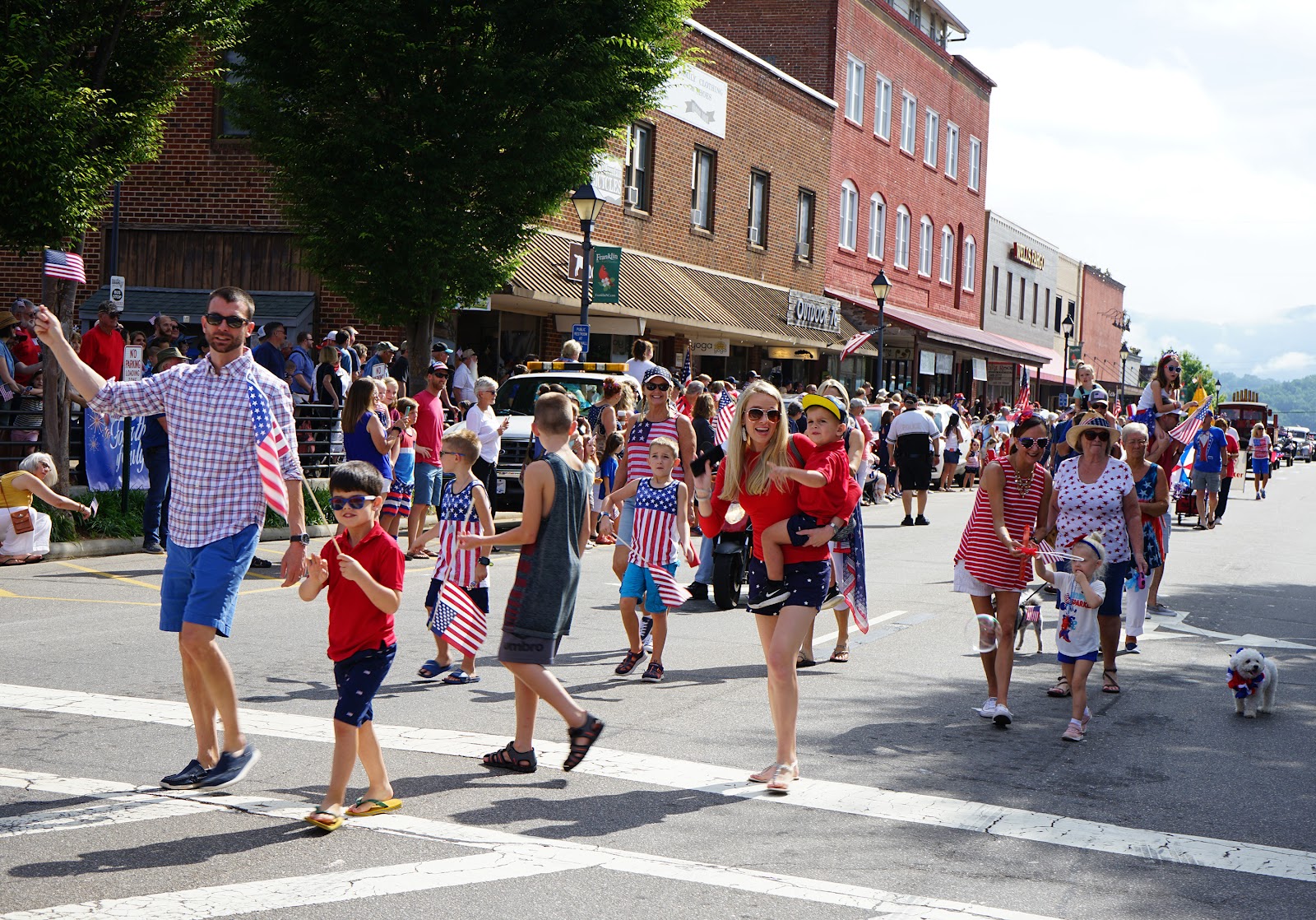
The annual Independence Day Parade took place at 11am this morning on Main Street in Franklin, Noerth Carolina. Here is a video and some photos taken by Macon Media at the event.

DAY SPONSOR

Young Tree Service is sponsoring Macon Media for today.

They provide complete tree care, are licensed and insured. Specializing in low ground impact. Danger tree removal. Crane Service, Pruning, Views, 24 hr emergency service. Call 828-421-0967 or visit Young Tree Service for more information.

2022 Independence Day Parade - Franklin, NC | Macon Media


Photos [Flickr Album]

2022 Independence Day Parade


Support Macon Media

If you receive value from what Macon Media provides to the community, please consider becoming a supporter and contribute at least a dollar a month. Those who support Macon Media with at least a dollar a month receive early access to video of some events and meetings before they are made public on the website. Videos and news involving public safety are not subject to early access.


Become a Patron!


Or, if you prefer Pay Pal, try PayPal.me/MaconMedia


Published at 1:00pam on Monday, July 04, 2022
Author: Bobby Coggins


Monday, June 13, 2022

Town of Franklin Announces July 4 th Celebration Details


PRESS RELEASE (06-13-2022)
TOWN OF FRANKLIN


Town of Franklin Announces July 4 th Celebration Details

(Franklin, NC) Franklin’s annual 4 th of July Celebration kicks off Monday, July 4 th with its traditional patriotic parade at 11:00 a.m.

“Franklin’s July 4 th celebration is a true, small town American experience. The Town Council and Employees are planning a Fourth that is open to everyone—veterans, children, residents, visitors, and even pets—to have the opportunity to take part in the parade and all activities as we celebrate our Nation’s 246th birthday. It is a celebration where everyone becomes a participant—not just a spectator,” said Mayor Jack Horton.

The activities begin with the parade lineup at 10:30 a.m. in the lower-level parking lot at Town Hall.

“Franklin hosts one of the few parades in the country that visitors can actually participate in,” said Amie Owens, Town Manager. “If you would like to be part of the parade, be in the lower parking lot of Town Hall at 10:30am for lineup.” Entrants can walk, drive or ride and are encouraged to don red, white, and blue. The same applies for pets.

The Parade will travel down Main Street, turn right on Iotla Street, and disband back at Town Hall.

“We are glad to bring back one of our July 4 th traditions in Franklin this year. Following the parade, we will be serving free cold watermelon as long as it lasts,” said Owens.

Also, after the parade, more free treats will be offered to those attending.

“New this year to the July 4 th event will be free Fireworks Popsicles from Carolina Ice Cream and free Kona Ice. These will be available to the first 200 in line following the parade.”

Other fun activities planned include free contests for youngsters and pets! The Little Miss & Mr. Firecracker Contest is open to all girls and boys ages 3 to 6. It is patriotic in nature with entrants

judged on their patriotic attire and one simple question. No registration or entry fee is required for this family-friendly contest.

Following will be the Patriotic Pet Contest, so deck your pets out in red, white, and blue for this fun event.

Both events are free, and no preregistration is required. Just be at the gazebo stage at 11:30 for the contests.

Then around noon, live music will be on the stage at the Gazebo on the Square featuring the popular local band, Paradise 56. They’ll bring a variety of music for those attending including Rhythm & Blues and Reggae. Paradise 56 will perform until 2:00 p.m.

Activities will then take a breather as the Town of Franklin prepares for Fireworks Over Franklin produced by Hale Artificier, Inc., of Lexington, NC.

Fireworks Over Franklin is an all-aerial show that will feature hundreds of fireworks with over 250 shells in the grand finale alone.

A perimeter around the site will be secured and spectators will not be allowed to park or walk close to the launching site. Please note that any unauthorized vehicles in the safety zone will be towed.

“Plans are to have a test fireworks shell fired at 9:00 p.m. and 9:15 p.m. These test shells will help those who want to view the display determine if they might need to move to a different location for better viewing,” Owens said. “You will be able to view the display from many different locales in East Franklin and even from Town Hill.”

Prior to the fireworks display, the Town of Franklin will host a live radio broadcast on WFSC Radio beginning at 8:30 p.m. At 9:30 p.m. WFSC will air a patriotic soundtrack for the fireworks display that you will be able to enjoy, no matter where you are. Tune your radios to 104.9 FM for both the live broadcast and fireworks soundtrack.

“The Town of Franklin is certainly very pleased to host these events for our residents and visitors as we begin to return to normal during the pandemic,” Mayor Horton said.

For additional information call (828) 524-2516 or online at TownofFranklinNC.com or follow on Facebook @FranklinNCEvents.


Sunday, July 4, 2021

Happy 245th Birthday, America!


Today, in 1776, the Declaration of Independence was publicly proclaimed after having been passed in secret on July 2nd by the Continental Congress. The Continental Congress voted to pass the Lee Resolution that formally declared the colonies free and independent states and absolved all allegiance to the British Crown. A more detailed play-by-play of the events and a copy of both the Lee Resolution and the Declaration of Independence is posted below. Also included is a video from the National Archives that discusses the Lee Resolution.


The Lee Resolution and the Declaration of Independence

On May 15, 1776, the revolutionary Virginia Convention, then meeting in Williamsburg, passed a resolution instructing Virginia's delegates in the Continental Congress "to propose to that respectable body to declare the United Colonies free and independent States, absolved from all allegiance to, or dependence upon, the Crown or Parliament of Great Britain". In accordance with those instructions, on June 7, Richard Henry Lee proposed the resolution to Congress and it was seconded by John Adams.

Resolved, That these United Colonies are, and of right ought to be, free and independent States, that they are absolved from all allegiance to the British Crown, and that all political connection between them and the State of Great Britain is, and ought to be, totally dissolved.
That it is expedient forthwith to take the most effectual measures for forming foreign Alliances.


That a plan of confederation be prepared and transmitted to the respective Colonies for their consideration and approbation.
Congress as a whole was not yet ready to declare independence at that moment, because the delegates from some of the colonies, including Maryland, Pennsylvania, Delaware, New Jersey, and New York, had not yet been authorized to vote for independence. Voting on the first clause of Lee's resolution was therefore postponed for three weeks while advocates of independence worked to build support in the colonial governments for the resolution. Meanwhile, a Committee of Five was appointed to prepare a formal declaration so that it would be ready when independence, which almost everyone recognized was now inevitable, was approved. The committee prepared a declaration of independence, written primarily by Thomas Jefferson, and presented it to Congress on June 28, 1776.

The declaration was set aside while the resolution of independence was debated for several days. The vote on the independence section of the Lee resolution had been postponed until Monday, July 1, when it was taken up by the Committee of the Whole. At the request of South Carolina, the resolution was not acted upon until the following day in the hope of securing unanimity. A trial vote had been tested on the 1st where it was found that South Carolina and Pennsylvania were in the negative, with Delaware split in a tie between its two delegates. The vote was held on July 2, with critical changes happening between Monday and Tuesday. Edward Rutledge was able to persuade South Carolina delegates to vote yea, two Pennsylvania delegates were persuaded to be absent, and Caesar Rodney had been sent for through the night to break Delaware's tie. So Lee's resolution of independence was approved by twelve of the thirteen colonies. Delegates from New York still lacked instructions to vote for independence, and so they abstained on this vote, although on July 9 the New York Provincial Congress would vote to "join with the other colonies in supporting" independence.

Video from the National Archives

Take a virtual journey with the National Archives to find out how the Declaration of Independence came to be and learn about Richard Henry Lee's writing of the Lee Resolution. The National Archives is the permanent home of the original Declaration of Independence. The Lee Resolution for Independence can be viewed here: https://catalog.archives.gov/ID/301684


Declaration of Independence, July 4, 1776

When in the course of human events, it becomes necessary for one people to dissolve the political bands which have connected them with another,
and to assume among the powers of the earth, the separate and equal station to which the laws of nature and of nature's God entitle them, a decent respect to the opinions of mankind requires that they should declare the causes which impel them to the separation.

We hold these truths to be self-evident:

That all men are created equal; that they are endowed by their Creator with certain unalienable rights; that among these are life, liberty, and the pursuit of happiness; that, to secure these rights, governments are instituted among men, deriving their just powers from the consent of the governed; that whenever any form of government becomes destructive of these ends, it is the right of the people to alter or to abolish it, and to institute new government, laying its foundation on such principles, and organizing its powers in such form, as to them shall seem most likely to effect their safety and happiness. Prudence, indeed, will dictate that governments long established should not be changed for light and transient causes; and accordingly all experience hath shown that mankind are more disposed to suffer, while evils are sufferable than to right themselves by abolishing the forms to which they are accustomed. But when a long train of abuses and usurpations, pursuing invariably the same object, evinces a design to reduce them under absolute despotism, it is their right, it is their duty, to throw off such government, and to provide new guards for their future security. Such has been the patient sufferance of these colonies; and such is now the necessity which constrains them to alter their former systems of government. The history of the present King of Great Britain is a history of repeated injuries and usurpations, all having in direct object the establishment of an absolute tyranny over these states. To prove this, let facts be submitted to a candid world.

He has refused his assent to laws, the most wholesome and necessary for the public good.

He has forbidden his governors to pass laws of immediate and pressing importance, unless suspended in their operation till his assent should be obtained; and, when so suspended, he has utterly neglected to attend to them.

He has refused to pass other laws for the accommodation of large districts of people, unless those people would relinquish the right of representation in the legislature, a right inestimable to them, and formidable to tyrants only.

He has called together legislative bodies at places unusual uncomfortable, and distant from the depository of their public records, for the sole purpose of fatiguing them into compliance with his measures.

He has dissolved representative houses repeatedly, for opposing, with manly firmness, his invasions on the rights of the people.

He has refused for a long time, after such dissolutions, to cause others to be elected; whereby the legislative powers, incapable of annihilation, have returned to the people at large for their exercise; the state remaining, in the mean time, exposed to all the dangers of invasions from without and convulsions within.

He has endeavored to prevent the population of these states; for that purpose obstructing the laws for naturalization of foreigners; refusing to pass others to encourage their migration hither, and raising the conditions of new appropriations of lands.

He has obstructed the administration of justice, by refusing his assent to laws for establishing judiciary powers.

He has made judges dependent on his will alone, for the tenure of their offices, and the amount and payment of their salaries.

He has erected a multitude of new offices, and sent hither swarms of officers to harass our people and eat out their substance.

He has kept among us, in times of peace, standing armies, without the consent of our legislatures.

He has affected to render the military independent of, and superior to, the civil power.

He has combined with others to subject us to a jurisdiction foreign to our constitution and unacknowledged by our laws, giving his assent to their acts of pretended legislation:

For quartering large bodies of armed troops among us;

For protecting them, by a mock trial, from punishment for any murders which they should commit on the inhabitants of these states;

For cutting off our trade with all parts of the world;

For imposing taxes on us without our consent;

For depriving us, in many cases, of the benefits of trial by jury;

For transporting us beyond seas, to be tried for pretended offenses;

For abolishing the free system of English laws in a neighboring province, establishing therein an arbitrary government, and enlarging its boundaries, so as to render it at once an example and fit instrument for introducing the same absolute rule into these colonies;

For taking away our charters, abolishing our most valuable laws, and altering fundamentally the forms of our governments;

For suspending our own legislatures, and declaring themselves invested with power to legislate for us in all cases whatsoever.

He has abdicated government here, by declaring us out of his protection and waging war against us.

He has plundered our seas, ravaged our coasts, burned our towns, and destroyed the lives of our people.

He is at this time transporting large armies of foreign mercenaries to complete the works of death, desolation, and tyranny already begun with circumstances of cruelty and perfidy scarcely paralleled in the most barbarous ages, and totally unworthy the head of a civilized nation.

He has constrained our fellow-citizens, taken captive on the high seas, to bear arms against their country, to become the executioners of their friends and brethren, or to fall themselves by their hands.

He has excited domestic insurrection among us, and has endeavored to bring on the inhabitants of our frontiers the merciless Indian savages, whose known rule of warfare is an undistinguished destruction of all ages, sexes, and conditions.

In every stage of these oppressions we have petitioned for redress in the most humble terms; our repeated petitions have been answered only by repeated injury. A prince, whose character is thus marked by every act which may define a tyrant, is unfit to be the ruler of a free people.

Nor have we been wanting in our attentions to our British brethren. We have warned them, from time to time, of attempts by their legislature to extend an unwarrantable jurisdiction over us. We have reminded them of the circumstances of our emigration and settlement here. We have appealed to their native justice and magnanimity; and we have conjured them, by the ties of our common kindred, to disavow these usurpations which would inevitably interrupt our connections and correspondence. They too, have been deaf to the voice of justice and of consanguinity. 

We must, therefore, acquiesce in the necessity which denounces our separation, and hold them as we hold the rest of mankind, enemies in war, in peace friends.

We, therefore, the representatives of the United States of America, in General Congress assembled, appealing to the Supreme Judge of the world for the rectitude of our intentions, do, in the name and by the authority of the good people of these colonies solemnly publish and declare, That these United Colonies are, and of right ought to be, FREE AND INDEPENDENT STATES; that they are absolved from all allegiance to the British crown and that all political connection between them and the state of Great Britain is, and ought to be, totally dissolved; and that, as free and independent states, they have full power to levy war, conclude peace, contract alliances, establish commerce, and do all other acts and things which independent states may of right do. And for the support of this declaration, with a firm reliance on the protection of Divine Providence, we mutually pledge to each other our lives, our fortunes, and our sacred honor.

[Signed by] JOHN HANCOCK [President]


New Hampshire
JOSIAH BARTLETT,
WM. WHIPPLE,
MATTHEW THORNTON.

Massachusetts Bay
SAML. ADAMS,
JOHN ADAMS,
ROBT. TREAT PAINE,
ELBRIDGE GERRY

Rhode Island
STEP. HOPKINS,
WILLIAM ELLERY.

Connecticut
ROGER SHERMAN,
SAM'EL HUNTINGTON,
WM. WILLIAMS,
OLIVER WOLCOTT.

New York
WM. FLOYD,
PHIL. LIVINGSTON,
FRANS. LEWIS,
LEWIS MORRIS.

New Jersey
RICHD. STOCKTON,
JNO. WITHERSPOON,
FRAS. HOPKINSON,
JOHN HART,
ABRA. CLARK.

Pennsylvania
ROBT. MORRIS
BENJAMIN RUSH,
BENJA. FRANKLIN,
JOHN MORTON,
GEO. CLYMER,
JAS. SMITH,
GEO. TAYLOR,
JAMES WILSON,
GEO. ROSS.

Delaware
CAESAR RODNEY,
GEO. READ,
THO. M'KEAN.

Maryland
SAMUEL CHASE,
WM. PACA,
THOS. STONE,
CHARLES CARROLL of Carrollton.

Virginia
GEORGE WYTHE,
RICHARD HENRY LEE,
TH. JEFFERSON,
BENJA. HARRISON,
THS. NELSON, JR.,
FRANCIS LIGHTFOOT LEE,
CARTER BRAXTON.

North Carolina
WM. HOOPER,
JOSEPH HEWES,
JOHN PENN.

South Carolina
EDWARD RUTLEDGE,
THOS. HAYWARD, JUNR.,
THOMAS LYNCH, JUNR.,
ARTHUR MIDDLETON.

Georgia
BUTTON GWINNETT,
LYMAN HALL,
GEO. WALTON.

NOTE.-Mr. Ferdinand Jefferson, Keeper of the Rolls in the Department of State, at Washington, says: " The names of the signers are spelt above as in the facsimile of the original, but the punctuation of them is not always the same; neither do the names of the States appear in the facsimile of the original. The names of the signers of each State are grouped together in the facsimile of the original, except the name of Matthew Thornton, which follows that of Oliver Wolcott."-Revised Statutes of the United States, 2d edition, 1878, p. 6.

Source:
Documents Illustrative of the Formation of the Union of the American States.
Government Printing Office, 1927. House Document No. 398. 


Published at 5:15am on Sunday, July 4, 2020, 245 years later.

Thursday, July 4, 2019

Happy Independence Day!


Today, in 1776, the Declaration of Independence was publicly proclaimed after having been passed in secret on July 2nd by the Continental Congress. The Continental Congress voted to pass the Lee Resolution that formally declared the colonies free and independent states and absolved all allegiance to the British Crown. A more detailed play by play of the events and a copy of both the Lee Resolution and the Declaration of Independence is posted below. Also included is a segment from the HBO historical drama, "John Adams," that depicts the final passage of the Lee Resolution on July 2, 1776.

DAY SPONSOR

Macon Media is being underwritten today by Franklin Health & Fitness, home of #ResultsForEveryone and the FREE 7-Day Guest Pass.

To claim your guest pass, and to learn more about @Franklin Health and Fitness, click here: 
https://franklinhealthandfitness.com/about-us/


The Lee Resolution and the Declaration of Independence

On May 15, 1776, the revolutionary Virginia Convention, then meeting in Williamsburg, passed a resolution instructing Virginia's delegates in the Continental Congress "to propose to that respectable body to declare the United Colonies free and independent States, absolved from all allegiance to, or dependence upon, the Crown or Parliament of Great Britain". In accordance with those instructions, on June 7, Richard Henry Lee proposed the resolution to Congress and it was seconded by John Adams.

Resolved, That these United Colonies are, and of right ought to be, free and independent States, that they are absolved from all allegiance to the British Crown, and that all political connection between them and the State of Great Britain is, and ought to be, totally dissolved.
That it is expedient forthwith to take the most effectual measures for forming foreign Alliances.


That a plan of confederation be prepared and transmitted to the respective Colonies for their consideration and approbation.
Congress as a whole was not yet ready to declare independence at that moment, because the delegates from some of the colonies, including Maryland, Pennsylvania, Delaware, New Jersey, and New York, had not yet been authorized to vote for independence. Voting on the first clause of Lee's resolution was therefore postponed for three weeks while advocates of independence worked to build support in the colonial governments for the resolution. Meanwhile, a Committee of Five was appointed to prepare a formal declaration so that it would be ready when independence, which almost everyone recognized was now inevitable, was approved. The committee prepared a declaration of independence, written primarily by Thomas Jefferson, and presented it to Congress on June 28, 1776.

The declaration was set aside while the resolution of independence was debated for several days. The vote on the independence section of the Lee resolution had been postponed until Monday, July 1, when it was taken up by the Committee of the Whole. At the request of South Carolina, the resolution was not acted upon until the following day in the hope of securing unanimity. A trial vote had been tested on the 1st where it was found that South Carolina and Pennsylvania were in the negative, with Delaware split in a tie between its two delegates. The vote was held on July 2, with critical changes happening between Monday and Tuesday. Edward Rutledge was able to persuade South Carolina delegates to vote yea, two Pennsylvania delegates were persuaded to be absent, and Caesar Rodney had been sent for through the night to break Delaware's tie. So Lee's resolution of independence was approved by twelve of the thirteen colonies. Delegates from New York still lacked instructions to vote for independence, and so they abstained on this vote, although on July 9 the New York Provincial Congress would vote to "join with the other colonies in supporting" independence.


Declaration of Independence, July 4, 1776

When in the course of human events, it becomes necessary for one people to dissolve the political bands which have connected them with another,
and to assume among the powers of the earth, the separate and equal station to which the laws of nature and of nature's God entitle them, a decent respect to the opinions of mankind requires that they should declare the causes which impel them to the separation.

We hold these truths to be self-evident:

That all men are created equal; that they are endowed by their Creator with certain unalienable rights; that among these are life, liberty, and the pursuit of happiness; that, to secure these rights, governments are instituted among men, deriving their just powers from the consent of the governed; that whenever any form of government becomes destructive of these ends, it is the right of the people to alter or to abolish it, and to institute new government, laying its foundation on such principles, and organizing its powers in such form, as to them shall seem most likely to effect their safety and happiness. Prudence, indeed, will dictate that governments long established should not be changed for light and transient causes; and accordingly all experience hath shown that mankind are more disposed to suffer, while evils are sufferable than to right themselves by abolishing the forms to which they are accustomed. But when a long train of abuses and usurpations, pursuing invariably the same object, evinces a design to reduce them under absolute despotism, it is their right, it is their duty, to throw off such government, and to provide new guards for their future security. Such has been the patient sufferance of these colonies; and such is now the necessity which constrains them to alter their former systems of government. The history of the present King of Great Britain is a history of repeated injuries and usurpations, all having in direct object the establishment of an absolute tyranny over these states. To prove this, let facts be submitted to a candid world.

He has refused his assent to laws, the most wholesome and necessary for the public good.

He has forbidden his governors to pass laws of immediate and pressing importance, unless suspended in their operation till his assent should be obtained; and, when so suspended, he has utterly neglected to attend to them.

He has refused to pass other laws for the accommodation of large districts of people, unless those people would relinquish the right of representation in the legislature, a right inestimable to them, and formidable to tyrants only.

He has called together legislative bodies at places unusual uncomfortable, and distant from the depository of their public records, for the sole purpose of fatiguing them into compliance with his measures.

He has dissolved representative houses repeatedly, for opposing, with manly firmness, his invasions on the rights of the people.

He has refused for a long time, after such dissolutions, to cause others to be elected; whereby the legislative powers, incapable of annihilation, have returned to the people at large for their exercise; the state remaining, in the mean time, exposed to all the dangers of invasions from without and convulsions within.

He has endeavored to prevent the population of these states; for that purpose obstructing the laws for naturalization of foreigners; refusing to pass others to encourage their migration hither, and raising the conditions of new appropriations of lands.

He has obstructed the administration of justice, by refusing his assent to laws for establishing judiciary powers.

He has made judges dependent on his will alone, for the tenure of their offices, and the amount and payment of their salaries.

He has erected a multitude of new offices, and sent hither swarms of officers to harass our people and eat out their substance.

He has kept among us, in times of peace, standing armies, without the consent of our legislatures.

He has affected to render the military independent of, and superior to, the civil power.

He has combined with others to subject us to a jurisdiction foreign to our constitution and unacknowledged by our laws, giving his assent to their acts of pretended legislation:

For quartering large bodies of armed troops among us;

For protecting them, by a mock trial, from punishment for any murders which they should commit on the inhabitants of these states;

For cutting off our trade with all parts of the world;

For imposing taxes on us without our consent;

For depriving us, in many cases, of the benefits of trial by jury;

For transporting us beyond seas, to be tried for pretended offenses;

For abolishing the free system of English laws in a neighboring province, establishing therein an arbitrary government, and enlarging its boundaries, so as to render it at once an example and fit instrument for introducing the same absolute rule into these colonies;

For taking away our charters, abolishing our most valuable laws, and altering fundamentally the forms of our governments;

For suspending our own legislatures, and declaring themselves invested with power to legislate for us in all cases whatsoever.

He has abdicated government here, by declaring us out of his protection and waging war against us.

He has plundered our seas, ravaged our coasts, burned our towns, and destroyed the lives of our people.

He is at this time transporting large armies of foreign mercenaries to complete the works of death, desolation, and tyranny already begun with circumstances of cruelty and perfidy scarcely paralleled in the most barbarous ages, and totally unworthy the head of a civilized nation.

He has constrained our fellow-citizens, taken captive on the high seas, to bear arms against their country, to become the executioners of their friends and brethren, or to fall themselves by their hands.

He has excited domestic insurrection among us, and has endeavored to bring on the inhabitants of our frontiers the merciless Indian savages, whose known rule of warfare is an undistinguished destruction of all ages, sexes, and conditions.

In every stage of these oppressions we have petitioned for redress in the most humble terms; our repeated petitions have been answered only by repeated injury. A prince, whose character is thus marked by every act which may define a tyrant, is unfit to be the ruler of a free people.

Nor have we been wanting in our attentions to our British brethren. We have warned them, from time to time, of attempts by their legislature to extend an unwarrantable jurisdiction over us. We have reminded them of the circumstances of our emigration and settlement here. We have appealed to their native justice and magnanimity; and we have conjured them, by the ties of our common kindred, to disavow these usurpations which would inevitably interrupt our connections and correspondence. They too, have been deaf to the voice of justice and of consanguinity. 

We must, therefore, acquiesce in the necessity which denounces our separation, and hold them as we hold the rest of mankind, enemies in war, in peace friends.

We, therefore, the representatives of the United States of America, in General Congress assembled, appealing to the Supreme Judge of the world for the rectitude of our intentions, do, in the name and by the authority of the good people of these colonies solemnly publish and declare, That these United Colonies are, and of right ought to be, FREE AND INDEPENDENT STATES; that they are absolved from all allegiance to the British crown and that all political connection between them and the state of Great Britain is, and ought to be, totally dissolved; and that, as free and independent states, they have full power to levy war, conclude peace, contract alliances, establish commerce, and do all other acts and things which independent states may of right do. And for the support of this declaration, with a firm reliance on the protection of Divine Providence, we mutually pledge to each other our lives, our fortunes, and our sacred honor.

[Signed by] JOHN HANCOCK [President]


New Hampshire
JOSIAH BARTLETT,
WM. WHIPPLE,
MATTHEW THORNTON.

Massachusetts Bay
SAML. ADAMS,
JOHN ADAMS,
ROBT. TREAT PAINE,
ELBRIDGE GERRY

Rhode Island
STEP. HOPKINS,
WILLIAM ELLERY.

Connecticut
ROGER SHERMAN,
SAM'EL HUNTINGTON,
WM. WILLIAMS,
OLIVER WOLCOTT.

New York
WM. FLOYD,
PHIL. LIVINGSTON,
FRANS. LEWIS,
LEWIS MORRIS.

New Jersey
RICHD. STOCKTON,
JNO. WITHERSPOON,
FRAS. HOPKINSON,
JOHN HART,
ABRA. CLARK.

Pennsylvania
ROBT. MORRIS
BENJAMIN RUSH,
BENJA. FRANKLIN,
JOHN MORTON,
GEO. CLYMER,
JAS. SMITH,
GEO. TAYLOR,
JAMES WILSON,
GEO. ROSS.

Delaware
CAESAR RODNEY,
GEO. READ,
THO. M'KEAN.

Maryland
SAMUEL CHASE,
WM. PACA,
THOS. STONE,
CHARLES CARROLL of Carrollton.

Virginia
GEORGE WYTHE,
RICHARD HENRY LEE,
TH. JEFFERSON,
BENJA. HARRISON,
THS. NELSON, JR.,
FRANCIS LIGHTFOOT LEE,
CARTER BRAXTON.

North Carolina
WM. HOOPER,
JOSEPH HEWES,
JOHN PENN.

South Carolina
EDWARD RUTLEDGE,
THOS. HAYWARD, JUNR.,
THOMAS LYNCH, JUNR.,
ARTHUR MIDDLETON.

Georgia
BUTTON GWINNETT,
LYMAN HALL,
GEO. WALTON.

NOTE.-Mr. Ferdinand Jefferson, Keeper of the Rolls in the Department of State, at Washington, says: " The names of the signers are spelt above as

in the facsimile of the original, but the punctuation of them is not always the same; neither do the names of the States appear in the facsimile of

the original. The names of the signers of each State are grouped together in the facsimile of the original, except the name of Matthew Thornton,

which follows that of Oliver Wolcott."-Revised Statutes of the United States, 2d edition, 1878, p. 6.

Source:
Documents Illustrative of the Formation of the Union of the American States.
Government Printing Office, 1927.
House Document No. 398. 

Saturday, July 2, 2016

On This Day in 1776:
Lee Resolution Passes Congress

Declaration of Independence by John Trumbull
John Trumbull's painting, Declaration of Independence, depicting the five-man drafting committee of the Declaration of Independence presenting their work to the Congress. The painting can be found on the back of the U.S. $2 bill. 
The original hangs in the US Capitol rotunda.

240 Years ago today, the Continental Congress passed the Lee Resolution that called for independence from Britain by a vote of 12 For 0 Against and 1 Abstaining (New York had failed to receive instructions from it's constituent assembly). The full text follows:


Resolved, That these United Colonies are, and of right ought to be, free and independent States, that they are absolved from all allegiance to the British Crown, and that all political connection between them and the State of Great Britain is, and ought to be, totally dissolved.

That it is expedient forthwith to take the most effectual measures for forming foreign Alliances.

That a plan of confederation be prepared and transmitted to the respective Colonies for their consideration and approbation.

John Adams wrote his wife Abigail on July 3 about the resolution of independence:

The second day of July, 1776, will be the most memorable epoch in the history of America. I am apt to believe that it will be celebrated by succeeding generations as the great anniversary festival. It ought to be commemorated as the day of deliverance, by solemn acts of devotion to God Almighty. It ought to be solemnized with pomp and parade, with shows, games, sports, guns, bells, bonfires, and illuminations, from one end of this continent to the other, from this time forward forever more.

Adams's prediction was off by two days. From the outset, Americans celebrated Independence Day on July 4, the date the much-publicized Declaration of Independence was approved, rather than on July 2, the date the resolution of independence was adopted.


The text of the Declaration of Independence follows, with original spelling of the day retained:

IN CONGRESS, July 4, 1776.

The unanimous Declaration of the thirteen united States of America,

When in the Course of human events, it becomes necessary for one people to dissolve the political bands which have connected them with another, and to assume among the powers of the earth, the separate and equal station to which the Laws of Nature and of Nature's God entitle them, a decent respect to the opinions of mankind requires that they should declare the causes which impel them to the separation.

We hold these truths to be self-evident, that all men are created equal, that they are endowed by their Creator with certain unalienable Rights, that among these are Life, Liberty and the pursuit of Happiness.--That to secure these rights, Governments are instituted among Men, deriving their just powers from the consent of the governed, --That whenever any Form of Government becomes destructive of these ends, it is the Right of the People to alter or to abolish it, and to institute new Government, laying its foundation on such principles and organizing its powers in such form, as to them shall seem most likely to effect their Safety and Happiness. Prudence, indeed, will dictate that Governments long established should not be changed for light and transient causes; and accordingly all experience hath shewn, that mankind are more disposed to suffer, while evils are sufferable, than to right themselves by abolishing the forms to which they are accustomed. But when a long train of abuses and usurpations, pursuing invariably the same Object evinces a design to reduce them under absolute Despotism, it is their right, it is their duty, to throw off such Government, and to provide new Guards for their future security.--Such has been the patient sufferance of these Colonies; and such is now the necessity which constrains them to alter their former Systems of Government. The history of the present King of Great Britain is a history of repeated injuries and usurpations, all having in direct object the establishment of an absolute Tyranny over these States. To prove this, let Facts be submitted to a candid world.

He has refused his Assent to Laws, the most wholesome and necessary for the public good.
He has forbidden his Governors to pass Laws of immediate and pressing importance, unless suspended in their operation till his Assent should be obtained; and when so suspended, he has utterly neglected to attend to them.
He has refused to pass other Laws for the accommodation of large districts of people, unless those people would relinquish the right of Representation in the Legislature, a right inestimable to them and formidable to tyrants only.
He has called together legislative bodies at places unusual, uncomfortable, and distant from the depository of their public Records, for the sole purpose of fatiguing them into compliance with his measures.
He has dissolved Representative Houses repeatedly, for opposing with manly firmness his invasions on the rights of the people.
He has refused for a long time, after such dissolutions, to cause others to be elected; whereby the Legislative powers, incapable of Annihilation, have returned to the People at large for their exercise; the State remaining in the mean time exposed to all the dangers of invasion from without, and convulsions within.
He has endeavoured to prevent the population of these States; for that purpose obstructing the Laws for Naturalization of Foreigners; refusing to pass others to encourage their migrations hither, and raising the conditions of new Appropriations of Lands.
He has obstructed the Administration of Justice, by refusing his Assent to Laws for establishing Judiciary powers.
He has made Judges dependent on his Will alone, for the tenure of their offices, and the amount and payment of their salaries.
He has erected a multitude of New Offices, and sent hither swarms of Officers to harrass our people, and eat out their substance.
He has kept among us, in times of peace, Standing Armies without the Consent of our legislatures.
He has affected to render the Military independent of and superior to the Civil power.
He has combined with others to subject us to a jurisdiction foreign to our constitution, and unacknowledged by our laws; giving his Assent to their Acts of pretended Legislation:
For Quartering large bodies of armed troops among us:
For protecting them, by a mock Trial, from punishment for any Murders which they should commit on the Inhabitants of these States:
For cutting off our Trade with all parts of the world:
For imposing Taxes on us without our Consent:
For depriving us in many cases, of the benefits of Trial by Jury:
For transporting us beyond Seas to be tried for pretended offences
For abolishing the free System of English Laws in a neighbouring Province, establishing therein an Arbitrary government, and enlarging its Boundaries so as to render it at once an example and fit instrument for introducing the same absolute rule into these Colonies:
For taking away our Charters, abolishing our most valuable Laws, and altering fundamentally the Forms of our Governments:
For suspending our own Legislatures, and declaring themselves invested with power to legislate for us in all cases whatsoever.
He has abdicated Government here, by declaring us out of his Protection and waging War against us.
He has plundered our seas, ravaged our Coasts, burnt our towns, and destroyed the lives of our people.
He is at this time transporting large Armies of foreign Mercenaries to compleat the works of death, desolation and tyranny, already begun with circumstances of Cruelty & perfidy scarcely paralleled in the most barbarous ages, and totally unworthy the Head of a civilized nation.
He has constrained our fellow Citizens taken Captive on the high Seas to bear Arms against their Country, to become the executioners of their friends and Brethren, or to fall themselves by their Hands.
He has excited domestic insurrections amongst us, and has endeavoured to bring on the inhabitants of our frontiers, the merciless Indian Savages, whose known rule of warfare, is an undistinguished destruction of all ages, sexes and conditions.

In every stage of these Oppressions We have Petitioned for Redress in the most humble terms: Our repeated Petitions have been answered only by repeated injury. A Prince whose character is thus marked by every act which may define a Tyrant, is unfit to be the ruler of a free people.

Nor have We been wanting in attentions to our Brittish brethren. We have warned them from time to time of attempts by their legislature to extend an unwarrantable jurisdiction over us. We have reminded them of the circumstances of our emigration and settlement here. We have appealed to their native justice and magnanimity, and we have conjured them by the ties of our common kindred to disavow these usurpations, which, would inevitably interrupt our connections and correspondence. They too have been deaf to the voice of justice and of consanguinity. We must, therefore, acquiesce in the necessity, which denounces our Separation, and hold them, as we hold the rest of mankind, Enemies in War, in Peace Friends.

We, therefore, the Representatives of the united States of America, in General Congress, Assembled, appealing to the Supreme Judge of the world for the rectitude of our intentions, do, in the Name, and by Authority of the good People of these Colonies, solemnly publish and declare, That these United Colonies are, and of Right ought to be Free and Independent States; that they are Absolved from all Allegiance to the British Crown, and that all political connection between them and the State of Great Britain, is and ought to be totally dissolved; and that as Free and Independent States, they have full Power to levy War, conclude Peace, contract Alliances, establish Commerce, and to do all other Acts and Things which Independent States may of right do. And for the support of this Declaration, with a firm reliance on the protection of divine Providence, we mutually pledge to each other our Lives, our Fortunes and our sacred Honor.