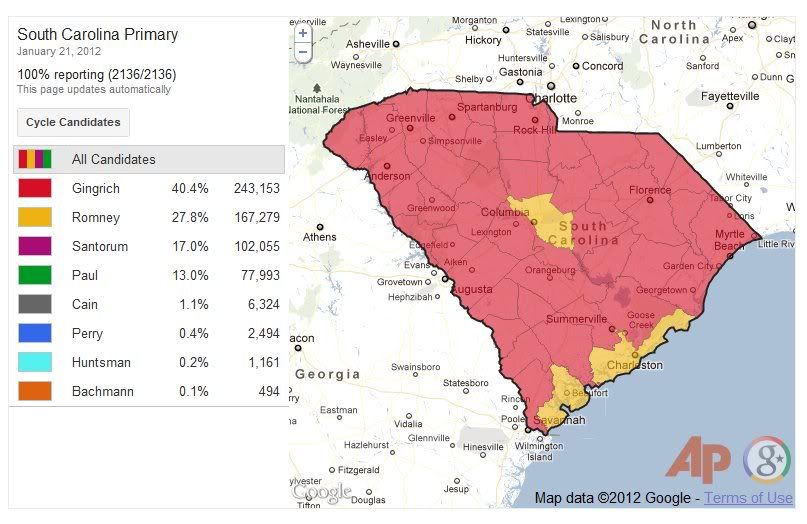
Last week at this time, Mitt Romney was the candidate conventional wisdom said would win. After a week-long assault on him by the media, his numbers started to slip. When an attack by the media on Newt Gingrich was foiled ahead of time by Matt Drudge, Gingrich was able to turn the attack around and made it about the media and the politics of personal destruction. Republicans in South Carolina responded very well to seeing Newt verbally skewer a Lefty Reporter on a spit at a debate on Thursday [see video].
Here is a table of the results:
Candidate
Votes
Percent
Percent Behind Leader
Newt Gingrich
243,153
40.4
0.0
Mitt Romney
167,279
27.8
-12.6
Rick Santorum
102,055
17.0
-23.4
Ron Paul
77,993
13.0
-27.4
Who got how many delegates varies according to which website you visit. The Green Papers estimates that Gingrich will get twenty three and Romney will get two, and that assessment is, I think, a reasonable assumption at this point.
The estimated total delegate count so far is as follows:
31 Romney
26 Gingrich
10 Paul
08 Santorum
Before you watch the speeches, check out a précis on the Florida primary, the first primary in which only registered Republicans will be voting. I'm expecting a different dynamic in this state.
Speeches
Newt Gingrich, who finished first with 40.4% of the vote.
Mitt Romney, who finished second with 27.8% of the vote.
Rick Santorum, who finished third with 17.0% of the vote.
Ron Paul, who finished fourth with 13.0% of the vote.
The next primary is Florida, which will happen on Tuesday, January 31, 2012. Due to the the unfriendly voter demographics and the limited nature of Ron Paul's war chest, he will not be campaigning heavily here and will move on to the caucus states that are coming up in February and March before the March 6th Super Tuesday, when the nomination will likely become more or less evident.
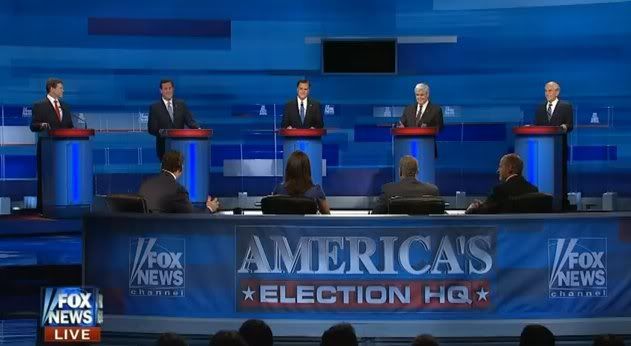
Here is the full video of the forum that took place in Myrtle Beach, South Carolina last night. All five of the remaining candidates for the Republican nomination participated in the event.
This video was recorded at a town hall with Congressman Tim Scott in Charleston, SC. The Governor of South Carolina, Nikki Haley, also spoke for a short time in favor of Mitt Romney's bid to become the nominee of the Republican Party in the 2012 Presidential Race.
The candidates in the Republican Party 2012 Presidential nomination race participated in a forum at Wofford College last night, an event that was billed as the "Commander-in-Chief Debate."
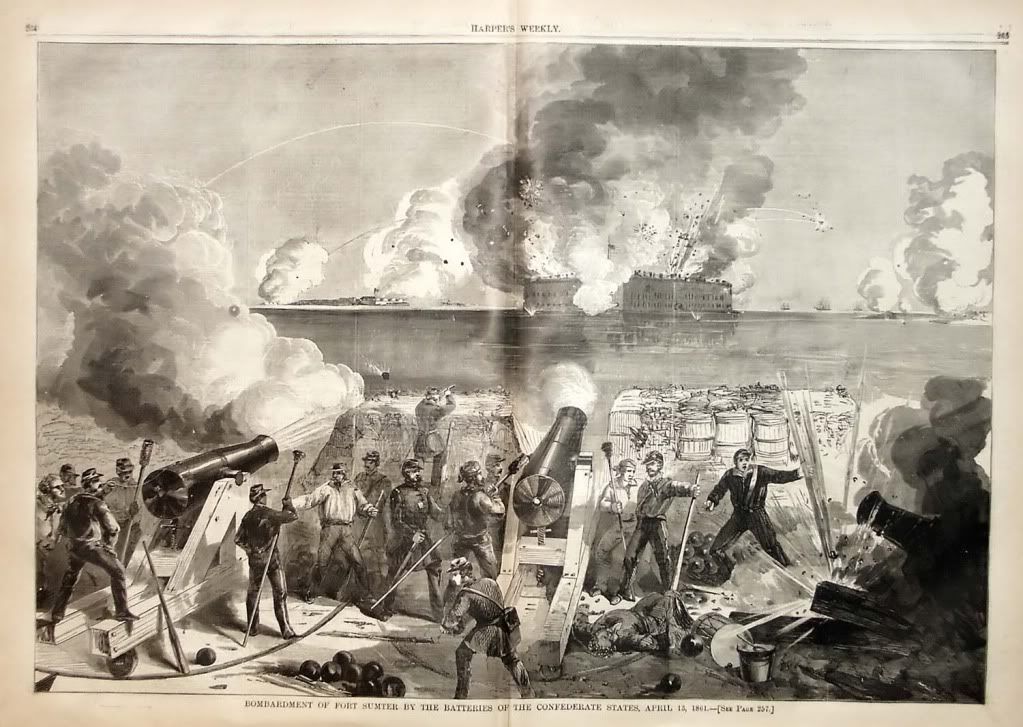
Today marks the 150th Anniversary of the first shots of the American Civil War, or as people around here like to call it, The War of Northern Aggression.
Here are a few tidbits of information, links and videos regarding The Battle of Fort Sumter that took place from April 12th to the 13th in the year 1861...
The Battle of Fort Sumter (April 12–13, 1861) was the bombardment and surrender of Fort Sumter, near Charleston, South Carolina, that started the American Civil War. Following declarations of secession by seven Southern states, South Carolina demanded that the U.S. Army abandon its facilities in Charleston Harbor. On December 26, 1860, U.S. Major Robert Anderson surreptitiously moved his small command from the indefensible Fort Moultrie on Sullivan's Island to Fort Sumter, a substantial fortress controlling the entrance of Charleston Harbor. An attempt by U.S. President James Buchanan to reinforce and resupply Anderson, using the unarmed merchant ship Star of the West, failed when it was fired upon by shore batteries on January 9, 1861. South Carolina authorities then seized all Federal property in the Charleston area, except for Fort Sumter.
During the winter months of 1861, the situation around Fort Sumter increasingly began to resemble a siege. In March, Brig. Gen.P.G.T. Beauregard, the first general officer of the newly formed Confederate States of America, was placed in command of Confederate forces in Charleston. Beauregard energetically directed the strengthening of batteries around Charleston harbor aimed at Fort Sumter. Conditions in the fort grew dire as the Federals rushed to complete the installation of additional guns. Anderson was short of men, food, and supplies.
The resupply of Fort Sumter became the first crisis of the administration of President Abraham Lincoln. He notified the Governor of South Carolina, Francis W. Pickens, that he was sending supply ships, which resulted in an ultimatum from the Confederate government: evacuate Fort Sumter immediately. Major Anderson refused to surrender. Beginning at 4:30 a.m. on April 12, the Confederates bombarded the fort from artillery batteries surrounding the harbor. Although the Union garrison returned fire, they were significantly outgunned and, after 34 hours, Major Anderson agreed to evacuate. There was no loss of life on either side as a direct result of this engagement, although a gun explosion during the surrender ceremonies on April 14 caused two Union deaths.
Following the battle, there was widespread support from both North and South for further military action. Lincoln's immediate call for 75,000 volunteers to suppress the rebellion resulted in an additional four states also declaring their secession and joining the Confederacy. The Civil War had begun.
Civil War re-enactors fire cannon from the Old Pitt Street Bridge in Mt. Pleasant toward Fort Sumter on the morning of April 12, 2011 marking the 150th anniversary of the first shots of the American Civil War.
This C-SPAN program is part of the 150th anniversary of the beginning of the Civil War on April 12, 1861.
After finishing with his survey of the manner in which historians have explained the coming of the Civil War, Professor Blight focuses on Fort Sumter. After months of political maneuvering, the Civil War began when Confederates fired on Fort Sumter, in the harbor outside Charleston, SC. The declaration of hostilities prompted four more states--Virginia, Tennessee, North Carolina, and Arkansas--to secede. Professor Blight closes the lecture with a brief discussion of some of the forces that motivated Americans--North and South--to go to war.
To submit releases for publication, email me here. This includes Guest Commentaries. If you have a photo that you wish me to use with your press release or article, please send it to me, otherwise I'll use whatever I feel best fits your article.
Letters to the Editor
Send Letters to the Editor to editor@MaconMedia. Limit is one submission every seven days. You may include photos, video or audio. Submissions will be edited for vulgarity or similar reasons. Limit submissions to less than 10,000 words. LOL
For a quicker response, send me a message on Twitter or add me to a circle on Google Plus and send it just to me.
If you have been sending me press releases via my private email address, that will continue to work just fine. The Twitter or Google+ account will get my attention quicker.
NON PROFIT OR CIVIC EVENTS
Macon Media will promote nonprofit or civic events if contacted by an organizer of the event. This includes rallies, protests, community forums, and parades. Messeanger Link http://m.me/MaconMediaNews
If you're of a mind, and can afford it, a dollar a month (or more) from enough people will make a huge difference in improving the quality of coverage of local meetings and events, as well as allowing remote weather stations and weather cams to be deployed throughout the county that you will be able to access online.
Currently, 20 people have pledged $99 a month. This is a tremendous help. Please visit www.patreon.com/MaconMedia for more information on how to contribute.
Businesses can underwrite this coverage by day sponsorships, surplus equipment donations, etc. Inquire at editor@maconmedia.com for more information.
Donations accepted for the purpose of supporting this blog and activities related to improving it's operations and my coverage of local festivals and local government meetings.













 Posts
Posts