I'm sure that by now all but the most oblivious of us are aware of the planned boycott tomorrow. I wonder about the significance of the choice of May 1st.
I will attempt to let others tell you in their own words, just so you know who these people are, and more importantly, the ones behind them.
Be warned, this is a long piece. My normal M.O. is to point you to things I or others have found. I feel this topic is important enough to include larger excerpts so that you may see what I have seen.
Date: Wed, 1 May 1996 14:44:31 CDT
Sender: Activists Mailing List
From: NY Transfer News Collective
Subject: L&M: May Day, the workers' day
From: "Workers World"
Date: Sat, 27 Apr 1996 16:34:48 -0400 EDT
May Day, The Workers' Day,
born in the struggle for the eight-hour day
By Andy McInerney, in Liberation & Marxism,
issue no. 27, Spring 1996
In the opening words of "The Communist Manifesto," Karl Marx and Frederick Engles describe the "specter haunting Europe_ the specter of communism." Since those words were written in 1848, this specter_the conscious organization of the working class into a revolutionary force_has haunted the exploiting classes in every corner of the world.
Before the working class seized state power in the Soviet Union, apologists for the bosses and bankers ridiculed communism as utopian and terroristic. After the 1917 Russian Revolution, the defenders of capitalist rule tried to use defects in the Soviet Union as proof that communism couldn't work. And after the collapse of the USSR, communism was once again deemed a hopeless utopia.
All of these "refutations" of communism are born from the utmost fear of the working class. Revolutions around the world_in Russia, China, Korea, Vietnam, Cuba, and others_ have shown that capitalist rule is not secure. The workers can win.
Every year, the ruling classes around the world are again reminded of their vulnerability and of the power of their gravedig-gers. On May 1, the world working class displays its strength in demonstrations and strikes. May Day_ International Workers' Day_is a reminder to the ruling classes that their days are numbered.
(...History Section deleted for space...Ed)
By May 3,(1886 Ed.) the number of workers on strike in Chicago had soared to 65,000. Alarmed, representatives of industry had decided that decisive action against the workers was necessary.
The battle was joined on the afternoon of May 3. Spies was addressing striking lumber workers, preparing to negotiate with the owners over the eight-hour day.
During the rally, several hundred lumber workers left to join the locked-out workers at the McCormick Harvester Works, about a quarter-mile away. The McCormick workers had been locked out for three months; the plant was being run with scabs, and the lumber workers were joining the locked- out workers to confront the scabs at shift change.
Within 15 minutes, hundreds of cops were on the scene. Spies and the remaining lumber workers, hearing gunshots, headed for McCormick to reinforce their comrades. But a force of police intercepted them, attacking them with clubs and firing into the crowd. At least four workers were killed outright, with many other injured.
Spies immediately issued two leaflets in both English and German. One had the headline, "Revenge! Workingmen, to Arms!" and put responsibility for the atrocity at the hands of the bosses. The other called for a mass rally at Haymarket Square to denounce the police murders.
On the day of the rally, May 4, the police carried out a wave of attacks against striking workers. Despite the attacks, 3,000 gathered for the evening rally_including the mayor, who wanted to insure that the rally remained peaceful.
Spies spoke first, taking up the cop murders the day before. Parsons also spoke, addressing the eight-hour day. After these two leaders left, Samuel Fielden addressed the remaining crowd.
Minutes after the mayor left the rally, while Fielden was speaking, 180 cops closed in on the speakers stand and demanded that the rally disperse. Fielden protested that the rally was peaceful.
Just as the police captain was giving orders to the cops, a bomb was thrown from the crowd into the ranks of the police. Sixty-six cops were wounded; seven later died. The cops turned their guns on the workers, wounding 200 and killing several.
SOLIDARITY VS. WITCH HUNT
The newspapers and the bosses whipped up a witch hunt against militant workers_especially the anarchist leaders. Seven were arrested within days_Spies, Fielden, Michael Schwab, Adolph Fischer, George Engel, Louis Lingg, and Oscar Neebe. Parsons evaded a police search until he turned himself in on the day of the trial.
The trial itself was a classical frame-up. The prosecutors produced no evidence that any of the eight men threw the bomb, nor that any of them had conspired to throw the bomb. As prosecuting Attorney Julius Grinnel said in his closing remarks, "Law is upon trial. Anarchy is on trial. These men have been selected, picked out by the grand jury and indicted because they were leaders. They are no more guilty than the thousands that follow them. ... Convict these men, make examples of them, hang them and save our institutions, our society."
All were sentenced to death except Neebe. Fielden and Schwab petitioned for clemency and had their sentences commuted to life in prison; 21-year-old Lingg cheated the hangman by exploding a dynamite tube in his mouth. The rest were hanged on November 11, 1887.
Six years later, Illinois Gov. John Atgeld freed Neebe, Fielden and Schwab and posthumously pardoned the five executed men, revealing that much of the evidence was phony and that the trial was a charade. But the damage had been done, and not just to the Haymarket Eight.
The entire labor movement came under attack in the witch hunt; the eight-hours' strikes by-and-large collapsed, and about a third of the workers who had won the eight-hour day lost it in the month after the Haymarket incident.
In the year between the Haymarket incident and the executions, the worldwide labor movement came to the defense of the accused. While the Knights of Labor officialdom took the opportunity to attack its more militant rivals, many Knights locals_including the Chicago local_championed the clemency campaign. The newly- founded American Federation of Labor, under Gompers, issued a public appeal for clemency.
Outside the United States, workers in England, Holland, Russia, Italy, France and Spain rallied and donated funds for the defendants. Prime Minister Otto von Bismarck of Germany, alarmed by the workers' movement in defense of the Haymarket defendants, outlawed public meetings of workers.
The Haymarket incident placed the U.S. working class_ especially the U.S. movement for the eight-hour day_at center stage of the world workers' movement. So when the AFL convention in 1888 announced that May 1, 1890, would be a day when labor would enforce the eight-hour day with strikes and demonstrations, the world was listening.
MAY DAY SPREADS WORLDWIDE
In 1889, over 400 delegates met in Paris on the 100th anniversary of the French revolution at the Marxist International Socialist Congress_the founding meeting of the Second International. Gompers sent a delegate with word of their call for action on May 1, 1890.
The Congress passed a resolution, introduced by the French delegate Lavigne, calling for a "great international demonstration" to take place for the eight-hour day. The demonstration was to take place on May 1, 1890, "in view of the fact that such a demonstration has already been resolved upon by the American Federation of Labor."
The call was a resounding success. On May 1, 1890, May Day demonstrations took place in the United States and most countries in Europe. Demonstrations were also held in Chile and Peru. In Havana, Cuba, workers marched in the world's first May Day demanding the eight-hour day, equal rights for Blacks and whites, and working-class unity.
Frederick Engels, who joined the half-million workers in Hyde Park in London on May 3, reported:
"As I write these lines, the proletariat of Europe and America is holding a review of its forces; it is mobilized for the first time as one army, under one flag, and fighting for one immediate aim: an eight-hour working day."
While the 1889 resolution called for a one-time demonstration on May 1, the day quickly became an annual event. Around the world, workers in more and more countries marked labor's day on May Day.
May Day was celebrated for the first time in Russia, Brazil and Ireland in 1891. By 1904, the Second International called on all socialists and trade unionists in every country to "demonstrate energetically" each May 1 "for the legal establishment of the eight-hour day, for the class demands of the proletariat, and for universal peace."
Chinese workers celebrated their first May Day in 1920, following the Russian socialist revolution. In 1927, workers in India observed May Day with demonstrations in Calcutta, Madras and Bombay. By that time, May Day was truly a world workers' day.
While May Day picked up momentum across the world, it lost steam in its country of origin, the United States. The AFL had begun a rightward turn as early as the aftermath of Haymarket; by 1905 it had disavowed May Day altogether, celebrating instead Labor Day on the first Monday of September_sanctioned by the federal government in 1894.
>From that time onward, May Day in the United States was organized by the left wing of the labor movement, against the hostile attitude of the more conservative labor bureaucracy. In 1910, for example, the Socialist Party brought 60,000 into the streets of New York City for May Day, including 10,000 women of the Shirt Waist Makers' Union. Five hundred thousand workers marched on May Day in 1911.
In 1919, following the now-certain victory of the workers and peasants in the Soviet Union, a vicious red scare swept the U.S. May Day rallies were attacked both in the press and physically.
>From 1919 onward, the success of May Day in the United States would depend on the success of the communist movement.
Despite its setbacks in the United States, May Day is embraced by millions of workers in every country of the world as a day to raise its class demands. Its strength has been in raising demands not just of workers in a particular factory or industry, but of the working class as a whole. The demands of May Day_for the eight-hour day, for unity against racism and national chauvinism, against imperialist war_are demands of the working class against the entire capitalist class.
For that reason, May Day_International Workers' Day_haunts the bankers and corporate barons as much as it inspires the millions of workers who observe it. It is the day when workers take their place in the class army that will one day unseat their masters.
Above the clenched fists and red flags of the assembled ranks of workers are the last words of August Spies, chiseled in stone on the monument to the Haymarket martyrs: "The day will come when our silence will be more powerful than the voices you are throttling today."
--------------------------------------------------------------------------------
Subscriptions $10/4 issues
Send to: L&M, 55 W. 17 St., 5th Floor, NY, NY 10011
Copyright Liberation & Marxism. Permission to reprint granted if source is cited. For more information contact L&M, 55 W. 17 St., 5th Fl., NY, NY 10011;
via e-mail: l&m@wwpublish.com. Web: http://www.workers.org
--------------------------------------------------------------------------------
I hope the previous section establishes May Day as a Communist, or, if you prefer, a Socialist holiday. Please note that the marchers are declaring themselves as
.
.
, the solidarity the Socialists, i.e. Communists, have with the participants of the "El Gran Boicot".
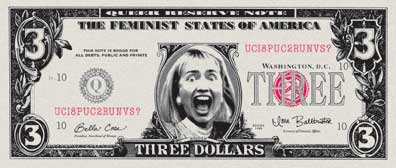
Note the attempt in the article to focus the readers attention on profits, and the "need" to have "affirmative action" in their redistribution. Can you say oil profits? Hmmm...
And finally, I will leave you with those in our government and a foreign government who support the "boicot":
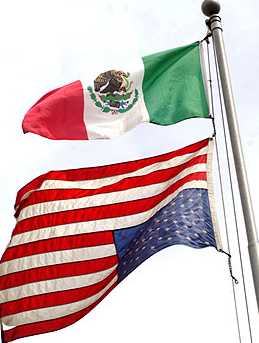
With the Mexican Governor's supporting the marches, my belief that boots on the ground in Mexico may be the only way to stem the flow of illegal aliens into our country. If they continue to call it theirs, then they have declared war on our country.
Keep your head down and your powder dry.



















 Posts
Posts