Notice

I am working on the template of this blog today in order to chase down some problems that have developed with my template and widgets.

Macon County Commissioners

Coverage of the meetings of the Macon County Board of County Commissioners.

Franklin Town Board of Aldermen

Coverage of the meetings of the Franklin Town Board of Aldermen.

Macon County School Board

Coverage of the meetings of the Macon County School Board.

Photoblog

Photos from my photoblog.

nullspace for future use

nullspace for future use

About

Showing posts with label MIddle East. Show all posts

Thursday, September 11, 2014

President Obama Addresses Nation
September 10, 2014

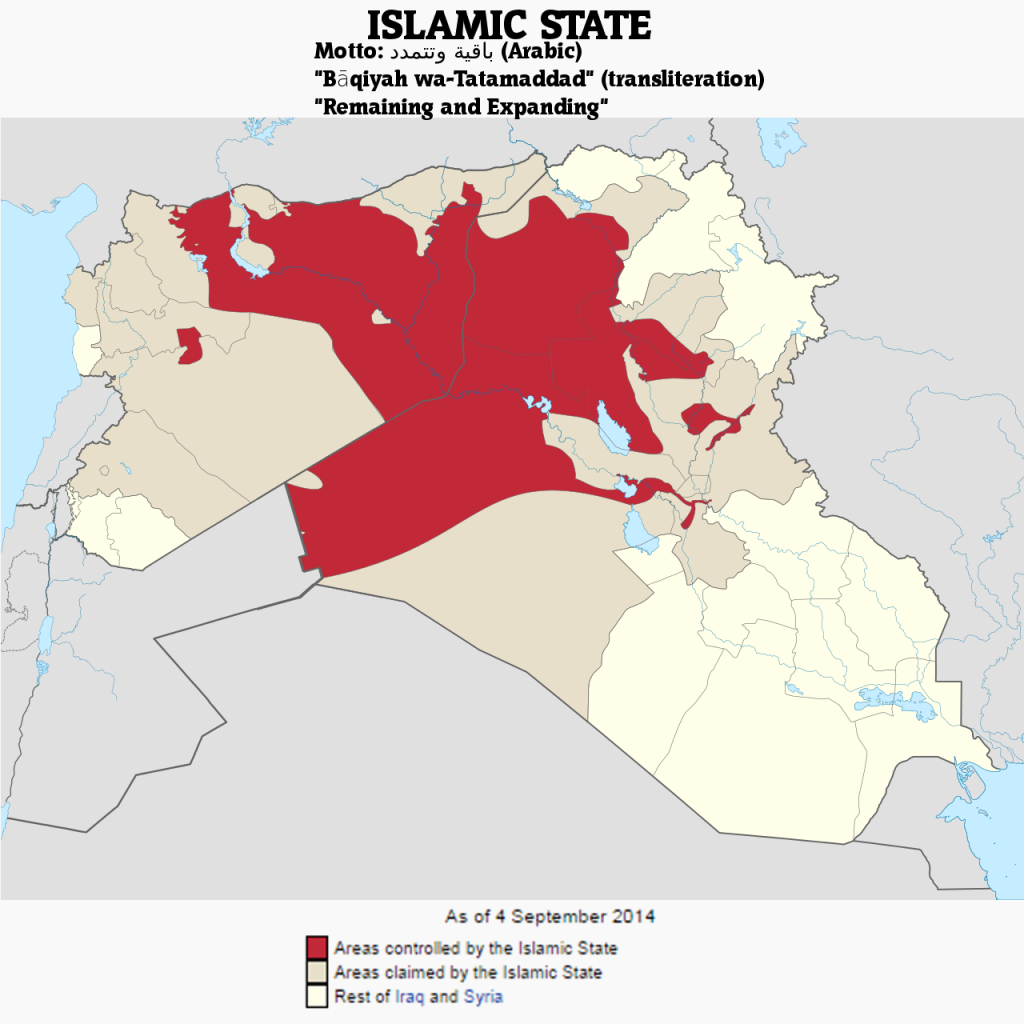
 photo ISV2_zps67847db7.png

"Territorial control of the ISIS" by NordNordWest, Spesh531 - BBC's recently updated map of ISIS controlled areas (This is the most recent source)BBC's map of Syria.Noria Research's map of Syria.Map and information on claimed areas.Some info in Aleppo and Ar-Raqqah Governorate (Jan 19, 2014)Derived from:File:Saudi Arabia location map.svgFile:Jordan location map.svgFile:Syria location map.svgFile:Iraq location map.svg. Licensed under CC BY-SA 3.0 via Wikimedia Commons.


President Obama has addressed the nation during prime time regarding the growing threat of the Islamic State (formerly known as the Islamic State in Iraq and the Levant or the Islamic State in Iraq and Syria), a self proclaimed caliphate that claims religious authority over all Muslims in the world. A video of his complete remarks are above, and a transcript from the White House is below.

More information can be found at the following locations:

The White House Fact Sheet

Wikipedia (I adapted a map from there for this post)


VOX: 17 THINGS YOU NEED TO KNOW ABOUT ISIS AND IRAQ

The Long War Journal: US strategy against Islamic State to mirror counterterrorism efforts in Yemen, Somalia


Transcript:

My fellow Americans — tonight, I want to speak to you about what the United States will do with our friends and allies to degrade and ultimately destroy the terrorist group known as ISIL.

As Commander-in-Chief, my highest priority is the security of the American people. Over the last several years, we have consistently taken the fight to terrorists who threaten our country. We took out Osama bin Laden and much of al Qaeda’s leadership in Afghanistan and Pakistan. We’ve targeted al Qaeda’s affiliate in Yemen, and recently eliminated the top commander of its affiliate in Somalia. We’ve done so while bringing more than 140,000 American troops home from Iraq, and drawing down our forces in Afghanistan, where our combat mission will end later this year. Thanks to our military and counterterrorism professionals, America is safer.

Still, we continue to face a terrorist threat. We cannot erase every trace of evil from the world, and small groups of killers have the capacity to do great harm. That was the case before 9/11, and that remains true today. That’s why we must remain vigilant as threats emerge. At this moment, the greatest threats come from the Middle East and North Africa, where radical groups exploit grievances for their own gain. And one of those groups is ISIL — which calls itself the “Islamic State.”

Now let’s make two things clear: ISIL is not “Islamic.” No religion condones the killing of innocents, and the vast majority of ISIL’s victims have been Muslim. And ISIL is certainly not a state. It was formerly al Qaeda’s affiliate in Iraq, and has taken advantage of sectarian strife and Syria’s civil war to gain territory on both sides of the Iraq-Syrian border. It is recognized by no government, nor the people it subjugates. ISIL is a terrorist organization, pure and simple. And it has no vision other than the slaughter of all who stand in its way.

In a region that has known so much bloodshed, these terrorists are unique in their brutality. They execute captured prisoners. They kill children. They enslave, rape, and force women into marriage. They threatened a religious minority with genocide. In acts of barbarism, they took the lives of two American journalists — Jim Foley and Steven Sotloff.

So ISIL poses a threat to the people of Iraq and Syria, and the broader Middle East — including American citizens, personnel and facilities. If left unchecked, these terrorists could pose a growing threat beyond that region — including to the United States. While we have not yet detected specific plotting against our homeland, ISIL leaders have threatened America and our allies. Our intelligence community believes that thousands of foreigners — including Europeans and some Americans — have joined them in Syria and Iraq. Trained and battle-hardened, these fighters could try to return to their home countries and carry out deadly attacks.

I know many Americans are concerned about these threats. Tonight, I want you to know that the United States of America is meeting them with strength and resolve. Last month, I ordered our military to take targeted action against ISIL to stop its advances. Since then, we have conducted more than 150 successful airstrikes in Iraq. These strikes have protected American personnel and facilities, killed ISIL fighters, destroyed weapons, and given space for Iraqi and Kurdish forces to reclaim key territory. These strikes have helped save the lives of thousands of innocent men, women and children.

But this is not our fight alone. American power can make a decisive difference, but we cannot do for Iraqis what they must do for themselves, nor can we take the place of Arab partners in securing their region. That’s why I’ve insisted that additional U.S. action depended upon Iraqis forming an inclusive government, which they have now done in recent days. So tonight, with a new Iraqi government in place, and following consultations with allies abroad and Congress at home, I can announce that America will lead a broad coalition to roll back this terrorist threat.

Our objective is clear: we will degrade, and ultimately destroy, ISIL through a comprehensive and sustained counter-terrorism strategy.

First, we will conduct a systematic campaign of airstrikes against these terrorists. Working with the Iraqi government, we will expand our efforts beyond protecting our own people and humanitarian missions, so that we’re hitting ISIL targets as Iraqi forces go on offense. Moreover, I have made it clear that we will hunt down terrorists who threaten our country, wherever they are. That means I will not hesitate to take action against ISIL in Syria, as well as Iraq. This is a core principle of my presidency: if you threaten America, you will find no safe haven.

Second, we will increase our support to forces fighting these terrorists on the ground. In June, I deployed several hundred American service members to Iraq to assess how we can best support Iraqi Security Forces. Now that those teams have completed their work — and Iraq has formed a government — we will send an additional 475 service members to Iraq. As I have said before, these American forces will not have a combat mission — we will not get dragged into another ground war in Iraq. But they are needed to support Iraqi and Kurdish forces with training, intelligence and equipment. We will also support Iraq’s efforts to stand up National Guard Units to help Sunni communities secure their own freedom from ISIL control.

Across the border, in Syria, we have ramped up our military assistance to the Syrian opposition. Tonight, I again call on Congress to give us additional authorities and resources to train and equip these fighters. In the fight against ISIL, we cannot rely on an Assad regime that terrorizes its people; a regime that will never regain the legitimacy it has lost. Instead, we must strengthen the opposition as the best counterweight to extremists like ISIL, while pursuing the political solution necessary to solve Syria’s crisis once and for all.

Third, we will continue to draw on our substantial counterterrorism capabilities to prevent ISIL attacks. Working with our partners, we will redouble our efforts to cut off its funding; improve our intelligence; strengthen our defenses; counter its warped ideology; and stem the flow of foreign fighters into — and out of — the Middle East. And in two weeks, I will chair a meeting of the UN Security Council to further mobilize the international community around this effort.

Fourth, we will continue providing humanitarian assistance to innocent civilians who have been displaced by this terrorist organization. This includes Sunni and Shia Muslims who are at grave risk, as well as tens of thousands of Christians and other religious minorities. We cannot allow these communities to be driven from their ancient homelands.

This is our strategy. And in each of these four parts of our strategy, America will be joined by a broad coalition of partners. Already, allies are flying planes with us over Iraq; sending arms and assistance to Iraqi Security Forces and the Syrian opposition; sharing intelligence; and providing billions of dollars in humanitarian aid. Secretary Kerry was in Iraq today meeting with the new government and supporting their efforts to promote unity, and in the coming days he will travel across the Middle East and Europe to enlist more partners in this fight, especially Arab nations who can help mobilize Sunni communities in Iraq and Syria to drive these terrorists from their lands. This is American leadership at its best: we stand with people who fight for their own freedom; and we rally other nations on behalf of our common security and common humanity.

My Administration has also secured bipartisan support for this approach here at home. I have the authority to address the threat from ISIL. But I believe we are strongest as a nation when the President and Congress work together. So I welcome congressional support for this effort in order to show the world that Americans are united in confronting this danger.

Now, it will take time to eradicate a cancer like ISIL. And any time we take military action, there are risks involved — especially to the servicemen and women who carry out these missions. But I want the American people to understand how this effort will be different from the wars in Iraq and Afghanistan. It will not involve American combat troops fighting on foreign soil. This counter-terrorism campaign will be waged through a steady, relentless effort to take out ISIL wherever they exist, using our air power and our support for partner forces on the ground. This strategy of taking out terrorists who threaten us, while supporting partners on the front lines, is one that we have successfully pursued in Yemen and Somalia for years. And it is consistent with the approach I outlined earlier this year: to use force against anyone who threatens America’s core interests, but to mobilize partners wherever possible to address broader challenges to international order.

My fellow Americans, we live in a time of great change. Tomorrow marks 13 years since our country was attacked. Next week marks 6 years since our economy suffered its worst setback since the Great Depression. Yet despite these shocks; through the pain we have felt and the grueling work required to bounce back — America is better positioned today to seize the future than any other nation on Earth.

Our technology companies and universities are unmatched; our manufacturing and auto industries are thriving. Energy independence is closer than it’s been in decades. For all the work that remains, our businesses are in the longest uninterrupted stretch of job creation in our history. Despite all the divisions and discord within our democracy, I see the grit and determination and common goodness of the American people every single day — and that makes me more confident than ever about our country’s future.

Abroad, American leadership is the one constant in an uncertain world. It is America that has the capacity and the will to mobilize the world against terrorists. It is America that has rallied the world against Russian aggression, and in support of the Ukrainian peoples’ right to determine their own destiny. It is America — our scientists, our doctors, our know-how — that can help contain and cure the outbreak of Ebola. It is America that helped remove and destroy Syria’s declared chemical weapons so they cannot pose a threat to the Syrian people — or the world — again. And it is America that is helping Muslim communities around the world not just in the fight against terrorism, but in the fight for opportunity, tolerance, and a more hopeful future.

America, our endless blessings bestow an enduring burden. But as Americans, we welcome our responsibility to lead. From Europe to Asia — from the far reaches of Africa to war-torn capitals of the Middle East — we stand for freedom, for justice, for dignity. These are values that have guided our nation since its founding. Tonight, I ask for your support in carrying that leadership forward. I do so as a Commander-in-Chief who could not be prouder of our men and women in uniform — pilots who bravely fly in the face of danger above the Middle East, and service-members who support our partners on the ground.

When we helped prevent the massacre of civilians trapped on a distant mountain, here’s what one of them said. “We owe our American friends our lives. Our children will always remember that there was someone who felt our struggle and made a long journey to protect innocent people.”

That is the difference we make in the world. And our own safety — our own security — depends upon our willingness to do what it takes to defend this nation, and uphold the values that we stand for — timeless ideals that will endure long after those who offer only hate and destruction have been vanquished from the Earth.

May God bless our troops, and may God bless the United States of America.
Saturday, September 7, 2013

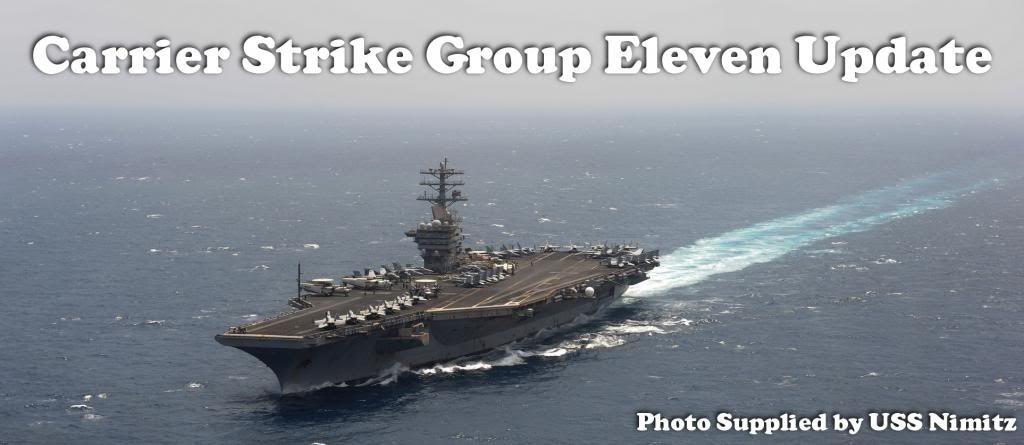
Carrier Strike Group Eleven Update:
September 7, 2013

CSG 11 Update Banner 
Photo by USS Nimitz PIO 
titles by Bobby Coggins

In light of the probable upcoming military strike on Syria, I will be posting updates on ship deployments and news from the Syrian Theater of Operations from time to time on the blog. All information I share will be open-source intelligence collected from publicly available sources.

Carrier Strike Group Eleven is currently commanded by Rear Admiral Michael S. White, a veteran of more than 1,000 carrier arrested landings during his career.

Carrier Strike Group Eleven (the one that the USS Nimitz leads) has indefinitely cancelled it's upcoming scheduled return to homeport due to possible combat operations in support of a strike on Syria.

The ships of the strike group are currently in the Red Sea.

Please keep these men and women in your thoughts and prayers.

Here is a list of ships currently assigned to the strike group:

Surface Action Group

USS William P. Lawrence DDG-110
USS Stockdale DDG-106
USS Shoup DDG-86
USS Higgins DDG-76

Carrier Escorts

USS Princeton CG-59
USS Preble DDG-88
USS Momsen DDG-92
EODMU-11 (Bomb Disposal Unit)

Carrier

USS Nimitz CVN-68

Carrier Airwing 11 squadrons aboard the Nimitz:

Marine Attack Squadron 323 (VMFA-323 Death Rattlers) composed of 10 F/A-18C(N) Hornets
Strike Fighter Squadron 154 (VFA-154 Black Knights) composed of 12 F/A-18F Hornets
Strike Fighter Squadron 147 (VFA-147 Argonauts) composed of 12 F/A-18C Hornets
Strike Fighter Squadron 146 (VFA-146 Blue Diamonds) composed of 10 F/A-18C Hornets
Electronic Attack Squadron 142 (VAQ-142 The Gray Wolves) composed of 10 EA-6B Prowlers
Carrier Airborne Early Warning Squadron 117 (VAW-117 The Wallbangers) 4 EC-2C Hawkeyes
Helicopter Sea Combat Squadron 6 (HSC-6 Indians) composed of 7 MH-60 Seahawks
Fleet Logistics Support Squadron 30: Detachment 3 (VRC-30 Providers) composed of 3 C-2A Greyhounds

Friday, August 30, 2013

White House Releases Statement on Syria's Use of Chemical Weapons

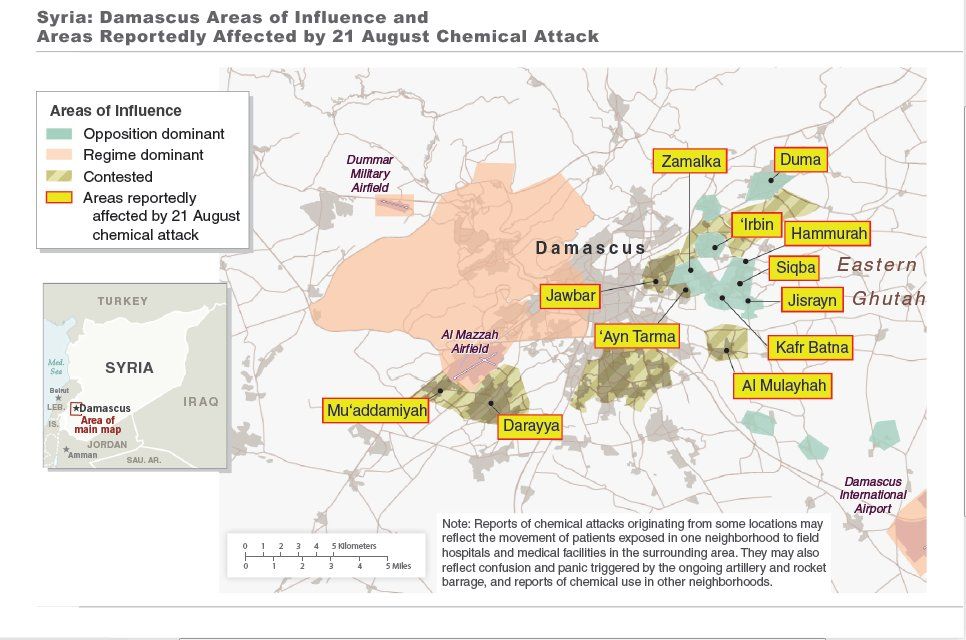
Syria Chemical Weapons Attacks 
Photo Supplied by White House
Click Image to Embiggen


Here is a press release from the White House regarding the Chemical Attack(s) in Syria:

Government Assessment of the Syrian Government’s Use of Chemical Weapons on August 21, 2013

The United States Government assesses with high confidence that the Syrian government carried out a chemical weapons attack in the Damascus suburbs on August 21, 2013. We further assess that the regime used a nerve agent in the attack. These all-source assessments are based on human, signals, and geospatial intelligence as well as a significant body of open source reporting.Our classified assessments have been shared with the U.S. Congress and key international partners. To protect sources and methods, we cannot publicly release all available intelligence – but what follows is an unclassified summary of the U.S. Intelligence Community’s analysis of what took place.
Syrian Government Use of Chemical Weapons on August 21
A large body of independent sources indicates that a chemical weapons attack took place in the Damascus suburbs on August 21. In addition to U.S. intelligence information, there are accounts from international and Syrian medical personnel; videos; witness accounts; thousands of social media reports from at least 12 different locations in the Damascus area; journalist accounts; and reports from highly credible nongovernmental organizations.
A preliminary U.S. government assessment determined that 1,429 people were killed in the chemical weapons attack, including at least 426 children, though this assessment will certainly evolve as we obtain more information.
We assess with high confidence that the Syrian government carried out the chemical weapons attack against opposition elements in the Damascus suburbs on August 21. We assess that the scenario in which the opposition executed the attack on August 21 is highly unlikely. The body of information used to make this assessment includes intelligence pertaining to the regime’s preparations for this attack and its means of delivery, multiple streams of intelligence about the attack itself and its effect, our post-attack observations, and the differences between the capabilities of the regime and the opposition. Our high confidence assessment is the strongest position that the U.S. Intelligence Community can take short of confirmation. We will continue to seek additional information to close gaps in our understanding of what took place.
Background:
The Syrian regime maintains a stockpile of numerous chemical agents, including mustard, sarin, and VX and has thousands of munitions that can be used to deliver chemical warfare agents.
Syrian President Bashar al-Asad is the ultimate decision maker for the chemical weapons program and members of the program are carefully vetted to ensure security and loyalty. The Syrian Scientific Studies and Research Center (SSRC) – which is subordinate to the Syrian Ministry of Defense – manages Syria’s chemical weapons program.
We assess with high confidence that the Syrian regime has used chemical weapons on a small scale against the opposition multiple times in the last year, including in the Damascus suburbs. This assessment is based on multiple streams of information including reporting of Syrian officials planning and executing chemical weapons attacks and laboratory analysis of physiological samples obtained from a number of individuals, which revealed exposure to sarin. We assess that the opposition has not used chemical weapons.
The Syrian regime has the types of munitions that we assess were used to carry out the attack on August 21, and has the ability to strike simultaneously in multiple locations. We have seen no indication that the opposition has carried out a large-scale, coordinated rocket and artillery attack like the one that occurred on August 21.
We assess that the Syrian regime has used chemical weapons over the last year primarily to gain the upper hand or break a stalemate in areas where it has struggled to seize and hold strategically valuable territory. In this regard, we continue to judge that the Syrian regime views chemical weapons as one of many tools in its arsenal, including air power and ballistic missiles, which they indiscriminately use against the opposition.
The Syrian regime has initiated an effort to rid the Damascus suburbs of opposition forces using the area as a base to stage attacks against regime targets in the capital. The regime has failed to clear dozens of Damascus neighborhoods of opposition elements, including neighborhoods targeted on August 21, despite employing nearly all of its conventional weapons systems. We assess that the regime’s frustration with its inability to secure large portions of Damascus may have contributed to its decision to use chemical weapons on August 21.
Preparation:
We have intelligence that leads us to assess that Syrian chemical weapons personnel – including personnel assessed to be associated with the SSRC – were preparing chemical munitions prior to the attack. In the three days prior to the attack, we collected streams of human, signals and geospatial intelligence that reveal regime activities that we assess were associated with preparations for a chemical weapons attack.
Syrian chemical weapons personnel were operating in the Damascus suburb of ‘Adra from Sunday, August 18 until early in the morning on Wednesday, August 21 near an area that the regime uses to mix chemical weapons, including sarin. On August 21, a Syrian regime element prepared for a chemical weapons attack in the Damascus area, including through the utilization of gas masks. Our intelligence sources in the Damascus area did not detect any indications in the days prior to the attack that opposition affiliates were planning to use chemical weapons.
The Attack:
Multiple streams of intelligence indicate that the regime executed a rocket and artillery attack against the Damascus suburbs in the early hours of August 21. Satellite detections corroborate that attacks from a regime-controlled area struck neighborhoods where the chemical attacks reportedly occurred – including Kafr Batna, Jawbar, ‘Ayn Tarma, Darayya, and Mu’addamiyah. This includes the detection of rocket launches from regime controlled territory early in the morning, approximately 90 minutes before the first report of a chemical attack appeared in social media. The lack of flight activity or missile launches also leads us to conclude that the regime used rockets in the attack.
Local social media reports of a chemical attack in the Damascus suburbs began at 2:30 a.m. local time on August 21. Within the next four hours there were thousands of social media reports on this attack from at least 12 different locations in the Damascus area. Multiple accounts described chemical-filled rockets impacting opposition-controlled areas.
Three hospitals in the Damascus area received approximately 3,600 patients displaying symptoms consistent with nerve agent exposure in less than three hours on the morning of August 21, according to a highly credible international humanitarian organization. The reported symptoms, and the epidemiological pattern of events – characterized by the massive influx of patients in a short period of time, the origin of the patients, and the contamination of medical and first aid workers – were consistent with mass exposure to a nerve agent. We also received reports from international and Syrian medical personnel on the ground.
We have identified one hundred videos attributed to the attack, many of which show large numbers of bodies exhibiting physical signs consistent with, but not unique to, nerve agent exposure. The reported symptoms of victims included unconsciousness, foaming from the nose and mouth, constricted pupils, rapid heartbeat, and difficulty breathing. Several of the videos show what appear to be numerous fatalities with no visible injuries, which is consistent with death from chemical weapons, and inconsistent with death from small-arms, high-explosive munitions or blister agents. At least 12 locations are portrayed in the publicly available videos, and a sampling of those videos confirmed that some were shot at the general times and locations described in the footage.
We assess the Syrian opposition does not have the capability to fabricate all of the videos, physical symptoms verified by medical personnel and NGOs, and other information associated with this chemical attack.
We have a body of information, including past Syrian practice, that leads us to conclude that regime officials were witting of and directed the attack on August 21. We intercepted communications involving a senior official intimately familiar with the offensive who confirmed that chemical weapons were used by the regime on August 21 and was concerned with the U.N. inspectors obtaining evidence. On the afternoon of August 21, we have intelligence that Syrian chemical weapons personnel were directed to cease operations. At the same time, the regime intensified the artillery barrage targeting many of the neighborhoods where chemical attacks occurred. In the 24 hour period after the attack, we detected indications of artillery and rocket fire at a rate approximately four times higher than the ten preceding days. We continued to see indications of sustained shelling in the neighborhoods up until the morning of August 26.
To conclude, there is a substantial body of information that implicates the Syrian government’s responsibility in the chemical weapons attack that took place on August 21.As indicated, there is additional intelligence that remains classified because of sources and methods concerns that is being provided to Congress and international partners.

Sunday, September 16, 2012

Netanyahu: Iran now in the Red Zone


Benjamin Netanyahu appeared on NBC's "Meet The Press" and basically said that Iran was in the "Red Zone" regarding it's nuclear weapons program and very close to requiring a military response from Israel before it becomes to late. The full interview with David Gregory is below.


As an aside, I would note that there is a new moon on October 15th, and that conditions will be favorable for an attack for two or three nights on either side of that date.

The US, UK and allied Navies have been increasing their forces in the region and we have two carriers in the region (possibly a third if the Enterprise tarries and a fourth if the Truman (which is currently at Norfolk and listed as 'surge-ready' should it be needed.

In my estimation, if the Israeli government sees an Obama victory as likely in November, they will act. If they think Romney is likely to win, they may hold off, knowing that his administration would be favorable toward increasing pressure on Iran to halt it's nuclear weapons program.


Bookmark and Share

Thursday, October 20, 2011

Gaddifi Reported Killed

**edit** Video Obituary by Al Jazeera:


It looks like Qadaffy Duck has been captured or killed near Sirte, Libya after a convoy he was travelling in was attacked by a formation of NATO jets. If the reports are true, this is a good thing. I suppose it is now only a matter of time before the Islamists steal Libya for their own purposes.

Photo source: BBC
Better Photo: UK Guardian


Live Coverage via Al Jazeera


Links via the Drudge Report:


Bookmark and Share

Tuesday, March 29, 2011

President Obama Libya Speech

President Obama addresses the nation regarding the US attack on Libya 
Screencap from Video


Last night, President Obama addressed the nation and laid out the reasons why the US attacked Libya last week. I have embedded the video and transcript without commentary:


Here is the full transcript, courtesy of the White House: 


Good evening. Tonight, I’d like to update the American people on the international effort that we have led in Libya – what we have done, what we plan to do, and why this matters to us.

I want to begin by paying tribute to our men and women in uniform who, once again, have acted with courage, professionalism and patriotism. They have moved with incredible speed and strength. Because of them and our dedicated diplomats, a coalition has been forged and countless lives have been saved. Meanwhile, as we speak, our troops are supporting our ally Japan, leaving Iraq to its people, stopping the Taliban’s momentum in Afghanistan, and going after al Qaeda around the globe. As Commander-in-Chief, I am grateful to our Soldiers, Sailors, Airmen, Marines, Coast Guardsmen, and their families, as are all Americans.

For generations, the United States of America has played a unique role as an anchor of global security and advocate for human freedom. Mindful of the risks and costs of military action, we are naturally reluctant to use force to solve the world’s many challenges. But when our interests and values are at stake, we have a responsibility to act. That is what happened in Libya over the course of these last six weeks. 

Libya sits directly between Tunisia and Egypt – two nations that inspired the world when their people rose up to take control of their own destiny. For more than four decades, the Libyan people have been ruled by a tyrant – Moammar Gaddafi. He has denied his people freedom, exploited their wealth, murdered opponents at home and abroad, and terrorized innocent people around the world – including Americans who were killed by Libyan agents.

Last month, Gaddafi’s grip of fear appeared to give way to the promise of freedom. In cities and towns across the country, Libyans took to the streets to claim their basic human rights. As one Libyan said, “For the first time we finally have hope that our nightmare of 40 years will soon be over.”

Faced with this opposition, Gaddafi began attacking his people.  As President, my immediate concern was the safety of our citizens, so we evacuated our Embassy and all Americans who sought our assistance. We then took a series of swift steps in a matter of days to answer Gaddafi’s aggression.  We froze more than $33 billion of the Gaddafi regime’s assets. Joining with other nations at the United Nations Security Council, we broadened our sanctions, imposed an arms embargo, and enabled Gaddafi and those around him to be held accountable for their crimes. I made it clear that Gaddafi had lost the confidence of his people and the legitimacy to lead, and I said that he needed to step down from power.

In the face of the world’s condemnation, Gaddafi chose to escalate his attacks, launching a military campaign against the Libyan people. Innocent people were targeted for killing. Hospitals and ambulances were attacked. Journalists were arrested, sexually assaulted, and killed. Supplies of food and fuel were choked off. The water for hundreds of thousands of people in Misratah was shut off. Cities and towns were shelled, mosques destroyed, and apartment buildings reduced to rubble. Military jets and helicopter gunships were unleashed upon people who had no means to defend themselves against assault from the air.

Confronted by this brutal repression and a looming humanitarian crisis, I ordered warships into the Mediterranean. European allies declared their willingness to commit resources to stop the killing. The Libyan opposition, and the Arab League, appealed to the world to save lives in Libya. At my direction, America led an effort with our allies at the United Nations Security Council to pass an historic Resolution that authorized a No Fly Zone to stop the regime’s attacks from the air, and further authorized all necessary measures to protect the Libyan people.

Ten days ago, having tried to end the violence without using force, the international community offered Gaddafi a final chance to stop his campaign of killing, or face the consequences. Rather than stand down, his forces continued their advance, bearing down on the city of Benghazi, home to nearly 700,000 men, women and children who sought their freedom from fear.

At this point, the United States and the world faced a choice. Gaddafi declared that he would show “no mercy” to his own people. He compared them to rats, and threatened to go door to door to inflict punishment. In the past, we had seen him hang civilians in the streets, and kill over a thousand people in a single day. Now, we saw regime forces on the outskirts of the city. We knew that if we waited one more day, Benghazi – a city nearly the size of Charlotte – could suffer a massacre that would have reverberated across the region and stained the conscience of the world.

It was not in our national interest to let that happen. I refused to let that happen. And so nine days ago, after consulting the bipartisan leadership of Congress, I authorized military action to stop the killing and enforce UN Security Council Resolution 1973. We struck regime forces approaching Benghazi to save that city and the people within it. We hit Gaddafi’s troops in neighboring Ajdabiya, allowing the opposition to drive them out. We hit his air defenses, which paved the way for a No Fly Zone. We targeted tanks and military assets that had been choking off towns and cities and we cut off much of their source of supply. And tonight, I can report that we have stopped Gaddafi’s deadly advance.

In this effort, the United States has not acted alone. Instead, we have been joined by a strong and growing coalition. This includes our closest allies – nations like the United Kingdom, France, Canada, Denmark, Norway, Italy, Spain, Greece, and Turkey – all of whom have fought by our side for decades. And it includes Arab partners like Qatar and the United Arab Emirates, who have chosen to meet their responsibility to defend the Libyan people.

To summarize, then: in just one month, the United States has worked with our international partners to mobilize a broad coalition, secure an international mandate to protect civilians, stop an advancing army, prevent a massacre, and establish a No Fly Zone with our allies and partners. To lend some perspective on how rapidly this military and diplomatic response came together, when people were being brutalized in Bosnia in the 1990s, it took the international community more than a year to intervene with air power to protect civilians.

Moreover, we have accomplished these objectives consistent with the pledge that I made to the American people at the outset of our military operations. I said that America’s role would be limited; that we would not put ground troops into Libya; that we would focus our unique capabilities on the front end of the operation, and that we would transfer responsibility to our allies and partners. Tonight, we are fulfilling that pledge.

Our most effective alliance, NATO, has taken command of the enforcement of the arms embargo and No Fly Zone. Last night, NATO decided to take on the additional responsibility of protecting Libyan civilians. This transfer from the United States to NATO will take place on Wednesday. Going forward, the lead in enforcing the No Fly Zone and protecting civilians on the ground will transition to our allies and partners, and I am fully confident that our coalition will keep the pressure on Gaddafi’s remaining forces. In that effort, the United States will play a supporting role – including intelligence, logistical support, search and rescue assistance, and capabilities to jam regime communications. Because of this transition to a broader, NATO-based coalition, the risk and cost of this operation – to our military, and to American taxpayers – will be reduced significantly.

So for those who doubted our capacity to carry out this operation, I want to be clear: the United States of America has done what we said we would do.

That is not to say that our work is complete. In addition to our NATO responsibilities, we will work with the international community to provide assistance to the people of Libya, who need food for the hungry and medical care for the wounded. We will safeguard the more than $33 billion that was frozen from the Gaddafi regime so that it is available to rebuild Libya. After all, this money does not belong to Gaddafi or to us – it belongs to the Libyan people, and we will make sure they receive it.

Tomorrow, Secretary Clinton will go to London, where she will meet with the Libyan opposition and consult with more than thirty nations. These discussions will focus on what kind of political effort is necessary to pressure Gaddafi, while also supporting a transition to the future that the Libyan people deserve. Because while our military mission is narrowly focused on saving lives, we continue to pursue the broader goal of a Libya that belongs not to a dictator, but to its people.

Despite the success of our efforts over the past week, I know that some Americans continue to have questions about our efforts in Libya. Gaddafi has not yet stepped down from power, and until he does, Libya will remain dangerous. Moreover, even after Gaddafi does leave power, forty years of tyranny has left Libya fractured and without strong civil institutions. The transition to a legitimate government that is responsive to the Libyan people will be a difficult task. And while the United States will do our part to help, it will be a task for the international community, and – more importantly – a task for the Libyan people themselves.

In fact, much of the debate in Washington has put forward a false choice when it comes to Libya. On the one hand, some question why America should intervene at all – even in limited ways – in this distant land. They argue that there are many places in the world where innocent civilians face brutal violence at the hands of their government, and America should not be expected to police the world, particularly when we have so many pressing concerns here at home.

It is true that America cannot use our military wherever repression occurs. And given the costs and risks of intervention, we must always measure our interests against the need for action. But that cannot be an argument for never acting on behalf of what’s right. In this particular country – Libya; at this particular moment, we were faced with the prospect of violence on a horrific scale. We had a unique ability to stop that violence: an international mandate for action, a broad coalition prepared to join us, the support of Arab countries, and a plea for help from the Libyan people themselves. We also had the ability to stop Gaddafi’s forces in their tracks without putting American troops on the ground.

To brush aside America’s responsibility as a leader and – more profoundly – our responsibilities to our fellow human beings under such circumstances would have been a betrayal of who we are. Some nations may be able to turn a blind eye to atrocities in other countries. The United States of America is different. And as President, I refused to wait for the images of slaughter and mass graves before taking action.

Moreover, America has an important strategic interest in preventing Gaddafi from overrunning those who oppose him. A massacre would have driven thousands of additional refugees across Libya’s borders, putting enormous strains on the peaceful – yet fragile – transitions in Egypt and Tunisia. The democratic impulses that are dawning across the region would be eclipsed by the darkest form of dictatorship, as repressive leaders concluded that violence is the best strategy to cling to power. The writ of the UN Security Council would have been shown to be little more than empty words, crippling its future credibility to uphold global peace and security. So while I will never minimize the costs involved in military action, I am convinced that a failure to act in Libya would have carried a far greater price for America.

Now, just as there are those who have argued against intervention in Libya, there are others who have suggested that we broaden our military mission beyond the task of protecting the Libyan people, and do whatever it takes to bring down Gaddafi and usher in a new government.

Of course, there is no question that Libya – and the world – will be better off with Gaddafi out of power. I, along with many other world leaders, have embraced that goal, and will actively pursue it through non-military means. But broadening our military mission to include regime change would be a mistake.

The task that I assigned our forces – to protect the Libyan people from immediate danger, and to establish a No Fly Zone – carries with it a UN mandate and international support. It is also what the Libyan opposition asked us to do.  If we tried to overthrow Gaddafi by force, our coalition would splinter. We would likely have to put U.S. troops on the ground, or risk killing many civilians from the air. The dangers faced by our men and women in uniform would be far greater. So would the costs, and our share of the responsibility for what comes next.

To be blunt, we went down that road in Iraq. Thanks to the extraordinary sacrifices of our troops and the determination of our diplomats, we are hopeful about Iraq’s future. But regime change there took eight years, thousands of American and Iraqi lives, and nearly a trillion dollars. That is not something we can afford to repeat in Libya.

As the bulk of our military effort ratchets down, what we can do – and will do – is support the aspirations of the Libyan people. We have intervened to stop a massacre, and we will work with our allies and partners as they’re in the lead to maintain the safety of civilians. We will deny the regime arms, cut off its supply of cash, assist the opposition, and work with other nations to hasten the day when Gaddafi leaves power. It may not happen overnight, as a badly weakened Gaddafi tries desperately to hang on to power. But it should be clear to those around Gadaffi, and to every Libyan, that history is not on his side. With the time and space that we have provided for the Libyan people, they will be able to determine their own destiny, and that is how it should be.

Let me close by addressing what this action says about the use of America’s military power, and America’s broader leadership in the world, under my presidency.

As Commander-in-Chief, I have no greater responsibility than keeping this country safe. And no decision weighs on me more than when to deploy our men and women in uniform. I have made it clear that I will never hesitate to use our military swiftly, decisively, and unilaterally when necessary to defend our people, our homeland, our allies, and our core interests. That is why we are going after al Qaeda wherever they seek a foothold. That is why we continue to fight in Afghanistan, even as we have ended our combat mission in Iraq and removed more than 100,000 troops from that country. 

There will be times, though, when our safety is not directly threatened, but our interests and values are. Sometimes, the course of history poses challenges that threaten our common humanity and common security – responding to natural disasters, for example; or preventing genocide and keeping the peace; ensuring regional security, and maintaining the flow of commerce. These may not be America’s problems alone, but they are important to us, and they are problems worth solving. And in these circumstances, we know that the United States, as the world’s most powerful nation, will often be called upon to help.

In such cases, we should not be afraid to act – but the burden of action should not be America’s alone. As we have in Libya, our task is instead to mobilize the international community for collective action. Because contrary to the claims of some, American leadership is not simply a matter of going it alone and bearing all of the burden ourselves. Real leadership creates the conditions and coalitions for others to step up as well; to work with allies and partners so that they bear their share of the burden and pay their share of the costs; and to see that the principles of justice and human dignity are upheld by all.

That’s the kind of leadership we have shown in Libya. Of course, even when we act as part of a coalition, the risks of any military action will be high. Those risks were realized when one of our planes malfunctioned over Libya. Yet when one of our airmen parachuted to the ground, in a country whose leader has so often demonized the United States – in a region that has such a difficult history with our country – this American did not find enemies. Instead, he was met by people who embraced him. One young Libyan who came to his aid said, “We are your friends. We are so grateful to these men who are protecting the skies.”

This voice is just one of many in a region where a new generation is refusing to be denied their rights and opportunities any longer. Yes, this change will make the world more complicated for a time. Progress will be uneven, and change will come differently in different countries. There are places, like Egypt, where this change will inspire us and raise our hopes. And there will be places, like Iran, where change is fiercely suppressed. The dark forces of civil conflict and sectarian war will have to be averted, and difficult political and economic concerns addressed. 

The United States will not be able to dictate the pace and scope of this change. Only the people of the region can do that. But we can make a difference. I believe that this movement of change cannot be turned back, and that we must stand alongside those who believe in the same core principles that have guided us through many storms: our opposition to violence directed against one’s own citizens; our support for a set of universal rights, including the freedom for people to express themselves and choose their leaders; our support for governments that are ultimately responsive to the aspirations of the people.

Born, as we are, out of a revolution by those who longed to be free, we welcome the fact that history is on the move in the Middle East and North Africa, and that young people are leading the way. Because wherever people long to be free, they will find a friend in the United States. Ultimately, it is that faith – those ideals – that are the true measure of American leadership.

My fellow Americans, I know that at a time of upheaval overseas – when the news is filled with conflict and change – it can be tempting to turn away from the world. And as I have said before, our strength abroad is anchored in our strength at home. That must always be our North Star – the ability of our people to reach their potential, to make wise choices with our resources, to enlarge the prosperity that serves as a wellspring of our power, and to live the values that we hold so dear.

But let us also remember that for generations, we have done the hard work of protecting our own people, as well as millions around the globe. We have done so because we know that our own future is safer and brighter if more of mankind can live with the bright light of freedom and dignity. Tonight, let us give thanks for the Americans who are serving through these trying times, and the coalition that is carrying our effort forward; and let us look to the future with confidence and hope not only for our own country, but for all those yearning for freedom around the world. Thank you, God Bless you, and may God Bless the United States of America.


Bookmark and Share

Saturday, March 19, 2011

Coalition Forces Launch Odyssey Dawn Against Libya


A coalition of nations that include the United States, United Kingdom, Italy, Canada and France has launched air and missile attacks against targets in Libya in order to assist rebel forces  that have been facing annihilation by troops loyal to Muamar Qadaffi (known on Thunder Pig as Qadaffy Duck).


A statement from the UK Prime Minister says, in part, "It is necessary because with others we should be trying to prevent him [Gaddafi] from using his military against his own people. It is legal because we have the backing of the UN Security Council and also of the Arab League and many others. And it is right because I do not believe we should stand aside while this dictator murders his own people."


A total of 110 Tomahawk cruise missiles have been launched against targets in Libya and, according to a live Pentagon press conference that has just concluded, 25 coalition ships, including 3 submarines, are taking part in the operation.


The BBC is currently webcasting live for those who have no access to a TV and Al Jazeera seems to be on top of it as well. They also have a live stream that is better than any that the American networks offer. Fox News has a live web player as well.


For those on Twitter, the main hashtag seems to be #OdysseyDawn. Here is a widget to keep up with the breaking news:


Bookmark and Share

Wednesday, February 16, 2011

Libyans Organize to End 41 Year Rule of Qadaffy Duck

Frame grab from As Sahab video


A new revolution is planned for Libya just days after he called for protests across the Middle East, the dictator of Libya is facing some of his own medicine...


Frame grab from As Sahab video
Here are some snapshots of the planned protests in Libya that have gotten off to an early start that I've gathered from around the Internet...

Several hundred demonstrators clashed with policemen in the Libyan town of Benghazi overnight on Tuesday, witnesses say. Fourteen people were injured in the unrest, a Libyan newspaper said on Wednesday.

The arrest of a lawyer and human rights activist in Benghazi sparked a protest, which turned into clashes with the police on Tuesday.

Online news portal Al-Manara reports that the families of 14 people killed at an Islamist rally in Benghazi in 2006 started the protest to demand the release of their lawyer Fethi Tarbel outside a police post.

Pro-government supporters joined policemen in fighting the protesters, witnesses say. According to the Libyan newspaper Quryna, 14 people were injured in the violence.

Pro-democracy movements have swept through northern Africa in recent months leading to the ouster of Tunisian President Zine-El Abidine Ben Ali and of the Egyptian President Hosni Mubarak.

Kadhafi’s regime has faced rare internet calls for protests by activists buoyed by the political changes in both Egypt and Tunisia. Demonstrations were called to commemorate the deaths of the people killed in Benghazi in 2006.

Under the banner "The 17 February Intifada: A Day of Strikes in Libya", a Facebook group urging a popular uprising had garnered more than 5,000 members by Tuesday.

Here is another video produced by organizers of the planned protests...


Here are some places to keep an eye out for developing news from the Libyans...


Bookmark and Share