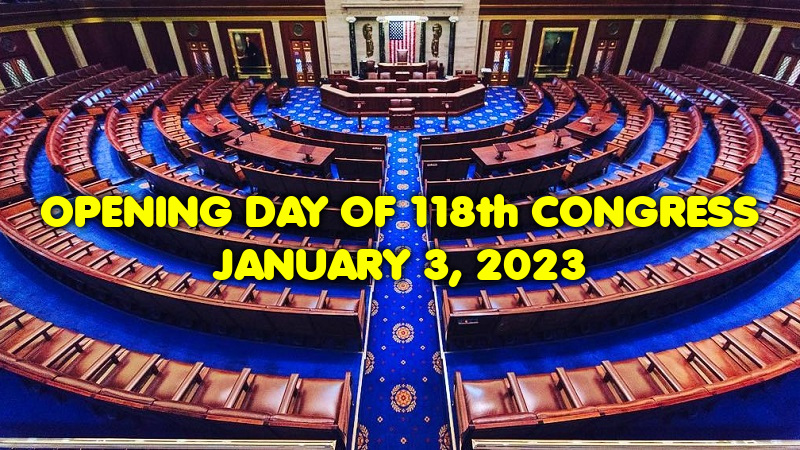
This is Day Four of the election of the Speaker of the US House of Representatives. It will start with the 12th Round of Voting at around noon. If it goes into multiple sessions for the day, the additional part(s) will be added below in chronological order.
Previous days: [DAY ONE] [DAY TWO] [DAY THREE]
118th Congress - House Speaker Election Continues (Day 4) | C-SPAN
118th Congress - House Speaker Election Continues (Day 4 - Evening) | C-SPAN
This is Day Three of the election of the Speaker of the US House of Representatives. It will start with the 7th Round of Voting. If it goes into multiple sessions for the day, the additional part(s) will be added below in chronological order.
The opening day of the 118th Congress failed to produce a Speaker of the House after three rounds of voting after 20 Republicans refused to vote for Representative Kevin McCarthy (50th Congressional District of California). Learn more about the First Day of Voting [LINK].
Order of Business
Today at noon the US House of Representatives will continue voting to elect a new Speaker of the House. This is the 15th time over the course of 118 Congresses this has been necessary. The outcome of this election is usually not in doubt, but for the first time in a hundred years, more than one round of voting has been necessary. In 1923, it took 9 rounds of voting and in 1856, it took 133 rounds of voting over a two-month period. Learn more about the times it took multiple rounds of voting to elect a Speaker on the US House website. [LINK]
To win a vote to be Speaker requires a majority of votes. If all 435 members participate in the vote, then 218 votes is needed. Members that vote present will not be counted to determine a majority.
You can watch the voting via the video player below.
118th Congress - House Speaker Election Continues (Day Two Part One) | C-SPAN
118th Congress - House Speaker Election Continues (Day Two Part Two) | C-SPAN
Here are some links about what happened yesterday:
• 118th Congress - House Speaker Election Continues (LIVE VIDEO AT NOON) [Macon Media]
• Kevin McCarthy Falls Short of House Speaker Win in Three Rounds of Voting [WSJ (video and audio)] [WSJ]
• House GOP back in familiar pattern — fury at the Freedom Caucus [Politico]
• House speaker battle: Profanities fly as Republican factions get heated over McCarthy speakership bid [Fox News]
• House Adjourns Without A Speaker After Kevin McCarthy Fails On 3 Straight Votes [Huffington Post]
The chamber will meet in a pro forma session at 10 a.m. this morning. At around 11:50 a.m., the House will meet to sine die the 117th Congress and will convene the 118th Congress at noon on the House floor. If there is a speaker elected, House members will take ceremonial swearing-in photos with the speaker at 3 p.m.
Order of Business
Today at noon the US House of Representatives will begin its first session today and one of the first items of business is to elect a new Speaker of the House. The outcome of this election is usually not in doubt, but this time, there are enough members of the Freedom Caucus in the Republican party who have publicly stated they will not vote for the Majority Leader to be Speaker. If a Speaker is not elected on the first ballot, it will be the first time in a hundred years it has happened.
To win a vote to be Speaker requires a majority of votes. If all 435 members participate in the vote, then 218 votes is needed.
The Select Committee to Investigate the January 6th Attack on the United States Capitol will be holding its final public hearing today at 1pm. Macon Media has embedded a video player that will stream the C-SPAN version live. There is also a link to the committee website so you can peruse media and documents at your own pace regarding their work. Links to a couple of articles about the hearings have been included and then there are videos of all the public hearings posted below that for those wanting to see and hear the unfiltered public hearing for yourselves. This is as neutral as this outlet can be, to treat our readers as intelligent adults who can, after seeing and hearing all the evidence, make up their own minds about the material presented to them.
"The advancement and diffusion of knowledge is the only guardian of true liberty."
--James Madison, in a letter to George Thomson, 30 June 1825, Letters and other Writings of James Madison (1865) vol. 3
• The Select Committee to Investigate the January 6th Attack on the United States Capitol [US House of Representatives]
LIVE: January 6th Committee Final Public Meeting | C-SPAN
President Biden ordered the United States Flag to be flown at half-staff effective immediately and returned to full staff at midnight tonight, Saturday, March 19, 2022 in honor of the passing of Representative Don Young. Young was the longest-serving member of Congress, representing Alaska as a Republican in the United States House of Representatives from 1973 until his death on Friday, March 18.
STATEMENT BY PRESIDENT JOE BIDEN ON THE PASSING OF CONGRESSMAN DON YOUNG
I knew Don Young for a long time. He always stayed true to who he was and the people of Alaska he represented. Tough. Loyal. A consensus builder.
He was larger than life, but always focused on Alaskans’ everyday lives. As Dean of the House, he was the longest-serving House Republican in history—but cherished photos of his legislation being signed into law by ten presidents, Republicans and Democrats.
There is no doubt that few legislators have left a greater mark on their state. Don’s legacy lives on in the infrastructure projects he delighted in steering across Alaska. In the opportunities he advanced for his constituents. In the enhanced protections for Native tribes he championed. His legacy will continue in the America he loved.
Jill and I send our prayers to his wife Anne, to his daughters and the entire Young family, and to the people of Alaska.
The Joint Subcommittee (US House and US Senate) on Consumer Protection and Commerce will be having a public hearing today regarding "Social Media's Role in Promoting Extremism and Misinformation." Since this is a topic of supreme importance to public discourse and free speech, Macon Media has embedded a live video player of the hearing that will begin at noon today. Macon Media has also included several documents released by the subcommittee in order to assist members of the public to have more complete information on what is happening. Since not everyone can watch it live, the material will be archived here for members of the public to refer to later.
DAY SPONSOR
Macon Media is being underwritten today by Franklin Health and Fitness, home of #ResultsForEveryone. Try FHF with a FREE 3-Day Guest Pass! To claim your pass, and to learn more about Franklin Health and Fitness, visit franklinhealthandfitness.com.
HEARING NOTICE
Subcommittee on Consumer Protection and Commerce
SUBJECT: Joint Subcommittee Hearing on “Disinformation Nation: Social Media's Role
in Promoting Extremism and Misinformation”
The Subcommittee on Communications and Technology and the Subcommittee on Consumer
Protection and Commerce of the Committee on Energy and Commerce will hold a virtual, fully remote
joint hearing on Thursday, March 25, 2021, at 12 p.m. (EDT). The hearing is entitled, “Disinformation
Nation: Social Media's Role in Promoting Extremism and Misinformation.” Witnesses will be by
invitation only.
Livestream of Hearing
MEMORANDUM
March 22, 2021
To: Subcommittee on Communications and Technology and Subcommittee on
Consumer Protection and Commerce Members and Staff
Fr: Committee on Energy and Commerce Staff
Re: Hearing on “Disinformation Nation: Social Media’s Role in Promoting Extremism
and Disinformation”
On Thursday, March 25, 2021, at 12 p.m. via Cisco Webex online video
conferencing, the Subcommittee on Communications and Technology and the Subcommittee on
Consumer Protection and Commerce will hold a joint hearing entitled, “Disinformation Nation:
Social Media’s Role in Promoting Extremism and Disinformation.”
I. THE ROLE OF SOCIAL MEDIA PLATFORMS IN PROMOTING MISINFORMATION AND EXTREMIST CONTENT
A. Background
Facebook, Google, and Twitter operate some of the largest and most influential online
social media platforms reaching billions of users across the globe. As a result, they are among
the largest platforms for the dissemination of misinformation and extremist content.
These platforms maximize their reach—and advertising dollars—by using algorithms or other
technologies to promote content and make content recommendations that increase user
engagement.2
Users of these platforms often engage more with questionable or provocative
content, thus the algorithms often elevate or amplify disinformation and extremist content. 3
Facebook, Google, and Twitter also have access to vast swaths of user data that allows them to
microtarget content to users who would be more susceptible to disinformation and extremist
content.4
B. The Spread and Consequences of Misinformation and Extremist Content
Facebook, Google, and Twitter have long come under fire for their role in the
dissemination and amplification of misinformation and extremist content. For instance, since the
beginning of the coronavirus disease of 2019 (COVID-19) pandemic, all three platforms have
spread substantial amounts of misinformation about COVID-19.5
At the outset of the COVID-19 pandemic, disinformation regarding the severity of the virus and the effectiveness of alleged
cures for COVID-19 was widespread.6
More recently, COVID-19 disinformation has misrepresented the safety and efficacy of COVID-19 vaccines.7
Facebook, Google, and Twitter have also been distributors for years of election
disinformation that appeared to be intended either to improperly influence or undermine the
outcomes of free and fair elections.8
During the November 2016 election, social media platforms were used by foreign governments to disseminate information to manipulate public opinion.9
This trend continued during and after the November 2020 election, often fomented by domestic
actors, with rampant disinformation about voter fraud, defective voting machines, and premature
declarations of victory.10
Additionally, Facebook executives were repeatedly warned that extremist content was
thriving on their platform, and that Facebook’s own algorithms and recommendation tools were
responsible for the appeal of extremist groups and divisive content.11
Similarly, since 2015, videos from extremists have proliferated on YouTube; and YouTube’s algorithm often guides
users from more innocuous or alternative content to more fringe channels and videos.12
Twitter has been criticized for being slow to stop white nationalists from organizing, fundraising,
recruiting and spreading propaganda on Twitter.13
The consequences of disinformation and extremist content on these platforms are
apparent. Many experts agree that disinformation about COVID-19 has greatly intensified an
already deadly public health crisis.14
Experts also acknowledge that misinformation about the 2020 presidential election and extremist content has further divided the nation and provoked an insurrection.15
C. Facebook, Google, and Twitter’s Response to Misinformation and Extremist Content
All three platforms have a policy against demonstrably false COVID-19 information or
COVID-19 misinformation that can cause harm.16
Facebook and Twitter also demote or label certain misinformation, such as misinformation about social and political issues.17
In September 2020, Facebook adopted new policies related to the November election
such as banning political advertisements and labeling allegations of election fraud.18 After the
January 6, 2021 U.S. Capitol riots, Facebook began removing disinformation that could lead to
further violence.19 Last month, Facebook updated its policies on COVID-19 misinformation
from initially removing false information “that could lead to imminent physical harm” to
banning misinformation about COVID-19 and threatening to ban users, groups, or pages that
repeatedly spread misinformation.20
In October 2020, YouTube announced it would remove videos containing misinformation
about COVID-19 vaccines, expanding on its prohibition of COVID-19 misinformation that contradicted local health authorities or the World Health Organization.21 In December 2020, YouTube announced it would begin removing content that falsely alleged widespread election
fraud, but that policy would not apply to videos uploaded prior to the announcement.22
After the
U.S. Capitol riots, YouTube announced that it would suspend accounts that promoted videos of
false allegations about the 2020 presidential election.23
In advance of the November 2020 election, Twitter expanded the use of its warning labels to limit the spread of election misinformation.24
In December 2020, Twitter announced it would label misinformation about COVID-19 vaccines.
These platforms often ramp up their efforts against misinformation and extremist content in response to social and political pressure.25
Despite these efforts, recent studies have found that COVID-19 misinformation and extremist content continue to thrive on these platforms.26
II. WITNESSES
The following witnesses have been invited to testify:
Mark Zuckerberg
Chairman and Chief Executive Officer
Facebook
Sundar Pichai
Chief Executive Officer
Google
Jack Dorsey
Chief Executive Officer
Twitter
References
1 See NYU Stern Center For Business And Human Rights, Tackling Domestic
Disinformation: What The Social Media Companies Need To Do (Apr. 3, 2019).
2 See id.
3 See id.
4 See How Data Privacy Laws Can Fight Fake News, Just Security (Aug. 15, 2019)
Misinformation, CNBC (Jan. 25, 2021); Surge of Virus Misinformation Stumps Facebook and
Twitter, New York Times (Mar. 8, 2020).
6 Id.
7 ‘We Are Talking About People’s Lives’: Dire Warnings of Public Health Crisis as COVID19 Misinformation Rages, USA Today (Dec. 9, 2020); Misinformation Messengers Pivot from
Election Fraud to Peddling Vaccine Conspiracy Theories, New York Times (Dec. 16, 2020);
Normalization of Vaccine Misinformation on Social Media Amid COVID ‘a Huge problem,’
ABC News (Dec. 10, 2020); COVID Vaccine: Disappearing Needles and Other Rumors
Debunked, BBC News (Dec. 20, 2020).
8 Election 2020: Facebook, Twitter And YouTube Wrestle With Misinformation, CNET (Nov.
11, 2020); NYU Stern Center for Business and Human Rights, Disinformation and the 2020
Election: How the Social Media Industry Should Prepare (Sept. 1, 2019).
9 The Propaganda Tools Used by Russians to Influence the 2016 Election, New York Times
(Feb. 16, 2018).
10 'Not A Whole Lot Of Innovation': 2020 Election Misinformation Was Quite Predictable,
Experts Say, USA Today (Nov. 17, 2021); Did Social Media Actually Counter Election
Misinformation?, Associated Press, (Nov. 4, 2020).
11 Facebook Executives Shut Down Efforts To Make The Site Less Divisive, Wall Street
Journal (May 26, 2020); Facebook Knew Calls For Violence Plagued ‘Groups,’ Now Plans
Overhaul, Wall Street Journal (Jan. 31, 2020).
12 Cornell University, Auditing Radicalization Pathways On YouTube (Dec. 4, 2019).
13 Twitter Suspends More Than 50 White Nationalist Accounts, NBC News (July 10, 2020);
Twitter Still Has A White Nationalist Problem, HuffPost (May 30, 2019).
14 The Union of Concerned Scientists, We Just Witnessed the Dangers of the Autocratic
Disinformation Playbook (Jan. 8, 2021) (blog.ucsusa.org/genna-reed/dangers-of-autocraticdisinformation-playbook).
15 Id.
16 On Social Media, Only Some Lies Are Against The Rules, Consumer Reports (Aug. 13,
2020).
17 Id.
18 Facebook, New Steps to Protect the US Elections (Sept. 3, 2020) (press release).
19 Facebook, Our Preparations Ahead of Inauguration Day (Jan. 11, 2021) (press release).
20 Facebook, An Update on Our Work to Keep People Informed and Limit Misinformation
About COVID-19 (Feb. 8, 2021) (press release).
21 YouTube Bans Covid-19 Vaccine Misinformation, Forbes (Oct. 14, 2020); On Social
Media, Only Some Lies Are Against the Rules, Consumer Reports (Aug. 13, 2020).
22 YouTube Official Blog, Supporting The 2020 U.S. Election (Dec. 9, 2020)
(blog.youtube/news-and-events/supporting-the-2020-us-election/).
23 YouTube Will Start Penalizing Channels That Post Election Misinformation, TechCrunch
(Jan. 7, 2021).
24 Twitter Blog, Additional Steps We’re Taking Ahead of the 2020 US Election (Oct. 9, 2020)
(blog.twitter.com/en_us/topics/company/2020/2020-election-changes.html).
25 See The Technology 202: Democrats Ratchet Up Pressure on Silicon Valley to Tackle
Vaccine Misinformation, Washington Post (Jan. 26, 2021); Social Media Platforms Face A
Reckoning Over Hate Speech, Associated Press (June 29, 2020); EU Piles Pressure On Social
Media Over Fake News, Reuters (Apr. 26, 2018).
26 Cybersecurity for Democracy, Far-Right News Sources On Facebook More Engaging
(Mar. 3, 2021); Pew Research Center, How Americans Navigated the News in 2020: A
Tumultuous Year in Review (Feb. 22, 2021); Anti-Defamation League, Exposure to Alternative
& Extremist Content on YouTube (Feb.12, 2021); The German Marshall Fund, Engagement With
Deceptive Outlets Higher on Facebook Today than Run-Up to 2016 Election (Oct. 12, 2020).
Witnesses
Mark Zuckerberg
Chairman and Chief Executive Officer
Facebook
Hearing Before the United States House of Representatives
Committee on Energy and Commerce
Subcommittees on Consumer Protection & Commerce and Communications & Technology
March 25, 2021
Testimony of Mark Zuckerberg
Facebook, Inc.
I. Introduction
Chairs Pallone, Schakowsky, and Doyle, Ranking Members McMorris Rodgers, Latta, and
Bilirakis, and members of the Committee,
I want to start by extending my deepest condolences to the families of the Capitol police officers
who lost their lives in the wake of January 6 and my appreciation to the many officers who put
themselves at risk to protect you. Their bravery stands as an example to us all. My heart also goes
out to those of you who lived through the awful events of that day. The Capitol attack was a horrific
assault on our values and our democracy, and Facebook is committed to assisting law enforcement
in bringing the insurrectionists to justice.
I look forward to discussing the role that misinformation and disinformation play in our country’s
information ecosystem and the work Facebook is doing to reduce harmful content on our platform.
Facebook’s mission is to give people the power to build community and bring the world closer
together. Our services enable more than three billion people around the world to stay connected
with friends and family, discover what’s going on in the world, and entertain and express
themselves. We build products people use to share ideas, have fun, offer support, connect with
neighbors, celebrate milestones, promote small businesses and non-profits, and discuss important
topics, including family, careers, health, politics, and social issues.
It’s important to note that the vast majority of what people see on Facebook is neither political nor
hateful. Political posts make up only about 6 percent of what people in the United States see in
their News Feed, and the prevalence of hateful content people see on our service is less than 0.08
percent. While we work hard to prevent abuse of our platform, conversations online will always
reflect the conversations taking place in living rooms, on television, and in text messages and
phone calls across the country. Our society is deeply divided, and we see that on our services too.
We are committed to keeping people safe on our services and to protecting free expression, and
we work hard to set and enforce policies that meet those goals. We will continue to invest
extraordinary resources into content moderation, enforcement, and transparency.
II. Our Efforts to Combat Misinformation
People want to see accurate information on Facebook, and so do we. That’s why we have made
fighting misinformation and providing people with authoritative information a priority for the
company. We have recalibrated our products and built global partnerships to combat
misinformation on a massive scale.
We created an industry-leading fact-checking program. We work with 80 independent third-party
fact-checkers certified through the non-partisan International Fact-Checking Network to curb
misinformation on Facebook and Instagram. If content is rated false by one of these third-party
fact-checkers, we put a warning label on it. And based on one fact-check, we’re able to kick off
similarity detection methods that identify duplicates of debunked stories. When content is rated
false, we significantly reduce its distribution; on average, this cuts future views by more than 80
percent. If people do try to share the content, we notify them of additional reporting, and we also
notify people if content they have shared in the past is later rated false by a fact-checker. Group
admins are notified each time a piece of content rated false by fact-checkers is posted in their
Group, and they can see an overview of this in the Group Quality tool. We use information from
fact-checkers to improve our technology so we can identify misinformation faster in the future.
We also work to reduce the incentives for people to share misinformation to begin with. Since a
lot of the misinformation that spreads online is financially motivated spam, we focus on disrupting
the business model behind it. We take action against Pages that repeatedly share or publish content
rated false, including reducing their distribution and, if necessary, removing their ability to
monetize. And we’ve enhanced our recidivism policies to make it harder to evade our enforcement.
We’ve also taken steps to reduce clickbait and updated our products so people see fewer posts and
ads in News Feed that link to low-quality websites.
As well as taking steps to fight misinformation, we also use our platform to proactively connect
people to authoritative information. We have directed over 2 billion people to our Covid-19
Information Center, and over 140 million people to our Voting Information Center. This is an
important component of our work to build a healthier information ecosystem.
As one of the leading platforms where people share information and express themselves,
misinformation is an ongoing challenge for us. With millions of Americans using our services
every day, there will always be things we miss. However, I believe we do more to address
misinformation than any other company, and I am proud of the teams and systems we have built.
Below is an overview of this work in two important contexts: Covid-19 and the 2020 presidential
election.
A. Covid-19 and Vaccine Misinformation
Since Covid-19 was declared a global public health emergency, Facebook has been working to
connect people to authoritative information from health experts and keep harmful misinformation
about Covid-19 from spreading on our apps. As part of our efforts, we have focused on:
• Promoting reliable information by launching a Covid-19 Information Center which we showed
at the top of the Facebook News Feed and on Instagram, and that we direct people to when
they search for information about Covid-19. We have connected over 2 billion people to
authoritative information through this resource.
• Combating Covid-19 misinformation by removing over 12 million pieces of false content,
including from foreign leaders; barring entities that have repeatedly shared false information;
removing exploitative ads spreading panic about the virus or mistruths about cures for financial
gain; and promoting authoritative and science-based search results.
• Providing aggregated data on symptoms and travel patterns to public health officials,
researchers, and nonprofits to help them calibrate the public health response.
• Supporting newsgathering by investing $100 million to assist local news and journalists and
funding a $1 million grant program to support fact-checkers covering the virus.
In April 2020, we started showing messages in News Feed to people who liked, commented on, or
reacted to posts with Covid-19 misinformation that we later removed for violating our policy.
We’ve redesigned these notifications to make them more personalized and to more clearly connect
people with authoritative information. Now people will see a thumbnail of the post and more
information about where they saw it, how they engaged with it, why it was false, and why we
removed it. People will then be able to see more facts in our Covid-19 Information Center and take
other actions such as unfollowing the Page or Groups that shared this content.
We are also continuing to improve search results on our platforms. When people search for vaccine
or Covid-19 related content on Facebook, we promote relevant, authoritative results and provide
third-party resources to connect people to expert information about vaccines.
In the Appendix are some of the alerts people see on Facebook that are designed to keep them
informed and limit misinformation about Covid-19.
1. Covid-19 Vaccines
In addition to our work to combat misinformation about Covid-19 generally, we’re running the
largest worldwide campaign to promote authoritative information about Covid-19 vaccines
specifically by:
• Providing $120 million in ad credits to help health ministries, non-profits, and UN agencies
reach billions of people around the world with Covid-19 vaccine and preventive health
information.
• Providing training and marketing support to help governments and health organizations
move quickly and reach the right people with the latest vaccine information.
• Providing data to inform effective vaccine delivery and educational efforts to build trust in
Covid-19 vaccines.
• Helping people find where and when they can get vaccinated, similarly to how we helped
people find information about voting during elections.
We’re also focused on removing misinformation on Facebook and Instagram about Covid-19 and
vaccines. In December, we began removing false claims about Covid-19 vaccines that could lead
to imminent harm, including false claims about the safety, efficacy, ingredients, or side effects of
the vaccines. Last month, we expanded the list of false claims we will remove to include additional
debunked claims about Covid-19 and vaccines following consultations with leading health
organizations, including the World Health Organization. We already reject these claims in
advertisements and prohibit any ads that discourage vaccines.
Groups, Pages, and accounts on Facebook and Instagram that repeatedly share these debunked
claims may be removed altogether. In some instances, we are also requiring Group admins to
temporarily approve all posts from other admins or members who have violated our Covid-19
policies. Claims about Covid-19 or vaccines that do not violate these policies may remain eligible
for review by our independent third-party fact-checkers. If a claim is then identified as false, it will
be labeled and will be demoted in News Feed.
B. Election Misinformation and Support for the Democratic Process
Facebook stands for giving people a voice, and it was important to us that everyone could make
their voice heard during the election. While we were only a small piece of the broader election
ecosystem, we announced a series of policies in advance to help protect the integrity of the election
and support our democratic process.
As part of this effort, we worked hard to combat misinformation and voter suppression. We
partnered with election officials to remove false claims about polling conditions and displayed
warnings on more than 150 million pieces of content after review by our independent third-party
fact-checkers. We put in place strong voter suppression policies prohibiting explicit or implicit
misrepresentations about how or when to vote as well as attempts to use threats related to Covid19 to scare people into not voting. We also removed calls for people to engage in poll watching that used militarized language or suggested that the goal was to intimidate, exert control, or display
power over election officials or voters, and we stopped recommending civic Groups.
As the ballots were counted, we deployed additional measures that we announced in advance of
the election to help people stay informed:
• We partnered with Reuters and the National Election Pool to provide reliable information
about election results in the Voting Information Center and notified people proactively as
results became available. We added labels to posts about voting by candidates from both
parties and directed people to reliable information about results.
• We attached an informational label to content that sought to delegitimize the outcome of
the election or discuss the legitimacy of voting methods.
• We strengthened our enforcement against militias, conspiracy networks, and other groups
to help prevent them from using our platform to organize violence or civil unrest in the
period after the election.
Based on what we learned in 2016 about the risk of coordinated online efforts by foreign
governments and individuals to interfere in our elections, we invested heavily in our security
systems and monitored closely for any threats to the integrity of elections from at home or abroad.
We invested in combatting influence operations on our platforms, and since 2017, we have found
and removed over 100 networks of accounts for engaging in coordinated inauthentic behavior. We
also blocked ads from state-controlled media outlets in the US to provide an extra layer of
protection against various types of foreign influence in the public debate ahead of the election.
Finally, we proactively supported civic engagement on our platform. We ran the largest voting
information campaign in American history. Based on conversion rates we calculated from a few
states we partnered with, we estimate that we helped 4.5 million people register to vote across
Facebook, Instagram, and Messenger—and helped about 100,000 people sign up to be poll
workers. We launched a Voting Information Center to connect people with reliable information on
deadlines for registering and voting and details about how to vote by mail or vote early in person,
and we displayed links to the Voting Information Center when people posted about voting on
Facebook. 140 million people visited the Voting Information Center on Facebook and Instagram
since it launched. We are encouraged that more Americans voted in 2020 than ever before and that
our platform helped people take part in the democratic process.
III. Our Efforts to Address Polarization and Divisive Content
Facebook’s mission is to bring people together, and we stand firmly against hate and the incitement
of violence. We have industry-leading policies that prohibit such content on our platforms, and we
invest billions of dollars and work tirelessly to improve and enforce these policies. We are proud
of the work we have undertaken to address harmful content on Facebook, from our robust content
review and enforcement program to our industry-leading Community Standards Enforcement
Report, which includes hard data that we hope can inform public discourse and policymaking about
these issues.
A. Efforts to Keep Hate and Violence Off Our Platform
We have taken major steps to keep our community safe. While our enforcement efforts are not
perfect and there is always more work to be done, we have built industry-leading policies, teams
and systems to keep hate and violence off our platform.
Our Dangerous Organizations and Individuals policy prohibits content calling for or advocating
violence, and we ban organizations and individuals that proclaim a violent mission. We remove
language that incites or facilitates violence, and we ban Groups that proclaim a hateful and violent
mission from having a presence on our apps. We also remove content that represents, praises, or
supports them. We believe this policy has long been the broadest and most aggressive in the
industry.
In August 2020, we expanded this policy further to address militarized social movements and
violence-inducing conspiracy networks such as QAnon. To date, we have banned over 250 white
supremacist groups and 890 militarized social movements, and we have been enforcing our rules
that prohibit QAnon and militia groups from organizing on our platform. We have also continued
to enforce our ban on hate groups, including the Proud Boys and many others.
Moving quickly to find and remove dangerous organizations such as terrorist and hate groups takes
significant investment in both people and technology. That’s why we have tripled the size of our
teams working in safety and security since 2016 to over 35,000 people. Our team of experts
includes 300 professionals who work exclusively or primarily on preventing terrorist and violent content from appearing on our platform and quickly identifying and removing it if it does. These
professionals possess expertise ranging from law enforcement and national security to
counterterrorism intelligence and radicalization.
Four years ago, we developed automated techniques to detect content related to terrorist
organizations such as ISIS, al Qaeda, and their affiliates. We’ve since expanded these techniques
to detect and remove content related to other terrorist and hate groups. We are now able to detect
and review text embedded in images and videos, and we’ve built media-matching technology to
find content that’s identical or near-identical to photos, videos, text, and audio that we’ve already
removed. Our work on hate groups focused initially on those that posed the greatest threat of
violence at the time; we’ve now expanded this to detect more groups tied to different hate-based
and violent extremist ideologies. In addition to building new tools, we’ve also adapted strategies
from our counterterrorism work, such as leveraging off-platform signals to identify dangerous
content on Facebook and implementing procedures to audit the accuracy of our AI’s decisions over
time.
B. Actions to Address Content That Violates Community Standards in Groups
People turn to Facebook Groups to connect with others who share their interests and to build
community. This is particularly important in the midst of the Covid-19 crisis, which makes
connecting both more important and more challenging than ever. However, we recognize the
importance of keeping violent and hateful content out of Groups and have taken significant steps
towards that goal.
We remove Groups that represent QAnon, even if they contain no violent content. And we do not
allow militarized social movements—such as militias or groups that support and organize violent
acts amid protests—to have a presence on our platform. In addition, last year we temporarily
stopped recommending US civic or political Groups, and earlier this year we announced that policy
would be kept in place and expanded globally. We’ve instituted a recommendation waiting period
for new Groups so that our systems can monitor the quality of the content in the Group before
determining whether the Group should be recommended to people. And we limit the number of
Group invites a person can send in a single day, which can help reduce the spread of harmful
content from violating Groups.
We also take action to prevent people who repeatedly violate our Community Standards from
creating new Groups. Our recidivism policy stops the administrators of a previously removed
Group from creating another Group similar to the one removed, and an administrator or moderator
who has had Groups taken down for policy violations cannot create any new Groups for a period
of time. Posts from members who have violated any Community Standards in a Group must be
approved by an administrator or moderator for 30 days following the violation. If administrators
or moderators repeatedly approve posts that violate our Community Standards, we’ll remove the
Group.
Our enforcement effort in Groups demonstrates our commitment to keeping content that violates
these policies off the platform. In September, we shared that over the previous year we removed
about 1.5 million pieces of content in Groups for violating our policies on organized hate, 91
percent of which we found proactively. We also removed about 12 million pieces of content in Groups for violating our policies on hate speech, 87 percent of which we found proactively. When
it comes to Groups themselves, we will remove an entire Group if it repeatedly breaks our rules or
if it was set up with the intent to violate our standards. We took down more than one million
Groups for violating our policies in that same time period.
IV. Updating the Rules of the Internet
In my testimony above, I laid out many of the steps we have taken to balance important values
including safety and free expression in democratic societies. We invest significant time and
resources in thinking through these issues, but we also support updated Internet regulation to set
the rules of the road. One area that I hope Congress will take on is thoughtful reform of Section
230 of the Communications Decency Act.
Over the past quarter-century, Section 230 has created the conditions for the Internet to thrive, for
platforms to empower billions of people to express themselves online, and for the United States to
become a global leader in innovation. The principles of Section 230 are as relevant today as they
were in 1996, but the Internet has changed dramatically. I believe that Section 230 would benefit
from thoughtful changes to make it work better for people, but identifying a way forward is
challenging given the chorus of people arguing—sometimes for contradictory reasons—that the
law is doing more harm than good.
Although they may have very different reasons for wanting reform, people of all political
persuasions want to know that companies are taking responsibility for combatting unlawful content
and activity on their platforms. And they want to know that when platforms remove harmful
content, they are doing so fairly and transparently.
We believe Congress should consider making platforms’ intermediary liability protection for
certain types of unlawful content conditional on companies’ ability to meet best practices to
combat the spread of this content. Instead of being granted immunity, platforms should be required
to demonstrate that they have systems in place for identifying unlawful content and removing it.
Platforms should not be held liable if a particular piece of content evades its detection—that would
be impractical for platforms with billions of posts per day—but they should be required to have
adequate systems in place to address unlawful content.
Definitions of an adequate system could be proportionate to platform size and set by a third-party.
That body should work to ensure that the practices are fair and clear for companies to understand
and implement, and that best practices don’t include unrelated issues like encryption or privacy
changes that deserve a full debate in their own right.
In addition to concerns about unlawful content, Congress should act to bring more transparency,
accountability, and oversight to the processes by which companies make and enforce their rules
about content that is harmful but legal. While this approach would not provide a clear answer to
where to draw the line on difficult questions of harmful content, it would improve trust in and
accountability of the systems and address concerns about the opacity of process and decisionmaking within companies.
Ultimately it is up to Congress and the new Administration to chart the path forward. Facebook
stands ready to be a productive partner in the discussion about Section 230 reform—as well in
important and urgent conversations about updating the rules for privacy, elections, and data
portability.
V. Conclusion
Every day we see people using our services to come together and do good—forming supportive
communities, raising money for good causes, drawing attention to important issues, creating
opportunities for themselves, or simply being there for one another in times of need.
Facebook is successful because people around the world have a deep desire to connect and share,
not to stand apart and fight. This reaffirms our belief that connectivity and togetherness are
ultimately more powerful ideals than division and discord—and that technology can be part of the
solution to the deep-seated challenges in our society. We will continue working to ensure our
products and policies support this ambition.
APPENDIX: Facebook Efforts to Combat Covid-19 Misinformation
Sundar Pichai
Chief Executive Officer
Google
Written Testimony of Sundar Pichai
Chief Executive Officer, Alphabet
United States House Committee on Energy and Commerce “Disinformation Nation: Social Media's Role In Promoting Extremism And
Misinformation”
March 25, 2021
Chairman Doyle, Ranking Member Latta, Chairwoman Schakowsky, Ranking
Member Bilirakis, Full Committee Chair Pallone and Full Committee Ranking
Member McMorris Rodgers, thank you for the opportunity to appear before you
today.
This month, the worldwide web turned 32. Over the past three decades, we’ve seen
the web inspire the best in society, by expanding knowledge, powering businesses,
and providing opportunities for expression, discovery, and connection—no matter
who you are, or where you live.
I joined Google in 2004 because I believed the internet was the best way to bring the
benefits of technology to more people, and I believe that still today.
I am proud that Americans can turn to Google for help in moments that matter,
whether they’re looking for COVID vaccine information on Search and Maps, working
and learning from home using Google Workspace or Google Classroom, learning new
skills on YouTube, or using our digital tools to grow their businesses. In 2020, our
products helped 2 million US businesses, publishers, and others generate $426 billion in economic activity. And we helped billions of people find comfort and connection in
an otherwise awful year.
Beyond our products, we were proud to announce last week our plans to invest over
$7 billion in data centers and offices across 19 states, and create at least 10,000
full-time Google jobs in the U.S. That’s in addition to the 84,000 employees we
currently employ across the country. And according to an Oxford Economics report,
YouTube's creative ecosystem supported the equivalent of 345,000 full time jobs in
2019.
We are energized by the opportunity to help people at scale, and we are humbled by
the responsibility that comes with it. We have thousands of people focused on
everything from cyber attacks, to data privacy, to today’s topic: misinformation.
Our mission at Google is to organize the world’s information and make it universally
accessible and useful. Core to that mission is providing trustworthy content and
opportunities for free expression across our platforms, while limiting the reach of
harmful misinformation.
It’s a large, dynamic challenge without easy answers. More than 500 hours of video
are uploaded to YouTube every minute, and approximately 15% of the searches on
Google each day are new to us. Eighteen months ago most people hadn’t heard of
COVID-19; sadly, coronavirus was the top trending search of 2020.
Responding to the events of January 6th
Staying ahead of these challenges and keeping users safe and secure on our
platforms is a top priority. We saw how high those stakes can be on January 6, 2021,
when a mob stormed the U.S. Capitol. This was an unprecedented and tragic event,
and Google strongly condemns these violent attacks on our democracy, and mourns
the lives lost.
In response, our teams worked to raise up authoritative news sources across our
products. Teams at YouTube quickly took down any live streams or videos that
violated our incitement to violence policies, and on January 7th, we began issuing
strikes to those in violation of our presidential election integrity policy. In the Play
Store, we removed apps for violating our policies on inciting violence. We also
prohibited advertisers from running ads that referenced the 2020 election or topics
related to the Capitol riots in the scope of our Sensitive Events policy.
Doing our part to contribute to the integrity of the US 2020 election
We were able to act quickly because of the investments we made to prepare for the
2020 elections. Last year, teams across Google and YouTube worked around the
clock to contribute to election preparedness, by helping voters find authoritative
information about the election; by working with campaigns to equip them with
best-in-class security features and helping them connect with voters; and by
protecting our platforms from abuse.
Helping voters find authoritative information on our services
This U.S. election cycle saw all-time highs in searches on Google for civics-related
topics. Anticipating that need, we worked to launch features that would help people
find the information to participate in the democratic process, including how to
register and how to vote in their states.
Consistent with our approach to prior election cycles, we showed “how to register”
and “how to vote” reminders to all our U.S. users directly on Google Search, Maps and
YouTube. These reminders were seen over 2 billion times across our products. As the
election neared, we helped people find polling and ballot drop off locations: from mid-October through Election Day, we added more than 125,000 voting locations in
Google Maps. Across our products, these features were seen nearly 500 million times.
Finally, starting on Election Day, we worked with the Associated Press to provide
real-time election results for relevant searches on Google. These results had over six
times more views in 2020 than in 2016. Similarly, on YouTube, we launched an election
results information panel that showed on top of search results and under videos with
election-related content. It pointed to our election results page on Google, and over
time, we expanded it to include an additional link pointing to a page on the US
Cybersecurity and Infrastructure Security Agency (CISA) website that debunked
incorrect claims made about the integrity of the elections. Once the safe harbor
deadline for state certification passed, we updated this YouTube Election Results
Information Panel again to point to the National Archives Office of the Federal
Register page of record for the 2020 electoral college vote. Collectively, our election
information panels on YouTube have been shown over 8 billion times.
Working with campaigns
We also helped campaigns and elected officials effectively use Google and YouTube
products to reach voters and enhance their election security. As part of our Civics
Outreach Virtual Training Series, Google held 21 training sessions for over 900
candidates, campaigns, public officials, and nonprofit leaders. Overall, we held 45
group and individual trainings to help more than 2,900 election workers learn to use
Google tools to amplify their message and better connect with voters through events
like digital town halls, debates and virtual campaign rallies.
In addition, as a part of our Election Cybersecurity Initiative with the University of
Southern California’s Annenberg School, nearly 4,000 elected officials, secretaries of
state, campaign staffers, political party representatives, and state election directors in
all 50 states received training on ways to secure their information and protect their campaigns against cyberattacks.
At the start of the 2020 election season, we partnered with Defending Digital
Campaigns (DDC), a nonprofit and nonpartisan organization, to give any eligible
federal campaign access to free Titan Security Keys—the strongest form of
two-factor authentication. This collaboration is a part of our Advanced Protection
Program, which protects high-risk individuals, such as election officials, campaigns,
and journalists, who have access to high visibility and sensitive information. In the lead
up to the 2020 elections, DDC distributed more than 10,000 Titan Security key
bundles to more than 140 U.S. federal campaigns. We recently expanded our support
for DDC to provide eligible campaigns and political parties, committees, and related
organizations, at both the federal and state levels, with knowledge, training and
resources to defend themselves from security threats.
Protecting our platforms from abuse
In the years leading up to the 2020 election, we made numerous enhancements to
protect the integrity of elections around the world and better secure our platforms.
Among them, we introduced strict policies and processes for identity verification for
advertisers who run election-related advertising on our platform; we launched
comprehensive political ad libraries in the U.S. and in other countries around the world;
we developed and implemented policies to prohibit election-related abuse such as
voter suppression and deceptive practices on platforms like YouTube, Google Ads,
Google Maps and Google Play; our Threat Analysis Group (TAG) launched a quarterly
bulletin to provide regular updates on our work to combat coordinated influence
operations across our platforms and flagged phishing attempts against the
presidential campaigns; and we worked closely with government agencies, including
the FBI’s Foreign Influence Task Force, and other companies to share information
around suspected election interference campaigns.
On YouTube, throughout 2020, we identified and removed content that was
misleading voters about where or how to vote, to help ensure viewers saw accurate
information about the upcoming election. After December 8th, which marked the
"safe harbor" deadline for states to certify their election, in accordance with our
Presidential Election Integrity policy we began to remove content uploaded on or after
December 9th that misled people by alleging that widespread fraud or errors changed
the outcome of the 2020 U.S. presidential election. In addition, we continued to
enforce our broader policies – for instance, from October to December 2020, we
removed 13,000 YouTube channels for promoting violence and violent extremism;
89% of videos removed for violating our violent extremism policy were taken down
before they had 10 views.
This work was in addition to improvements in the ranking systems we use to reduce
the spread of harmful misinformation on YouTube: in January 2019, we announced
that we would begin reducing recommendations of borderline content or videos that
could misinform viewers in harmful ways but that do not violate YouTube Community
Guidelines. Since then, we've launched numerous changes to reduce recommendations of borderline content and harmful misinformation, and we continue
to invest in this work: our models review more than 100,000 hours of videos every day
to find and limit the spread of borderline content.
Our work is never done, and we continue to learn and improve from one election cycle
to the next, and continue to evolve our policies. That principle has guided our
approach to new and evolving challenges, including COVID-19 misinformation.
Addressing the challenge of COVID-19 misinformation
This past year we’ve also focused on providing quality information during the
pandemic. Since the outbreak of COVID-19, teams across Google have worked to
provide quality information and resources to help keep people safe, and to provide
public health, scientists and medical professionals with tools to combat the pandemic.
We’ve launched more than 200 new products, features and initiatives—including the
Exposure Notification API to assist contact tracing—and have pledged over $1 billion
to assist our users, customers and partners around the world.
Today, when people search on Google for information for COVID-19 vaccines in the
United States, we present them with a list of authorized vaccines in their location, with
information on each individual vaccine from the FDA or CDC, as relevant. We also
provide them with information about vaccination locations near them in Google
Search and Google Maps, when that information is available. On YouTube, we
launched COVID-19 information panels directing viewers to the CDC’s information
about the virus and, later on, about vaccines. These information panels are featured
on the YouTube homepage, and on videos and in search results about the pandemic.
Since March 2020, they have been viewed over 400 billion times. And we continue to
work with YouTube creators to pair them with health experts who can get the facts to
a wide range of audiences – we promote this content in our “ask the experts” feature.
Another way we’ve been helping is by offering over $350 million in Ad Grants to help
more than 100 government agencies and non-profit organizations around the world
run critical public service announcements (PSAs) about COVID-19. Grantees can use
these funds throughout 2021 for things like vaccine education and outreach
campaigns.
In parallel to our efforts to elevate authoritative information about the pandemic and
vaccines, we have worked across our services to combat harmful misinformation
about these topics. Across our products, we’ve had long-standing policies prohibiting
harmful and misleading medical or health-related content. When COVID-19 hit, our
Trust and Safety team worked to stop a variety of abuses stemming from the
pandemic, including phishing attempts, malware, dangerous conspiracy theories, and
fraud schemes. We took quick action to remove content that promoted inaccurate or
misleading claims about cures, masks, and vaccines; our teams have removed
850,000 videos related to dangerous or misleading COVID-19 medical information,
and in total, we blocked nearly 100 million COVID-related ads throughout 2020. Our
teams have also been planning for new threats and abuse patterns related specifically
to COVID-19 vaccines. For example, in October, we expanded our COVID-19 medical
misinformation policy on YouTube to remove content about vaccines that contradicts
consensus from health authorities, such as the Centers for Disease Control or the
World Health Organization (WHO).
Developing Clear and Transparent Policies
We were able to act quickly and decisively because of the significant investments we
have made over years, not only to make information useful and accessible, but also to
remove and reduce the spread of harmful misinformation. Across all of this work, we
strive to have clear and transparent policies and enforce them without regard to
political party or point of view. We work to raise up authoritative sources, and reduce
the spread of misinformation in recommendations and elsewhere. Teams across the
company work in a variety of roles to help develop and enforce our policies, monitor
our platforms for abuse, and protect users from everything from account hijackings
and disinformation campaigns to misleading content and inauthentic activity. And we
don’t do this work alone; we work closely with experts to stay ahead of emerging
threats.
Supporting innovation in journalism and the development of new business models
At Google, we believe that a vibrant news industry is vital to tackling misinformation
on a societal scale. We invested millions to support COVID-19 related fact checking
initiatives, providing training or resources to nearly 10,000 journalists In addition to
helping journalists tackle misinformation, we have long been committed to supporting
newsrooms and journalists in the United States and abroad. Over the past 20 years,
we have collaborated closely with the news industry and provided billions of dollars to
support the creation of quality journalism in the digital age.
We share a strong interest in supporting a diverse and sustainable ecosystem of
quality news providers. Our products are designed to elevate high quality journalism
and connect consumers to diverse news sites — from global media companies to
smaller digital startups.
We are proud that our services help people all over the world find relevant,
authoritative news about issues that matter to them. Each month, people click
through from Google Search and Google News results to publishers' websites more
than 24 billion times — that’s over 9,000 clicks per second. This free traffic helps new
publishers increase their readership, build trust with readers and earn money through
advertising and subscriptions. We also recently announced a new investment in
Google News Showcase and committed $1 billion over the next three years to pay
publishers to produce editorially curated content experiences and for limited free
user access to paywalled content. In less than one year, we have been able to partner
with over 500 publications across more than a dozen countries, spanning global,
national, regional, metro and local publications.
Our commitment to the future of news extends beyond our products and services.
We launched the Google News Initiative to support journalistic innovation and the
emergence of new business models. Since 2018, we have committed $61 million in
funding to support more than two thousand news partners across the United States
and Canada. As part of this initiative, we have also helped more than 447,200
journalists develop knowledge and skills in digital journalism through in person and
online trainings through the Google News Lab. And when the pandemic hit, we turned
our resources to support local news organizations and fact-checkers — contributing
$10.6 million to over 1,800 local newsrooms across the U.S. and Canada through our
Journalism Emergency Relief Fund and committing $6.5 million to combat Covid-19
misinformation. We look forward to continuing this work with our partners in the news
industry to ensure a thriving and healthy future for journalism.
The role of Section 230 in fighting misinformation
These are just some of the tangible steps we’ve taken to support high quality
journalism and protect our users online, while preserving people’s right to express
themselves freely. Our ability to provide access to a wide range of information and
viewpoints, while also being able to remove harmful content like misinformation, is
made possible because of legal frameworks like Section 230 of the Communications
Decency Act.
Section 230 is foundational to the open web: it allows platforms and websites, big and
small, across the entire internet, to responsibly manage content to keep users safe
and promote access to information and free expression. Without Section 230,
platforms would either over-filter content or not be able to filter content at all. In the
fight against misinformation, Section 230 allows companies to take decisive action on
harmful misinformation and keep up with bad actors who work hard to circumvent
their policies.
Thanks to Section 230, consumers and businesses of all kinds benefit from
unprecedented access to information and a vibrant digital economy. Today, more
people have the opportunity to create content, start a business online, and have a
voice than ever before. At the same time, it is clear that there is so much more work to
be done to address harmful content and behavior, both online and offline.
Regulation has an important role to play in ensuring that we protect what is great
about the open web, while addressing harm and improving accountability. We are,
however, concerned that many recent proposals to change Section 230—including
calls to repeal it altogether—would not serve that objective well. In fact, they would
have unintended consequences—harming both free expression and the ability of
platforms to take responsible action to protect users in the face of constantly
evolving challenges.
We might better achieve our shared objectives by focusing on ensuring transparent,
fair, and effective processes for addressing harmful content and behavior. Solutions
might include developing content policies that are clear and accessible, notifying
people when their content is removed and giving them ways to appeal content
decisions, and sharing how systems designed for addressing harmful content are
working over time. With this in mind, we are committed not only to doing our part on
our services, but also to improving transparency across our industry.
I look forward to sharing more about our approach with you today, and working
together to create a path forward for the web’s next three decades.
Jack Dorsey
Chief Executive Officer
Twitter
WRITTEN TESTIMONY OF TWITTER CEO JACK DORSEY (@JACK)
U.S. HOUSE COMMITTEE ON ENERGY & COMMERCE
MARCH 25, 2021
Twitter’s purpose is to serve the public conversation. While much has changed in the world since
we started fifteen years ago, we believe our mission is more important than ever.
Every day Twitter grapples with complex considerations on how to address extremism and
misinformation. How do we prevent harm, while also safeguarding free expression and the right
of diverse individuals to express a range of views? How do we develop policies that can be built
at scale and adapt rapidly, especially given diverse regulatory models around the world? What
role should our company play in determining these pivotal questions? What information should
we rely on when making decisions? How do we earn the trust of those who use our service?
These are even harder questions in an increasingly polarized world, which has consequently
heightened concerns about information sources. Quite simply, a trust deficit has been building
over the last several years, and it has created uncertainty — here in the United States and
globally. That deficit does not just impact the companies sitting at the table today but exists
across the information ecosystem and, indeed, across many of our institutions.
This Committee has expressed interest in what we are doing to combat “falsehoods about the
COVID-19 vaccine” and “debunked claims of election fraud.” We have COVID-19 and vaccine
misinformation policies, as well as a COVID information hub. Our civic integrity and platform
manipulation policies are available on our Help Center, along with information on our bans on
state-controlled media advertising and political advertising. As a follow-up to our preliminary
post-election update, we are conducting a review of the 2020 U.S. election, the findings of which
we intend to share.
Our efforts to combat misinformation, however, must be linked to earning trust. Without trust,
we know the public will continue to question our enforcement actions. I believe we can earn trust
by focusing on the following: enhancing transparency, ensuring procedural fairness, enabling
algorithmic choice, and strengthening privacy.
Building & Earning Trust
Every day, millions of people around the world Tweet hundreds of millions of Tweets, with one
set of rules that applies to everyone and every Tweet. We strive to implement policies impartially
and at scale. We built our policies primarily around the promotion and protection of three
fundamental human rights — freedom of expression, safety, and privacy.
At times, these rights can conflict with one another. As we develop, implement, and enforce our
policies, we must balance these rights. Additionally, our policies must be adaptable to changes in
behavior and evolving circumstances. This is why we must be transparent, embrace procedural
fairness and choice, and protect privacy.
Transparency
While Twitter has made significant progress with respect to transparency, we know that we can
do more to strengthen our efforts. People who use our service should understand our processes
— how potential violations of our rules are reported and reviewed, how content-related decisions
are made, and what tools are used to enforce these decisions. Publishing answers to questions
like these will continue to make our internal processes both more robust and more accountable to
the people we serve.
Twitter’s open nature means our enforcement actions are plainly visible to the public, even when
we cannot reveal the private details behind individual accounts that have violated our rules. We
use a combination of machine learning and human review to assess potential violations of the
Twitter Rules. We take a behavior-first approach, meaning we look at how accounts behave
before we review the content they are posting. If an account owner breaks our Rules and may be
required to delete a Tweet, we have worked to build better in-app notices to communicate with
both the account that reports a Tweet and the account that posted it with additional information
about our actions. In January, we published our biannual update to the Twitter Transparency
Center, with additional data about actions we have taken to disrupt state-backed information
operations, to enforce our COVID-19 policy, and take action on Tweets that violate our Rules.
In addition to ensuring transparency around our decisions, we are seeking ways to enhance
transparency around how we develop our content moderation policies. In recent months, for
example, there have been increased questions about how we should address policy violations
from world leaders. As a result, we are currently re-examining our approach to world leaders and
are soliciting feedback from the public. Our feedback period is currently open and our survey
will be available in more than a dozen languages to ensure a global perspective is reflected.
Twitter is focused on advancing procedural fairness in our decision-making. We strive to give
people an easy, clear way to appeal decisions we make that they think are not right. Mistakes in
enforcement — made either by a human or an automated system — are inevitable and why we
strive to make appeals easier. We believe that all companies should be required to provide those
who use their service with straightforward processes to appeal decisions that impact them.
Algorithmic Choice
We believe that people should have transparency or meaningful control over the algorithms that
affect them. We recognize that we can do more to provide algorithmic transparency, fair machine
learning, and controls that empower people. The machine learning teams at Twitter are studying
techniques and developing a roadmap to ensure our present and future algorithmic models
uphold a high standard when it comes to transparency and fairness.
We also provide people control over algorithms that affect their core experience on Twitter. We
have invested heavily in building systems that organize content to show individuals relevant
information that improves their experience. With 192 million people last quarter using Twitter
daily in dozens of languages and countless cultural contexts, we rely upon machine learning
algorithms to help us organize content by relevance to provide a better experience for the people
who use our service.
Privacy
We have always believed that privacy is a fundamental human right. We believe that individuals
should understand the personal data that is shared with companies and have the tools to help them control their information. To help people better understand their options, we have created
the Twitter Privacy Center, which acts as a hub for information about our privacy and data
protection work.
We are constantly working to improve the controls people have to manage their personal data
and experience on Twitter. In addition, we continue to support efforts to pass strong federal
privacy legislation to safeguard important privacy rights.
Innovations to Address Misinformation
We also recognize that addressing harms associated with misinformation requires innovative
solutions. Content moderation in isolation is not scalable, and simply removing content fails to
meet the challenges of the modern Internet. This is why we are investing in two experiments —
Birdwatch and Bluesky. Both are aimed at improving our efforts to counter harmful
misinformation.
Birdwatch
In January, we launched the “Birdwatch” pilot, a community-based approach to misinformation.
Birdwatch is expected to broaden the range of voices involved in tackling misinformation, and
streamline the real-time feedback people already add to Tweets. We hope that engaging diverse
communities here will help address current deficits in trust for all. More information on
Birdwatch can be found here. We expect data related to Birdwatch will be publicly available at
Birdwatch Guide, including the algorithm codes that power it.
Bluesky
Twitter is also funding Bluesky, an independent team of open source architects, engineers, and
designers, to develop open and decentralized standards for social media. This team has already
created an initial review of the ecosystem around protocols for social media to aid this effort.
Bluesky will eventually allow Twitter and other companies to contribute to and access open
recommendation algorithms that promote healthy conversation and ultimately provide
individuals greater choice. These standards will support innovation, making it easier for startups
to address issues like abuse and hate speech at a lower cost. Since these standards will be open
and transparent, our hope is that they will contribute to greater trust on the part of the individuals
who use our service. This effort is emergent, complex, and unprecedented, and therefore it will
take time. However, we are excited by its potential and will continue to provide the necessary
exploratory resources to push this project forward.
Conclusion
As we look to the future, I agree with this Committee that technology companies have work to
do to earn trust from those who use our services. For Twitter, that means tackling transparency,
procedural fairness, algorithmic choice, and privacy. I think that this approach will be a growing
trend across all companies and organizations, both big and small. I look forward to your
questions.
CROWDFUNDING OR DAY SPONSORSHIP OPPORTUNITIES
If you receive value from what Macon Media provides to the community, please consider becoming a supporter and contribute at least a dollar a month. Those who support Macon Media with at least a dollar a month receive early access to video of some events and meetings before they are made public on the website. Videos and news involving public safety are not subject to early access.
To submit releases for publication, email me here. This includes Guest Commentaries. If you have a photo that you wish me to use with your press release or article, please send it to me, otherwise I'll use whatever I feel best fits your article.
Letters to the Editor
Send Letters to the Editor to editor@MaconMedia. Limit is one submission every seven days. You may include photos, video or audio. Submissions will be edited for vulgarity or similar reasons. Limit submissions to less than 10,000 words. LOL
For a quicker response, send me a message on Twitter or add me to a circle on Google Plus and send it just to me.
If you have been sending me press releases via my private email address, that will continue to work just fine. The Twitter or Google+ account will get my attention quicker.
NON PROFIT OR CIVIC EVENTS
Macon Media will promote nonprofit or civic events if contacted by an organizer of the event. This includes rallies, protests, community forums, and parades. Messeanger Link http://m.me/MaconMediaNews
If you're of a mind, and can afford it, a dollar a month (or more) from enough people will make a huge difference in improving the quality of coverage of local meetings and events, as well as allowing remote weather stations and weather cams to be deployed throughout the county that you will be able to access online.
Currently, 20 people have pledged $99 a month. This is a tremendous help. Please visit www.patreon.com/MaconMedia for more information on how to contribute.
Businesses can underwrite this coverage by day sponsorships, surplus equipment donations, etc. Inquire at editor@maconmedia.com for more information.
Donations accepted for the purpose of supporting this blog and activities related to improving it's operations and my coverage of local festivals and local government meetings.






 Posts
Posts


