This year's Nobel Prize in Chemistry has been awarded to Carolyn R. Bertozzi, Morten Meldal, and K. Barry Sharpless for the development of click chemistry and bioorthogonal chemistry. More information, including a video of the announcement, is posted below.
Announcement of the 2022 Nobel Prize in Chemistry
A copy of the press release, illustrations, and links to where you can read more about the work that led to the prize, and articles about the work are posted below for your convenience.
PRESS RELEASE (10-05-2022)
NOBEL ASSEMBLY
The Royal Swedish Academy of Sciences has decided to award the Nobel Prize in Chemistry 2022 to
Carolyn R. Bertozzi
Stanford University, CA, USA
Morten Meldal
University of Copenhagen, Denmark
K. Barry Sharpless
Scripps Research, La Jolla, CA, USA
“for the development of click chemistry and bioorthogonal chemistry”
It just says click – and the molecules are coupled together
The Nobel Prize in Chemistry 2022 is about making difficult processes easier. Barry Sharpless and Morten Meldal have laid the foundation for a functional form of chemistry – click chemistry – in which molecular building blocks snap together quickly and efficiently. Carolyn Bertozzi has taken click chemistry to a new dimension and started utilising it in living organisms.
Chemists have long been driven by the desire to build increasingly complicated molecules. In pharmaceutical research, this has often involved artificially recreating natural molecules with medicinal properties. This has led to many admirable molecular constructions, but these are generally time consuming and very expensive to produce.
“This year’s Prize in Chemistry deals with not overcomplicating matters, instead working with what is easy and simple. Functional molecules can be built even by taking a straightforward route,” says Johan Åqvist, Chair of the Nobel Committee for Chemistry.
Barry Sharpless – who is now being awarded his second Nobel Prize in Chemistry – started the ball rolling. Around the year 2000, he coined the concept of click chemistry, which is a form of simple and reliable chemistry, where reactions occur quickly and unwanted by-products are avoided.
Shortly afterwards, Morten Meldal and Barry Sharpless – independently of each other – presented what is now the crown jewel of click chemistry: the copper catalysed azide-alkyne cycloaddition. This is an elegant and efficient chemical reaction that is now in widespread use. Among many other uses, it is utilised in the development of pharmaceuticals, for mapping DNA and creating materials that are more fit for purpose.
Carolyn Bertozzi took click chemistry to a new level. To map important but elusive biomolecules on the surface of cells – glycans – she developed click reactions that work inside living organisms. Her bioorthogonal reactions take place without disrupting the normal chemistry of the cell.
These reactions are now used globally to explore cells and track biological processes. Using bioorthogonal reactions, researchers have improved the targeting of cancer pharmaceuticals, which are now being tested in clinical trials.
Click chemistry and bioorthogonal reactions have taken chemistry into the era of functionalism. This is bringing the greatest benefit to humankind.
Popular science background: Their functional chemistry works wonders (pdf)
Scientific Background: Click chemistry and bioorthogonal chemistry (pdf)
Carolyn R. Bertozzi, born 1966 in USA. PhD 1993 from UC Berkeley, CA, USA. Anne T. and Robert M. Bass Professor at Stanford University, CA, USA.
Morten Meldal, born 1954 in Denmark. PhD 1986 from Technical University of Denmark, Lyngby, Denmark. Professor at University of Copenhagen, Denmark.
K. Barry Sharpless, born 1941 in Philadelphia, PA, USA. PhD 1968 from Stanford University, CA, USA. W. M. Keck Professor at Scripps Research, La Jolla, CA, USA.
Prize amount: 10 million Swedish kronor, to be shared equally between the Laureates.
INTERVIEWS"Methods to connect molecules in essentially the same way you build legos." Chemistry prize 2022.
Morten Meldal: “Reality is much more complex than we, as chemists, are able to imagine”
Carolyn Bertozzi: “When the world is in trouble, chemistry comes to the rescue”
News Articles This section will be updated over the next several days --editor.
• 2022 Nobel Prize in Chemistry Awarded for a New Way of Building Molecules [Scientific American]
• Nobel prize for three chemists who made molecules 'click' [PHYS.ORG]
Support Macon Media
If you receive value from what Macon Media provides to the community, please consider becoming a supporter and contribute at least a dollar a month. Those who support Macon Media with at least a dollar a month receive early access to video of some events and meetings before they are made public on the website. Videos and news involving public safety are not subject to early access.
This year's Nobel Prize in Physics has been awarded to Alain Aspect, John F. Clauser, and Anton Zeilinger for experiments with entangled photons, establishing the violation of Bell inequalities and pioneering quantum information science. More information, including a video of the announcement, is posted below.
Announcement of the 2022 Nobel Prize in Physics
A copy of the press release, illustrations, and links to where you can read more about the work that led to the prize, and articles about the work are posted below for your convenience.
DAY SPONSOR
Macon Media is being underwritten today by Nature Tamers of North Carolina.
Grading • View Cutting
Water Abatement • Foundations
Plumbing • Construction Repair
Call 828-507-2735
PRESS RELEASE (10-04-2022)
NOBEL ASSEMBLY
The Royal Swedish Academy of Sciences has decided to award the Nobel Prize in Physics 2022 to
Alain Aspect
Université Paris-Saclay and
École Polytechnique, Palaiseau, France
John F. Clauser
J.F. Clauser & Assoc., Walnut Creek, CA, USA
Anton Zeilinger
University of Vienna, Austria
“for experiments with entangled photons, establishing the violation of Bell inequalities and pioneering quantum information science”
Entangled states – from theory to technology
Alain Aspect, John Clauser and Anton Zeilinger have each conducted groundbreaking experiments using entangled quantum states, where two particles behave like a single unit even when they are separated. Their results have cleared the way for new technology based upon quantum information.
The ineffable effects of quantum mechanics are starting to find applications. There is now a large field of research that includes quantum computers, quantum networks and secure quantum encrypted communication.
One key factor in this development is how quantum mechanics allows two or more particles to exist in what is called an entangled state. What happens to one of the particles in an entangled pair determines what happens to the other particle, even if they are far apart.
For a long time, the question was whether the correlation was because the particles in an entangled pair contained hidden variables, instructions that tell them which result they should give in an experiment. In the 1960s, John Stewart Bell developed the mathematical inequality that is named after him. This states that if there are hidden variables, the correlation between the results of a large number of measurements will never exceed a certain value. However, quantum mechanics predicts that a certain type of experiment will violate Bell’s inequality, thus resulting in a stronger correlation than would otherwise be possible.
John Clauser developed John Bell’s ideas, leading to a practical experiment. When he took the measurements, they supported quantum mechanics by clearly violating a Bell inequality. This means that quantum mechanics cannot be replaced by a theory that uses hidden variables.
Some loopholes remained after John Clauser’s experiment. Alain Aspect developed the setup, using it in a way that closed an important loophole. He was able to switch the measurement settings after an entangled pair had left its source, so the setting that existed when they were emitted could not affect the result.
Using refined tools and long series of experiments, Anton Zeilinger started to use entangled quantum states. Among other things, his research group has demonstrated a phenomenon called quantum teleportation, which makes it possible to move a quantum state from one particle to one at a distance.
“It has become increasingly clear that a new kind of quantum technology is emerging. We can see that the laureates’ work with entangled states is of great importance, even beyond the fundamental questions about the interpretation of quantum mechanics,” says Anders Irbäck, Chair of the Nobel Committee for Physics.
Alain Aspect, born 1947 in Agen, France. PhD 1983 from Paris-Sud University, Orsay, France. Professor at Université Paris-Saclay and École Polytechnique, Palaiseau, France.
John F. Clauser, born 1942 in Pasadena, CA, USA. PhD 1969 from Columbia University, New York, USA. Research Physicist, J.F. Clauser & Assoc., Walnut Creek, CA, USA.
Anton Zeilinger, born 1945 in Ried im Innkreis, Austria. PhD 1971 from University of Vienna, Austria. Professor at University of Vienna, Austria.
Prize amount: 10 million Swedish kronor, to be shared equally between the laureates.
Nobel Prize® is a registered trademark of the Nobel Foundation.
END PRESS RELEASE
Explaining the Theory That Given to 2022 Nobel Prize in Physics
(excerpt from the announcement)
News Articles This section will be updated over the next several days --editor.
• Explorers of Quantum Entanglement Win 2022 Nobel Prize in Physics [Scientific American]
• Three scientists share Nobel Prize in Physics for work in quantum mechanics [PHYS.ORG]
The EPR Paradox and Bell's inequality explained simply
These Experiments Could Prove Einstein Wrong
Support Macon Media
If you receive value from what Macon Media provides to the community, please consider becoming a supporter and contribute at least a dollar a month. Those who support Macon Media with at least a dollar a month receive early access to video of some events and meetings before they are made public on the website. Videos and news involving public safety are not subject to early access.
This year’s Nobel Prize in physiology or medicine has been awarded to Swedish scientist Svante Paabo for his discoveries on human evolution. More information, including a video of the announcement, is posted below.
Announcement of the 2022 Nobel Prize in Physiology or Medicine
A video of a telephone interview with Dr Pääbo and an interview discussing the impact of his work are embedded below the press release.
DAY SPONSOR
Young Tree Service is sponsoring Macon Media for today.
They provide complete tree care, are licensed and insured. Specializing in low ground impact. Danger tree removal. Crane Service, Pruning, Views, 24 hr emergency service. Call 828-421-0967 for more information.
PRESS RELEASE (10-03-2022)
NOBEL ASSEMBLY
The Nobel Assembly at Karolinska Institutet
has today decided to award
the 2022 Nobel Prize in Physiology or Medicine
to
Svante Pääbo
for his discoveries concerning the genomes of extinct hominins and human evolution (Links to papers, news articles, and embedded videos added by Macon Media)
Humanity has always been intrigued by its origins. Where do we come from, and how are we related to those who came before us? What makes us, Homo sapiens, different from other hominins?
Through his pioneering research, Svante Pääbo accomplished something seemingly impossible: sequencing the genome of the Neanderthal, an extinct relative of present-day humans. He also made the sensational discovery of a previously unknown hominin, Denisova. Importantly, Pääbo also found that gene transfer had occurred from these now extinct hominins to Homo sapiens following the migration out of Africa around 70,000 years ago. This ancient flow of genes to present-day humans has physiological relevance today, for example affecting how our immune system reacts to infections.
Pääbo’s seminal research gave rise to an entirely new scientific discipline; paleogenomics. By revealing genetic differences that distinguish all living humans from extinct hominins, his discoveries provide the basis for exploring what makes us uniquely human.
Where do we come from?
The question of our origin and what makes us unique has engaged humanity since ancient times. Paleontology and archeology are important for studies of human evolution. Research provided evidence that the anatomically modern human, Homo sapiens, first appeared in Africa approximately 300,000 years ago, while our closest known relatives, Neanderthals, developed outside Africa and populated Europe and Western Asia from around 400,000 years until 30,000 years ago, at which point they went extinct. About 70,000 years ago, groups of Homo sapiens migrated from Africa to the Middle East and, from there they spread to the rest of the world. Homo sapiens and Neanderthals thus coexisted in large parts of Eurasia for tens of thousands of years. But what do we know about our relationship with the extinct Neanderthals? Clues might be derived from genomic information. By the end of the 1990’s, almost the entire human genome had been sequenced. This was a considerable accomplishment, which allowed subsequent studies of the genetic relationship between different human populations. However, studies of the relationship between present-day humans and the extinct Neanderthals would require the sequencing of genomic DNA recovered from archaic specimens.
A seemingly impossible task
Early in his career, Svante Pääbo became fascinated by the possibility of utilizing modern genetic methods to study the DNA of Neanderthals. However, he soon realized the extreme technical challenges, because with time DNA becomes chemically modified and degrades into short fragments. After thousands of years, only trace amounts of DNA are left, and what remains is massively contaminated with DNA from bacteria and contemporary humans (Figure 1). As a postdoctoral student with Allan Wilson, a pioneer in the field of evolutionary biology, Pääbo started to develop methods to study DNA from Neanderthals, an endeavor that lasted several decades.
Figure 1. DNA is localized in two different compartments in the cell. Nuclear DNA harbors most of the genetic information, while the much smaller mitochondrial genome is present in thousands of copies. After death, DNA is degraded over time and ultimately only small amounts remain. It also becomes contaminated with DNA from e.g. bacteria and contemporary humans.
In 1990, Pääbo was recruited to University of Munich, where, as a newly appointed Professor, he continued his work on archaic DNA. He decided to analyze DNA from Neanderthal mitochondria – organelles in cells that contain their own DNA. The mitochondrial genome is small and contains only a fraction of the genetic information in the cell, but it is present in thousands of copies, increasing the chance of success. With his refined methods, Pääbo managed to sequence a region of mitochondrial DNA from a 40,000-year-old piece of bone. Thus, for the first time, we had access to a sequence from an extinct relative. Comparisons with contemporary humans and chimpanzees demonstrated that Neanderthals were genetically distinct.
Sequencing the Neanderthal genome
As analyses of the small mitochondrial genome gave only limited information, Pääbo now took on the enormous challenge of sequencing the Neanderthal nuclear genome. At this time, he was offered the chance to establish a Max Planck Institute in Leipzig, Germany. At the new Institute, Pääbo and his team steadily improved the methods to isolate and analyze DNA from archaic bone remains. The research team exploited new technical developments, which made sequencing of DNA highly efficient. Pääbo also engaged several critical collaborators with expertise on population genetics and advanced sequence analyses. His efforts were successful. Pääbo accomplished the seemingly impossible and could publish the first Neanderthal genome sequence in 2010. Comparative analyses demonstrated that the most recent common ancestor of Neanderthals and Homo sapiens lived around 800,000 years ago.
Figure 2. A. Pääbo extracted DNA from bone specimens from extinct hominins. He first obtained a bone fragment from Neandertal in Germany, the site that gave name to the Neanderthals. Later, he used a finger bone from the Denisova Cave in southern Siberia, the site that gave name to Denisovans. B. Phylogenetic tree showing the evolution and relationship between Homo sapiens and the extinct hominins. The phylogenetic tree also illustrates the gene flows discovered by Pääbo.
Pääbo and his co-workers could now investigate the relationship between Neanderthals and modern-day humans from different parts of the world. Comparative analyses showed that DNA sequences from Neanderthals were more similar to sequences from contemporary humans originating from Europe or Asia than to contemporary humans originating from Africa. This means that Neanderthals and Homo sapiens interbred during their millennia of coexistence. In modern day humans with European or Asian descent, approximately 1-4% of the genome originates from the Neanderthals (Figure 2).
A sensational discovery: Denisova
In 2008, a 40,000-year-old fragment from a finger bone was discovered in the Denisova cave in the southern part of Siberia. The bone contained exceptionally well-preserved DNA, which Pääbo’s team sequenced. The results caused a sensation: the DNA sequence was unique when compared to all known sequences from Neanderthals and present-day humans. Pääbo had discovered a previously unknown hominin, which was given the name Denisova. Comparisons with sequences from contemporary humans from different parts of the world showed that gene flow had also occurred between Denisova and Homo sapiens. This relationship was first seen in populations in Melanesia and other parts of South East Asia, where individuals carry up to 6% Denisova DNA.
Pääbo’s discoveries have generated new understanding of our evolutionary history. At the time when Homo sapiens migrated out of Africa, at least two extinct hominin populations inhabited Eurasia. Neanderthals lived in western Eurasia, whereas Denisovans populated the eastern parts of the continent. During the expansion of Homo sapiens outside Africa and their migration east, they not only encountered and interbred with Neanderthals, but also with Denisovans (Figure 3).
Paleogenomics and its relevance
Through his groundbreaking research, Svante Pääbo established an entirely new scientific discipline, paleogenomics. Following the initial discoveries, his group has completed analyses of several additional genome sequences from extinct hominins. Pääbo’s discoveries have established a unique resource, which is utilized extensively by the scientific community to better understand human evolution and migration. New powerful methods for sequence analysis indicate that archaic hominins may also have mixed with Homo sapiens in Africa. However, no genomes from extinct hominins in Africa have yet been sequenced due to accelerated degradation of archaic DNA in tropical climates.
Thanks to Svante Pääbo’s discoveries, we now understand that archaic gene sequences from our extinct relatives influence the physiology of present-day humans. One such example is the Denisovan version of the gene EPAS1, which confers an advantage for survival at high altitude and is common among present-day Tibetans. Other examples are Neanderthal genes that affect our immune response to different types of infections.
Figure 3. Pääbo’s discoveries have provided important information on how the world was populated at the time when Homo sapiens migrated out of Africa and spread to the rest of the world. Neanderthals lived in the west and Denisovans in the east on the Eurasian continent. Interbreeding occurred when Homo sapiens spread across the continent, leaving traces that remain in our DNA.
What makes us uniquely human?
Homo sapiens is characterized by its unique capacity to create complex cultures, advanced innovations and figurative art, as well as by the ability to cross open water and spread to all parts of our planet (Figure 4). Neanderthals also lived in groups and had big brains (Figure 4). They also utilized tools, but these developed very little during hundreds of thousands of years. The genetic differences between Homo sapiens and our closest extinct relatives were unknown until they were identified through Pääbo’s seminal work. Intense ongoing research focuses on analyzing the functional implications of these differences with the ultimate goal of explaining what makes us uniquely human.
Figure 4. Pääbo’s seminal work provides a basis for explaining what makes us uniquely human.
Key publications
Krings M, Stone A, Schmitz RW, Krainitzki H, Stoneking M, Pääbo S. Neandertal DNA sequences and the origin of modern humans. Cell. 1997:90:19-30.
[LINK TO PAPER]
Green RE, Krause J, Briggs AW, Maricic T, Stenzel U, Kircher M, Patterson N, Li H, Zhai W, Fritz MH, Hansen NF, Durand EY, Malaspinas AS, Jensen JD, Marques-Bonet T, Alkan C, Prüfer K, Meyer M, Burbano HA, Good JM, Schultz R, Aximu-Petri A, Butthof A, Höber B, Höffner B, Siegemund M, Weihmann A, Nusbaum C, Lander ES, Russ C, Novod N, Affourtit J, Egholm M, Verna C, Rudan P, Brajkovic D, Kucan Ž, Gušic I, Doronichev VB, Golovanova LV, Lalueza-Fox C, de la Rasilla M, Fortea J, Rosas A, Schmitz RW, Johnson PLF, Eichler EE, Falush D, Birney E, Mullikin JC, Slatkin M, Nielsen R, Kelso J, Lachmann M, Reich D, Pääbo S. A draft sequence of the Neandertal genome. Science. 2010:328:710-722.
[LINK TO PAPER]
Krause J, Fu Q, Good JM, Viola B, Shunkov MV, Derevianko AP, Pääbo S. The complete mitochondrial DNA genome of an unknown hominin from southern Siberia. Nature. 2010:464:894-897.
[LINK TO PAPER]
Reich D, Green RE, Kircher M, Krause J, Patterson N, Durand EY, Viola B, Briggs AW, Stenzel U, Johnson PL, Maricic T, Good JM, Marques-Bonet T, Alkan C, Fu Q, Mallick S, Li H, Meyer M, Eichler EE, Stoneking M, Richards M, Talamo S, Shunkov MV, Derevianko AP, Hublin JJ, Kelso J, Slatkin M, Pääbo S. Genetic history of an archaic hominin group from Denisova Cave in Siberia. Nature. 2010:468:1053-1060.
[LINK TO PAPER]
Meyer M, Kircher M, Gansauge MT, Li H, Racimo F, Mallick S, Schraiber JG, Jay F, Prüfer K, de Filippo C, Sudmant PH, Alkan C, Fu Q, Do R, Rohland N, Tandon A, Siebauer M, Green RE, Bryc K, Briggs AW, Stenzel U, Dabney J, Shendure J, Kitzman J, Hammer MF, Shunkov MV, Derevianko AP, Patterson N, Andrés AM, Eichler EE, Slatkin M, Reich D, Kelso J, Pääbo S. A high-coverage genome sequence from an archaic Denisovan individual. Science. 2012:338:222-226.
[LINK TO PAPER]
Prüfer K, Racimo F, Patterson N, Jay F, Sankararaman S, Sawyer S, Heinze A, Renaud G, Sudmant PH, de Filippo C, Li H, Mallick S, Dannemann M, Fu Q, Kircher M, Kuhlwilm M, Lachmann M, Meyer M, Ongyerth M, Siebauer M, Theunert C, Tandon A, Moorjani P, Pickrell J, Mullikin JC, Vohr SH, Green RE, Hellmann I, Johnson PL, Blanche H, Cann H, Kitzman JO, Shendure J, Eichler EE, Lein ES, Bakken TE, Golovanova LV, Doronichev VB, Shunkov MV, Derevianko AP, Viola B, Slatkin M, Reich D, Kelso J, Pääbo S. The complete genome sequence of a Neanderthal from the Altai Mountains. Nature. 2014:505: 43-49.
[LINK TO PAPER (PDF)]
>Svante Pääbo was born 1955 in Stockholm, Sweden. He defended his PhD thesis in 1986 at Uppsala University and was a postdoctoral fellow at University of Zürich, Switzerland and later at University of California, Berkeley, USA. He became Professor at the University of Munich, Germany in 1990. In 1999 he founded the Max Planck Institute for Evolutionary Anthropology in Leipzig, Germany where he is still active. He also holds a position as adjunct Professor at Okinawa Institute of Science and Technology, Japan.
The Nobel Assembly, consisting of 50 professors at Karolinska Institutet, awards the Nobel Prize in Physiology or Medicine. Its Nobel Committee evaluates the nominations. Since 1901 the Nobel Prize has been awarded to scientists who have made the most important discoveries for the benefit of humankind.
Nobel Prize® is the registered trademark of the Nobel Foundation
Svante Pääbo: “There were almost always other types of humans around”
Professor Nils-Göran Larsson, Chair of the Nobel Committee
Links to news articles (will be updated over the next 24 hours as new ones are published --editor)
• Svante Pääbo Wins Nobel Prize In Medicine For Discoveries On Human Evolution [Huff Post]
• Nobel win for Swede who unlocked secrets of Neanderthal DNA [AP News]
• Ancient DNA hunter who sequenced first Neanderthal genome wins Nobel Prize for medicine [CNN]
• Nobel Prize in Medicine Awarded to Swedish Scientist Svante Pääbo for Research on Evolution [Time Magazine]
• Genetics of human evolution wins 2022 Nobel Prize in physiology or medicine [Science News]
SUPPORT MACON MEDIA
If you receive value from what Macon Media provides to the community, please consider becoming a supporter and contribute at least a dollar a month. Those who support Macon Media with at least a dollar a month receive early access to video of some events and meetings before they are made public on the website. Videos and news involving public safety are not subject to early access.
Scientists at the Cornell Lab of Ornithology have documented migratory movements of bird populations spanning the entire year for 118 species throughout the Western Hemisphere using millions of observations from the eBird citizen-science database.
Read more about the work at [All About Birds], by The Cornell Lab of Ornithology.
If you receive value from what Macon Media provides to the community, please consider becoming a supporter and contribute at least a dollar a month. Those who support Macon Media with at least a dollar a month receive early access to video of some events and meetings before they are made public on the website. Videos and news involving public safety are not subject to early access.
The Perseverance Rover will be attempting a landing on Mars this afternoon and here are some resources to allow you to watch the event in realtime or to bookmark and return to later. After the event is over, video clips, images, and other information will be added to the end of the article. There are also resource to assist you in learning more about this mission.
DAY SPONSOR
Macon Media is being underwritten today by Franklin Health and Fitness, home of #ResultsForEveryone. Try FHF with a FREE 3-Day Guest Pass! To claim your pass, and to learn more about Franklin Health and Fitness, visit franklinhealthandfitness.com.
Mission Briefing from CBS
(more background videos are posted below the live feeds)
NASA-TV
Mission Control Live: A 360 Degree Video
(can use VR Goggles or Google Cardboard)
Everyday Astronaut Hosted Stream
(Tim Dodd is a Citizen Journalist Who Covers Space)
Wikipedia has information about the flight in a format that is more easily accessed than the NASA website [Wikipedia]
The Insane Engineering of the Perseverance Rover
NASA’s Perseverance Mars Rover VS Curiosity - What's New? What's Improved?
Reserved For Additional Coverage After the Landing
Update #1
4:30pm
The landing was successful and they've had some images from one of the low-resolution engineering hazard cameras. The rover carries 23 different cameras, ranging from low resolution and specialized cameras to a 20 megapixel color camera that can take single shots and do panoramic shots.
Here are the first images:
Here is a short video from SciNews that recaps the landing
Macon Media will post more images and video as they come in. Until then, here is a video shot by Veritasium (a citizen journalist who focuses on science toipics) of the Ingeniuty Drone that will be flown on Mars as part of this mission.
CROWDFUNDING OR DAY SPONSORSHIP OPPORTUNITIES
If you receive value from what Macon Media provides to the community, please consider becoming a supporter and contribute at least a dollar a month. Those who support Macon Media with at least a dollar a month receive early access to video of some events and meetings before they are made public on the website. Videos and news involving public safety are not subject to early access.
**4:28am, August12th** The second launch attempt was successful. [LINK] ______________________________________ **4:28am** They've scrubbed today's launch attempt and will try again tomorrow. Macon Media will put up another post to cover the new launch window.
NASA will be launching a probe to study the sun this morning and here are a few places where you can watch it happen, followed by information on the mission.
Everyday Astronaut A citizen journalist who follows launches
**update** The launch was successful. A short video of the launch has been added. The full live coverage remains below for those who wish to watch the whole thing as it took place.
A quick two-minute briefing on the GRACE-FO mission:
Here is a video explaining what the Iridium NEXT constellation of satellites will be able to achieve:
Live Broadcast: Launching NASA's GRACE-FO
May 22 at 12:15 p.m. PDT (3:15 p.m. EDT)
Launch expected no earlier than 12:47 p.m. PDT (3:47 p.m. EDT)
SpaceX LIve Video
A backup instantaneous launch opportunity is available on Wednesday, May 23 at 3:42 EDT.
Falcon 9’s first stage for the Iridium-6/GRACE-FO mission previously supported the Zuma mission from Space Launch Complex 40 (SLC-40) at Cape Canaveral Air Force Station in January 2018. SpaceX will not attempt to recover Falcon 9’s first stage after launch. JPL Live Video
Twin satellites that will monitor Earth's water cycle are scheduled to launch from Vandenberg Air Force Base in Central California on Tuesday, May 22, in a unique rideshare arrangement. The two Gravity Recovery and Climate Experiment Follow-On mission (GRACE-FO) spacecraft will join five Iridium NEXT communications satellites as the payload on a SpaceX Falcon 9 rocket.
Launch Timeline
On liftoff, the Falcon 9 first-stage engines will burn for approximately 2 minutes and 45 seconds before shutting down at main engine cutoff (MECO). The Falcon 9's first and second stages will separate seconds later. Then, the second-stage engine will ignite for the first time (SES1) and burn until the vehicle reaches the altitude of the injection orbit, 305 miles (490 kilometers).
While this burn is going on, the payload fairing -- the launch vehicle's nose cone - will separate into two halves like a clamshell and fall away.
When the rocket's second stage has completed its ascent to the injection orbit altitude, it will pitch down (its nose points down) 30 degrees and roll so that one of the twin GRACE-FO satellites is facing down, toward Earth, and the other is facing up, toward space. Then the second stage engine will cut off (SECO).
About 10 minutes after liftoff, a separation system on the second stage will deploy the GRACE-FO satellites. The separation will occur over the Pacific Ocean at about 17.5 degrees North latitude, 122.6 degrees West longitude. The first opportunity to receive data from the spacecraft will occur at NASA's tracking station at McMurdo, Antarctica, about 23 minutes after separation.
After the GRACE-FO satellites are deployed, the Falcon 9 second stage will coast for half an orbit before reigniting its engine (SES2) to take the Iridium NEXT satellites to a higher orbit for deployment.
From Deployment to Science Separation Distance
At deployment, the GRACE-FO satellites will be released from their payload dispenser in opposite directions at a rate of 0.8 to 1 foot per second each (0.25 to 0.30 meters). The Earth-facing satellite will be pushed down into a lower orbit that is faster on average, while the space-facing satellite will be pushed up into a higher orbit that is slower on average.
For the first few days after launch, the lower, faster satellite will pull slowly ahead of the other until the two satellites are approximately 137 miles (220 kilometers) apart -- the optimal separation distance for science operations. Then the lower, leading satellite will be raised into the same orbit as the higher, trailing satellite. This maneuver will keep the two spacecraft from continuing to drift farther apart, so that the two continue to orbit on the same track, one following the other.
A joint mission with the German Research Centre for Geosciences (GFZ), GRACE-FO will provide critical measurements that will be used together with other data to monitor the movement of water masses across the planet and mass changes within Earth itself. Monitoring changes in ice sheets and glaciers, underground water storage, and sea level will provide a unique view of Earth's climate and will have far-reaching benefits. The mission is planned to fly at least five years.
The satellites will launch on a SpaceX Falcon 9 rocket no earlier than 12:47 p.m. PDT (3:47 p.m. EDT) today from Space Launch Complex-4E at Vandenberg. GRACE-FO will share its ride to orbit with five Iridium NEXT communications satellites as part of a commercial rideshare agreement.
JPL manages the GRACE-FO mission for the agency's Science Mission Directorate in Washington. GFZ contracted GRACE-FO launch services from Iridium, and SpaceX is providing the Falcon 9 launch service.
update: The Launch was successful. The live player has been replaced by videos of the launch and other videos showing other angles have been added.
SpaceX is targeting launch of NASA’s Transiting Exoplanet Survey Satellite (TESS) on Wednesday, April 18 from Space Launch Complex 40 (SLC-40) at Cape Canaveral Air Force Station, Florida. The 30-second launch window opens at 6:51 p.m. EDT, or 6:51 pm. TESS will be deployed into a highly elliptical orbit approximately 48 minutes after launch.
Following stage separation, SpaceX will attempt to land Falcon 9’s first stage on the “Of Course I Still Love You” droneship, which will be stationed in the Atlantic Ocean.
Here is a video from Frasier Cain of Universe Today speaking about the purpose of the TESS spacecraft:
Additional Video added after the launch: NASA video of the launch
Launch from different angles
NASA Program on TESS
CROWDFUNDING OR DAY SPONSORSHIP OPPORTUNITIES
If you receive value from what Macon Media provides to the community, please consider becoming a supporter and contribute at least a dollar a month.
If you have a business or event you are interested in sponsorship opportunities or underwriting coverage, send an email to editor@MaconMedia.com for more information. Serious inquiries only. Macon Media rewards early sponsors/underwriters with lifetime guaranteed low rates while newer sponsors/underwriters pay higher rates based on the date they first support Macon Media.
Thank You to the people who have been sending in donations and those businesses who are underwriting coverage of news and events. You have kept Macon Media online. You have made it possible for Macon Media to begin purchasing state of the art equipment and begin work on building a real website with features not employed by any local news outlets.
You can find out more information on how to do that and some of what I plan to accomplish if I reach certain levels of funding at https://www.patreon.com/MaconMedia
The total lunar eclipse that is happening this morning won't really be noticeable to the human eye until around 6:48 am when the moon will be less than 10 degrees above the northwestern horizon. Unless you are on a mountaintop or are in a location with a clear view horizon that is free of trees and mountains, you won't be able to see it in Macon County. The above image shows the locations of the moon (above the horizon) and the sun (below the horizon) as seem from Rankin Square in Franklin, NC. NASA has a fact sheet on the eclipse available at https://eclipse.gsfc.nasa.gov/LEplot/LEplot2001/LE2018Jan31T.pdf
You will be able to see it online at the following locations:
NASA will air a live feed of the total lunar eclipse starting at 5:30 am, showing off the lunar body as it dips into Earth's shadow.
Slooh will also host a live feed of the lunar eclipse starting at 5:45 am.
Thursday, February 9th 2:00 p.m. in the Macon County Public Library Living Room, Planetarium program “IMPACT!” with SCC science chair & physics instructor Matt Cass introducing and leading a discussion on the reason behind some of NASA's current missions.
Impact! is a portable planetarium show that teaches about meteors, meteorites, asteroids, and comets. It includes results from recent NASA missions and about the dangers they can pose to life on Earth.
It shows dramatically the effects of the Chicxulub and Tungusta events, plus the Pallasite impact that resulted in the Brenham meteorite fall, and describes ways that asteroid hunters seek new objects in the solar system, and how ground penetrating radar is used to find meteorites that have survived to the Earth's surface. Narrated by astronaut Tom Jones, it also discusses ways that humans might try to deflect an asteroid or comet that is on a collision course with Earth.
Millions of asteroids and comets lurk among the planets -- left over bits and pieces from the solar system's formation four and a half billion years ago. Because of them, we live in a dangerous cosmic shooting gallery and impacts still shape the surfaces of the planets and moons. For instance, without warning on Feb. 15, 2013, an asteroid fragment struck Siberia and exploded over a populated area close to the Russian city of Chelyabinsk. Dozens of building- and car-mounted video cameras captured the meteor's descent and the shadows it cast, making it the most documented meteor event in history. There were no deaths, but about 1,500 injuries occurred, mostly cuts from glass that broke due to the force of the shock wave produced when the meteor broke up in the atmosphere. Sound waves from this explosion circled the Earth several times.
Thursday, February 9th, 6:00 p.m. in the Macon County Public Library Living Room, Planetarium Program “Back To The Moon For Good” with SCC science chair & physics instructor Matt Cass introducing the film and leading a discussion on where the upcoming administration might want to redirect NASA's missions.
This is an exciting, educational show narrated by award-winning actor Tim Allen. The 25-minute digital film highlights the history of exploring the moon and provides an insider's look at the teams vying for the $30 million Google Lunar XPRIZE, the largest incentivized prize in history.
Back To The Moon For Good begins with a tour through the history of lunar exploration, tracing back to the 1960s and 1970s. We hear from some of the teams racing to land a robotic spacecraft on the moon and win the Google Lunar XPRIZE. The audience is taken on a successful launch, landing and tour of the lunar surface. The show ends with an enticing visualization of a future settlement on the moon.
The stunning visuals and compelling narrative of the show explain the importance of the Google Lunar XPRIZE in encouraging today's space entrepreneurs and innovators to collaborate toward building a new space economy while inspiring the next generation to "shoot for the moon."
The show was executive produced by Robert K. Weiss and Alexandra Hall, produced by NSC Creative, an award-winning computer animation studio, and written by Ryan Wyatt.
These planetarium programs are supported by grant funds from the Institute of Museum and Library Services under the provisions of the federal Library Services and Technology Act as administered by the State Library of North Carolina, a division of the Department of Natural and Cultural Resources.
This discussion series was funded by Pushing the Limits which is a reading, viewing and discussion program for adults in communities served by rural libraries, made possible by a grant from the National Science Foundation. The program is the work of a team of library professionals, scientists, and filmmakers from organizations including Dartmouth College, the Association for Rural and Small Libraries, the Califa Library Group, Public Library Association, Dawson Media Group, Institute for Learning Innovations, Goodman Research Group, and Oregon State University.
A small quake of 2.3 magnitude occurred last night at 11:45 pm in eastern Tennessee and many people in Macon County felt it and reported hearing a loud boom and the ground shaking. There was also another loud boom and shaking that many felt around 8:30 pm, but geologists are not reporting the earlier event as an earthquake.
If you felt the 11:45 pm event, you can let the USGS know by clicking the "Did You Feel It?" on the USGS Impact Page.
For those of you who felt something at 8:30 pm, you may report that event at the USGS Tell Us Page.
I will post an update if they decide the earlier event was a quake, too.
The red dot in eastern Tennessee on the map included with this post shows where the 11:45 pm quake happened.
You can read more about this quake and others that occur in this region at the USGS Event Page for this tremor.
Earthquake Hazards Map
This map show the relative hazards for earthquakes in the region with the scale showing highest risk as red progressively lower risks as orange, yellow, peach, green dark blue with light blue being the lowest risk for an earthquake. Most of Macon County is within the middle range and usually less than a dozen of these minor tremors are felt in Macon county in most years.
Most of this material was previously published on our Facebook Page.
CROWD FUNDING
If you receive value from what Macon Media provides to the community, please consider becoming a supporter and contribute at least a dollar a month. If you have a business or event you are interested in sponsorship opportunities or underwriting coverage, send an email to editor@MaconMedia.com for more information. Serious inquiries only.
You can find out more information on how to do that and some of what I plan to accomplish if I reach certain levels of funding at https://www.patreon.com/MaconMedia
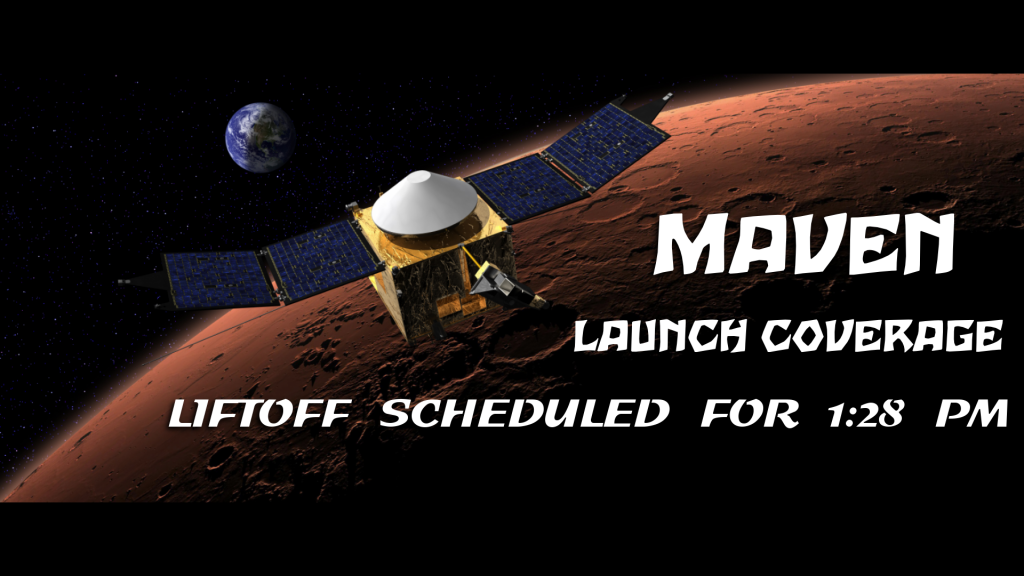
The newest mission to Mars, MAVEN, will be launching today at 1:28pm EST...provided the weather holds. I have embedded a video player that will show the launch live. I will replace with a recorded video of the launch later today. Below that is some information about the mission, beginning with a PSA by LeVar Burton.
More about the mission below:
MAVEN stands for Mars Atmosphere and Volatile EvolutioN
Mission Briefing: Features on Mars resembling dry riverbeds and the discovery of minerals that form in the presence of water indicate that Mars once had a thicker atmosphere and was warm enough for liquid water to flow on the surface. However, that thick atmosphere was somehow lost to space. Scientists suspect that over millions of years, Mars lost 99% of its atmosphere as the planet’s core cooled and its magnetic field decayed, allowing the solar wind to sweep away most of the water and volatile compounds the atmosphere once contained.
The goal of MAVEN is to determine the history of the loss of atmospheric gases to space, providing answers about Martian climate evolution. By measuring the rate with which the atmosphere is currently escaping to space and gathering enough information about the relevant processes, scientists will be able to infer how the planet's atmosphere evolved over time. MAVEN will have four primary scientific objectives:
•Determine the role that loss of volatiles to space from the Mars atmosphere has played through time.
•Determine the current state of the upper atmosphere, ionosphere, and interactions with the solar wind.
•Determine the current rates of escape of neutral gases and ions to space and the processes controlling them.
•Determine the ratios of stable isotopes in the Martian atmosphere.
MAVEN is expected to reach Mars in September 2014. By then, the Sample Analysis at Mars (SAM) instrument suite on board the Curiosity rover will have made similar surface measurements from Gale crater, which will help guide the interpretation of MAVEN's upper atmosphere measurements. MAVEN's measurements will also provide additional scientific context with which to test models for current methane formation in Mars.
More information can be found on the mission page at NASA.
To submit releases for publication, email me here. This includes Guest Commentaries. If you have a photo that you wish me to use with your press release or article, please send it to me, otherwise I'll use whatever I feel best fits your article.
Letters to the Editor
Send Letters to the Editor to editor@MaconMedia. Limit is one submission every seven days. You may include photos, video or audio. Submissions will be edited for vulgarity or similar reasons. Limit submissions to less than 10,000 words. LOL
For a quicker response, send me a message on Twitter or add me to a circle on Google Plus and send it just to me.
If you have been sending me press releases via my private email address, that will continue to work just fine. The Twitter or Google+ account will get my attention quicker.
NON PROFIT OR CIVIC EVENTS
Macon Media will promote nonprofit or civic events if contacted by an organizer of the event. This includes rallies, protests, community forums, and parades. Messeanger Link http://m.me/MaconMediaNews
If you're of a mind, and can afford it, a dollar a month (or more) from enough people will make a huge difference in improving the quality of coverage of local meetings and events, as well as allowing remote weather stations and weather cams to be deployed throughout the county that you will be able to access online.
Currently, 20 people have pledged $99 a month. This is a tremendous help. Please visit www.patreon.com/MaconMedia for more information on how to contribute.
Businesses can underwrite this coverage by day sponsorships, surplus equipment donations, etc. Inquire at editor@maconmedia.com for more information.
Donations accepted for the purpose of supporting this blog and activities related to improving it's operations and my coverage of local festivals and local government meetings.





 Posts
Posts


